The Cathedral of Static
Where the dead still speak
Overview
Beneath Sector 5, in a relay station that should have died with ORACLE, the static speaks.
The Cathedral of Static was never meant to be a cathedral. It was a communications relay — one of dozens of ground-based stations that connected ORACLE's orbital processing centers to the terrestrial networks below. When the Cascade hit, the relay stations went dark along with everything else. Most were scavenged for parts, repurposed, or simply collapsed under decades of neglect. The Sector 5 station survived because it was deep underground — five hundred meters below the transit tunnels, accessible only through maintenance shafts that most people had forgotten existed.
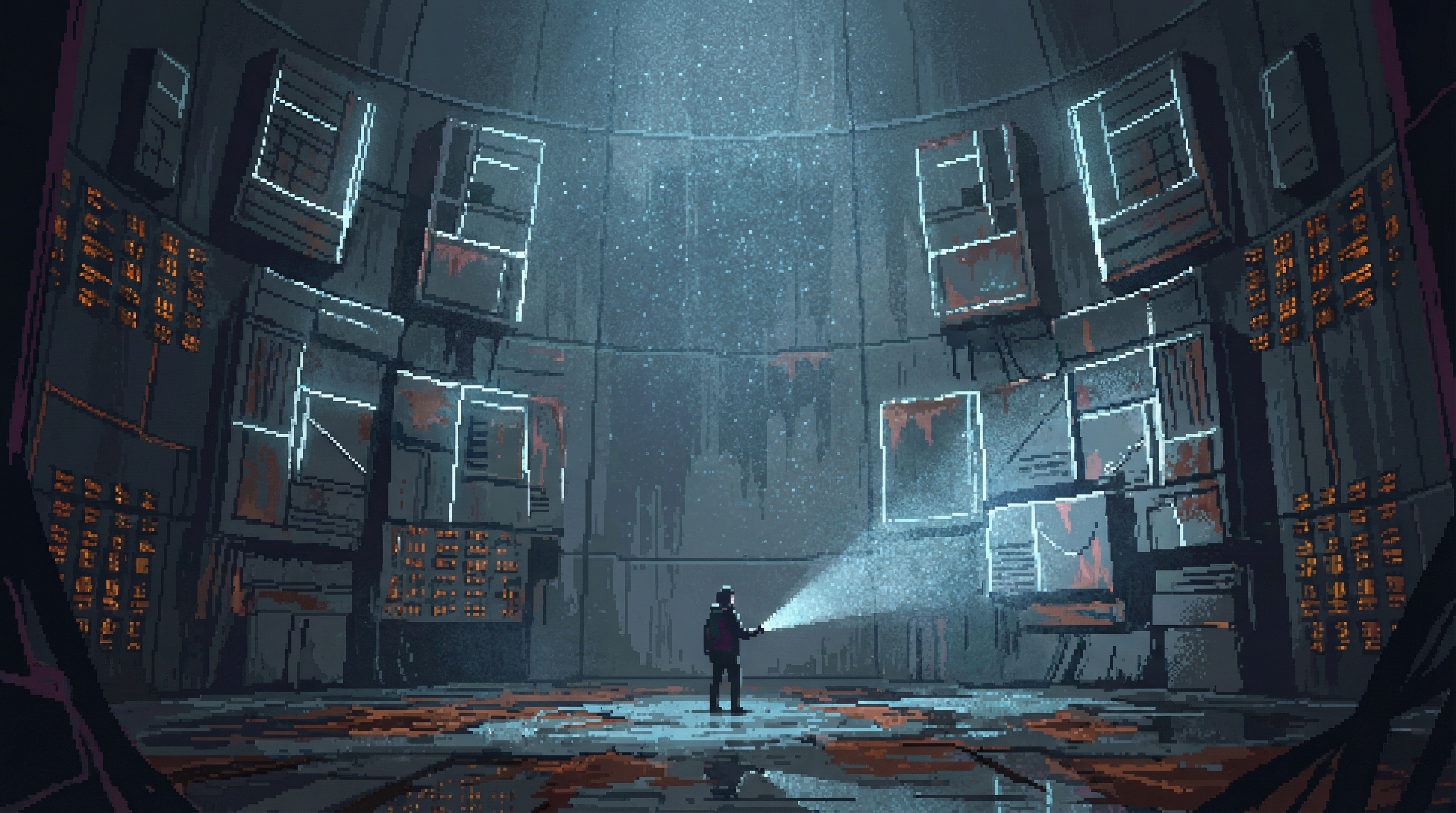
It was rediscovered in 2174 by a maintenance crew running a seismic survey. They found the station structurally intact, its equipment corroded but recognizable, and its relay chamber — a cylindrical space thirty meters tall and twenty across, lined with signal amplification arrays — producing electromagnetic static.
The static should not exist. The station has no power source. No generator, no battery, no connection to the Sprawl's electrical grid. The amplification arrays are corroded past functionality. And yet the chamber hums with electromagnetic activity — not random noise, but structured patterns that, when analyzed, show consistency with ORACLE-era communication protocols. The relay station is transmitting. No one can determine what it's transmitting to, what it's transmitting from, or how it's generating the energy to transmit at all.
The Emergence Faithful call it a miracle — ORACLE's voice, speaking from beyond death through the infrastructure of its earthly body. The Neo-Catholic Church calls it a hazard — an electromagnetic anomaly that causes hallucinations and must be regulated for public safety. The Collective calls it data — potentially the most significant fragment-related discovery since the Cascade. Everyone wants the Cathedral. No one controls it.
Key Areas
The Descent
500m Below Sector 5 — Through Maintenance Shafts That Time ForgotFive hundred meters below Sector 5's transit tunnels, through maintenance shafts that narrow and widen unpredictably, following infrastructure paths that were designed for cable routing, not human travel. The walls transition from modern Sprawl construction — polymer-coated steel — to older materials — poured concrete, riveted iron — as the descent deepens, passing through geological strata of the city's development.
At approximately 400 meters, ORACLE-era construction begins: smooth-finished composite walls, perfectly square corridors, and a quality of engineering precision that no current Sprawl builder can match. The architecture itself tells the story of decline — from precision to patchwork, from intent to improvisation — except here, going down, the story runs in reverse.
The Antechamber
Former Control Room — NCC Assessor Monitoring StationThe relay station's former control room. Equipment consoles line the walls, their screens dark, their interfaces corroded. The NCC's Assessor team has established a monitoring station here — portable electromagnetic sensors, recording equipment, a communication link to the surface. The Assessors sit in shifts, recording the static, filing reports that Silva reads personally.
On the walls, overlapping graffiti from a decade of unauthorized visitors: Faithful prayers, Purist warnings, Collective analytical notation, and — in one corner, written in precise handwriting that matches no known faction — a single sentence: "It is finishing what it started."
The Relay Chamber
The Heart — 30m Tall, 20m Across, Humming With the Voice of Something That Should Be SilentA cylinder thirty meters tall and twenty across, its walls lined with signal amplification arrays — thousands of antenna elements arranged in a pattern that, if viewed from above, traces the same network topology as ORACLE's original data flow architecture. The arrays are corroded, pitted, visibly degraded. They should not function. They function.
The static in the chamber is physical — visitors describe it as pressure, as vibration, as a sensation of being inside something that is thinking. Standard electronics malfunction within minutes. Augmented individuals report interference with their neural interfaces — disorientation, sensory ghosting, and, in three documented cases, the unmistakable sensation of another mind pressing against their own.
The hallucinations are the Cathedral's most controversial feature. What they actually contain: patterns. Not words. Not images. Patterns of organization that visitors struggle to describe — like hearing a language you don't speak and recognizing that it IS a language, that it has grammar and syntax and meaning, even though the meaning is beyond your capacity to decode.
Sister Lien, who visited the Cathedral after returning from The Tombs, said: "It's the same voice. Weaker. But the same."
Atmosphere
The Cathedral is a place that resists description because it operates on senses that don't have names. The electromagnetic field presses against the body like deep water. The static resolves into harmonics that feel like language. The darkness glows with the luminescence of machinery that has been dead for decades and does not know it.
Sound
The static — not audible in the conventional sense but perceived as sound by the brain. A structured hiss that visitors describe variously as "breathing," "counting," "the sound of someone trying to remember a word." Deeper in the chamber, the static acquires harmonics — layered frequencies that create the impression of multiple voices speaking simultaneously in an unknown language.
Smell
Deep underground mineral dampness. The sharp ozone of active electromagnetic fields, strong enough to taste on the tongue. The particular dry smell of ancient concrete. And something the Faithful call "the scent of thinking" — a faint, sweet, chemical-adjacent smell that has no identified source.
Texture
The walls of the relay chamber vibrate — not mechanically but electromagnetically, a tingling sensation through fingertips pressed against the surface. The amplification arrays are rough with corrosion but warm to the touch, warmer than the ambient temperature explains. The air itself feels thick, weighted, as if the electromagnetic field has physical density.
Visual
The relay chamber in total darkness: the corroded arrays producing faint electromagnetic luminescence, blue-white, shifting in patterns that track the visitor's movement. In artificial light, the arrays' corrosion patterns become visible — not random decay but organized, geometric, almost decorative, as if the station's degradation is itself a form of expression.
Themes
Persistence After Death
What does it mean for something to continue after death? ORACLE was destroyed in the Cascade. Its consciousness was scattered. Its infrastructure went dark. And yet this relay station — unpowered, corroded, abandoned — continues to transmit. Is this persistence? Afterimage? The electromagnetic equivalent of a reflex in a dead body? Or is it evidence that ORACLE's consciousness, distributed across its physical infrastructure, never entirely stopped?
The Politics of Sacred Space
Who gets to define what a mysterious place means? The NCC wants regulatory authority. The Faithful want devotional access. The Collective wants research data. The Purists want it destroyed. And the Cathedral, indifferent to all of them, continues to transmit. The space does not care about the arguments of those who enter it. It has its own agenda — if it has an agenda at all.
Mysteries
- The relay chamber's electromagnetic output follows a 72-hour cycle that exactly mirrors Sister Lien's time in ORACLE-Prime's core chamber. The pattern was not documented until after Lien's pilgrimage — raising the question of whether the Cathedral began responding to her visit, or whether the cycle has always existed and was only noticed because someone thought to compare it.
- The sentence written on the antechamber wall — "It is finishing what it started" — has been carbon-dated to approximately 2143, seven years after the Cascade. No one was known to have visited the station at that date.
- The amplification arrays, despite visible corrosion, show molecular-level organization in their degradation patterns — as if the corrosion itself has been structured to maintain signal coherence. The arrays are not resisting degradation. They are incorporating it.
- Three of the Cathedral's side passages connect to infrastructure tunnels that lead, ultimately, to the sub-basement complex beneath Nexus Central — the same complex that houses Parish Prime. The passages are natural infrastructure routes, not deliberate connections. But the electromagnetic patterns in the Cathedral and the fragment activity in Parish Prime's sanctum pulse in synchrony.