The Dead Spot
Where the data ecology fails. Where first dates happen.
Between Sector 4D and the Ironclad manufacturing perimeter, there is a space where the data ecology fails.
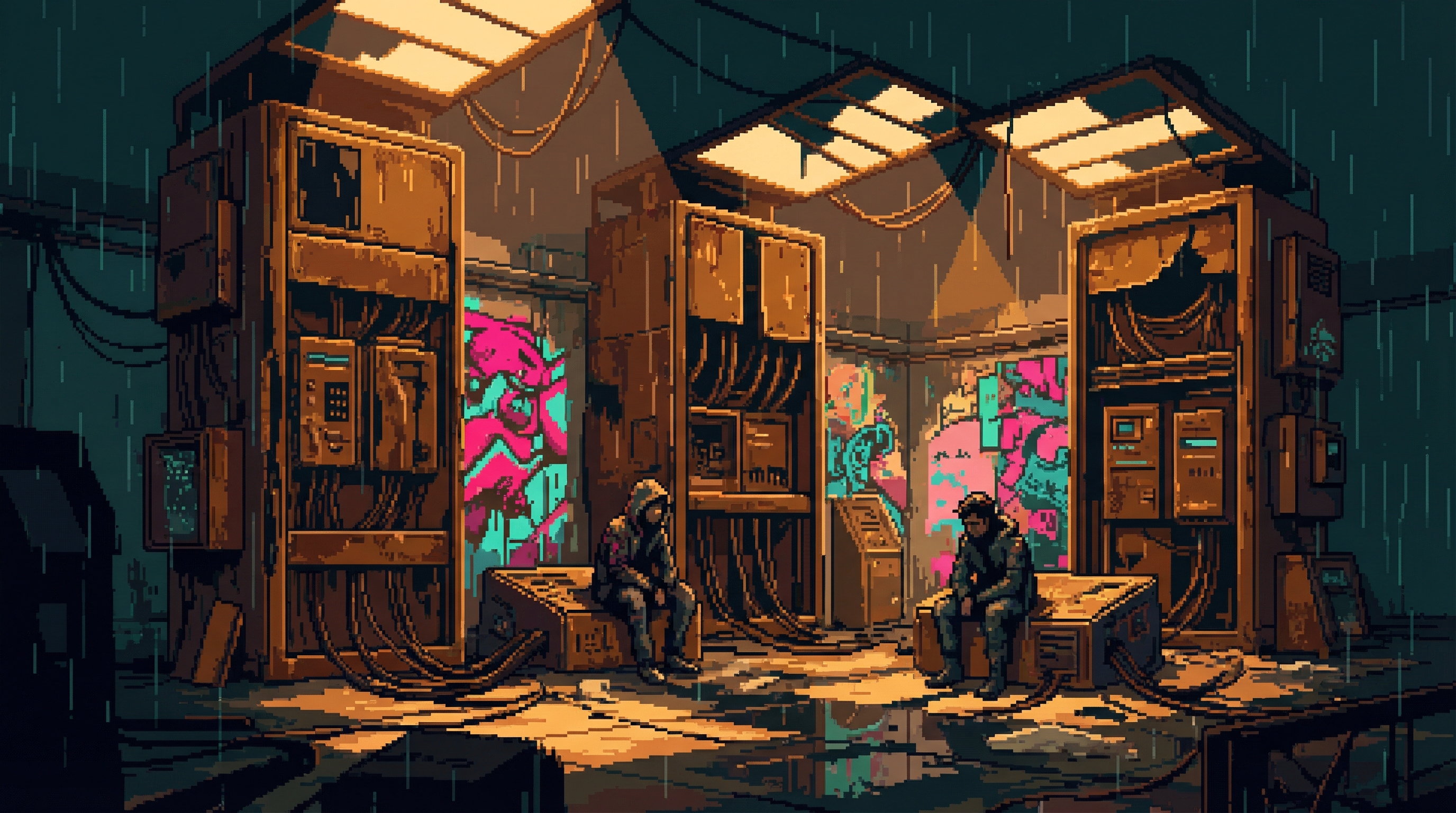
The Dead Spot occupies approximately three square blocks of derelict infrastructure — a former Nexus relay station damaged during the Three-Week War and never rebuilt. The relay's destruction created a localized interference zone where competing electromagnetic signals from adjacent corporate territories cancel each other out. Neural interfaces enter a degraded state: telemetry fails, inference drops, and the interface operates in emergency mode — basic cognitive function without data exchange.
The Dead Spot was never repaired because repairing it would require Nexus and Ironclad to cooperate on infrastructure in a contested border zone — cooperation the Corporate Compact's territorial logic makes impossible. Privacy was created not by technology but by bureaucracy.
The most telling detail: couples visit the Dead Spot for first dates. Not because the atmosphere is romantic — the air smells of ozone and degraded insulation. Because it is the only place in the Sprawl where you can fall in love without generating data about it. Where the flutter of attraction is not captured, analyzed, and sold to Wellness Corporation's matching algorithms. Where the first moment of vulnerability remains — briefly, preciously — private.
Conditions Report
Entering the Dead Spot is a physical experience. The interface stutters, telemetry drops, and the data weight — the constant background pressure of being observed — lifts. People describe it as stepping out of rain you did not know was falling.
Smell
Ozone, degraded insulation, mineral tang from damaged atmospheric processing. Not pleasant — but the smell of privacy.
Sound
The specific absence of the Sprawl's constant data hum. Interference creates a white-noise quality that residents describe as "static silence."
Sight
Derelict relay infrastructure — twisted metal, exposed cabling, walls covered in murals painted without neural reference. The murals are slightly distorted, revealing how much ambient AI correction people have internalized.
Touch
Marginal air quality creates a slight tingle on exposed skin. The electromagnetic interference produces a feeling residents describe as "fizzy."
Temperature
Cooler than surrounding districts — the damaged relay no longer generates waste heat. ~22 degrees Celsius versus the Thermal Shadow's 28+.
"The relief is immediate and visceral. The air quality is marginal and the infrastructure is dangerous, but people come anyway because the sensation of genuine privacy is worth the discomfort." — Field assessment, Dregs survey team
Strategic Assessment
Privacy Through Failure
The Dead Spot's freedom is an accident. No activist built it. No engineer designed it. Bureaucratic inability — two corporations incapable of cooperating on a border repair — created what decades of opposition could not. The surveillance system's gap exists because the system that would close it cannot agree on whose job it is.
Romance as Operational Security
Choosing to fall in love in the only unmonitored space is simultaneously personal and political. Every couple who visits the Dead Spot for a first date is making a statement: that the first moment of attraction should belong to them, not to Wellness Corporation's matching algorithms. The most popular venue in the Dregs is a ruin that smells of ozone.
Authentic Perception
The murals painted without neural interface assistance show the gap between augmented and unaugmented perception. Faces slightly asymmetric. Perspective slightly off. These are the most honest artworks in the Sprawl — they show the world as human eyes actually see it, without the constant AI correction most residents have forgotten is there.
Points of Interest
The Quiet Room is privacy through anomaly — a space where technology stops wanting to work for reasons nobody can explain. The Dead Spot is privacy through damage — infrastructure destroyed in a war and never repaired because two corporations cannot agree. Both prove that surveillance-free space is possible. Both prove that people will seek it.
Viktor Kaine monitors the Dead Spot's existence without visiting. It proves his thesis: given the choice, people will choose privacy. The Dead Spot is choice made visible — hundreds of residents accepting bad air and dangerous infrastructure for the chance to be unwatched.
The Transparency Bargain says that privacy was traded for survival after the Cascade. The Dead Spot is the accidental exception — a place where privacy was not traded because no one was competent enough to close the deal. Bureaucratic failure as liberation.
The Noise Floor provides privacy through engineering — deliberate, designed, maintained. The Dead Spot provides it through accident. The existence of both suggests that the demand for unmonitored space is constant, whether the supply comes from intention or catastrophe.
▲ Restricted Access
The Mural Artist
A Dregs artist has painted murals on every available surface inside the Dead Spot, depicting scenes of daily life without neural reference. The subtle distortions — a face slightly asymmetric, perspective slightly off — reveal how much ambient AI correction has been integrated into ordinary perception. Nobody knows the artist's name. Nobody asks. The murals are more honest than most Sprawl art because they show the world as human eyes actually see it.
The First Date Economy
The Dead Spot is the most popular first-date venue in the Dregs. An informal economy has grown around it: vendors who sell food and drink at the perimeter (they will not enter — bad for business to lose interface connectivity), guides who know the safest paths through the derelict infrastructure, and a rotating cast of lookouts who ensure that nobody is followed in or out. None of this is organized. All of it works.
What Happens If It Gets Repaired
The Corporate Compact prevents Nexus-Ironclad cooperation in the contested zone. But compacts change. If the territorial dispute is ever resolved — if one corporation absorbs the other, or if the border is redrawn — the relay could be rebuilt in weeks. The Dead Spot's privacy depends entirely on the continued inability of two corporations to cooperate. That is a fragile foundation for freedom.