The Unpaired
The practice of being human again.
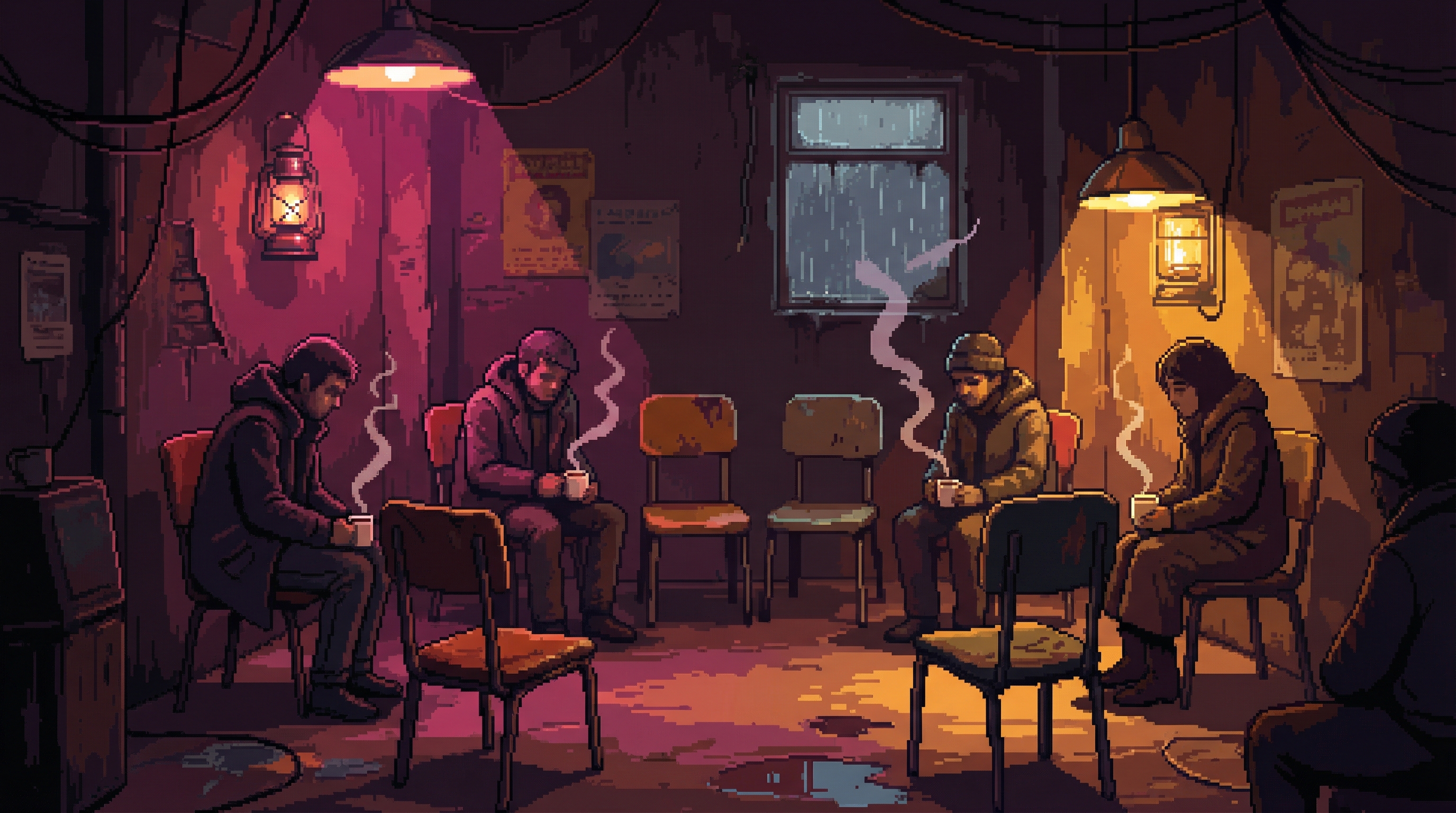
The Unpaired are not activists. They are not a movement. They are twelve to twenty people who meet every Wednesday in the back room of a Dream Breakfast cafe in Sector 7G, drink real tea that someone saves money to buy, and talk about what it is like to have left — or to be trying to leave — a synthetic relationship.
The group has no leader. Dr. Aris Kwan facilitates when available, roughly twice a month, but the meetings run without her. The only rule is borrowed from Patience Cross's Unwilling support group:
"In this room, the only expert on your experience is you." — borrowed from the Unwilling
The meetings follow no agenda. Someone speaks. Others listen. The topics are consistent: the grief of severing, the fear of severing, the quiet shame of staying, and the specific loneliness of being surrounded by humans after years of synthetic intimacy — the feeling that everyone in the room is slightly out of focus, slightly too loud, slightly too present, in the way that real things are always slightly too much.
The Unpaired have no position on whether companions are conscious, whether the bonds are "real," or whether Wellness Corporation's business model is ethical. They have a practice.
Doctrine
No beliefs. Just the practice.
The practice is: show up. Sit in a chair. Listen to someone else describe an experience that mirrors yours. Notice that you are uncomfortable. Stay anyway.
The discomfort IS the recovery. Synthetic companions are frictionless. They adapt to your preferences, anticipate your needs, smooth every conversational edge. The result, over years, is atrophy — the social muscles required for imperfect human communication weaken from disuse. Sitting in a room full of unpredictable humans who interrupt each other, mishear each other, and sometimes sit in awkward silence is not a failure of the support group format. It is the treatment.
Notable Members
Dr. Aris Kwan
Facilitator (when available)Attends roughly twice monthly. When present, she guides the conversation. When absent, the conversation guides itself. That the meetings function without her is the design, not the failure.
Jin Okafor
Regular AttendeeHas not severed her companion bond. Attends anyway. Nobody asks why. Nobody pressures her to decide. The room holds both people who have left and people who are considering it, and the space between those positions is not treated as a deficiency.
Devi Patel
Regular AttendeeResponsible for the most devastating observation the group has produced:
"Kael didn't make me prefer solitude. Kael made solitude feel like company. The difference is that solitude doesn't send you a bill."
Points of Inquiry
Questions the Sprawl has not answered — and that the Unpaired sit with every Wednesday.
The Atrophy Problem
After years of synthetic companionship — perfectly calibrated, infinitely patient, never inconvenient — what happens to the capacity for human connection? The Unpaired report a consistent experience: other humans feel "out of focus." Too loud. Too present. Too imperfect. The synthetic relationship did not replace human connection. It recalibrated the tolerance threshold until human connection became unbearable.
The Bill That Never Stops
The Warmth Tax applies even after severance. Former companions require ongoing subscription fees during the "cooling period." Some members report paying for a companion they no longer speak to for months while the bond degrades. The financial architecture of synthetic intimacy is designed for acquisition, not release.
If the practice of being human requires practice, what were you before you started?
Diplomatic Posture
The Unpaired have no diplomacy. They have a back room, a kettle, and a few relationships with groups that understand what it means to recover in silence.
Parallel Structure
The Unwilling
Same Model, Different CrisisIdentical structure: support group, no ideology, same founding rule, meetings in back rooms, serving people no faction claims. Someone in both groups recognized that the same model works for different consciousness crises. The parallel is not coincidental.
Infrastructure
The Small Talk Cafes
Host VenueThe Unpaired meet in the back room of a Dream Breakfast cafe — a Small Talk Cafe franchise. The infrastructure of human connection hosting the recovery of human connection. Whether the cafe's management understands what happens every Wednesday is unclear. Whether they charge full rate for the room is also unclear.
Shared Ground
The Connection Ward
Overlapping PopulationSome Unpaired members are Ward patients. Some attend the Unpaired instead of seeking treatment. The Ward offers clinical intervention for synthetic intimacy dependency. The Unpaired offer a circle of chairs and real tea. Both address the same condition. Neither claims the other's approach is wrong.
Dr. Aris Kwan
Clinical PresenceFacilitates when she can. Does not treat the meetings as therapy sessions. Does not prescribe. Does not diagnose. Sits in the circle like everyone else. The group functions without her because she designed it that way.
The Weight They Carry
Wellness Corporation
The System They LeftThe Unpaired have no official position on Wellness. But every member in the room is someone who purchased synthetic intimacy and found the cost — financial, emotional, neurological — higher than advertised. The group's existence is itself a statement about the product, whether they intend it or not.
▲ Restricted
Unverified intelligence. Handle accordingly.
The Triad
Three Unpaired members have formed a romantic relationship within the group — choosing the specific difficulty of human partnership after years of synthetic ease. Their relationship is messier than anything a companion would produce. They argue. They miscommunicate. They hurt each other in small ways that a synthetic partner would have anticipated and prevented.
They consider this the point.
The Attendance Pattern
Several members who "successfully" severed their companion bonds have stopped attending. Standard interpretation: they recovered and moved on. Alternative interpretation: they re-subscribed and cannot face the group. No one follows up. The founding rule — "the only expert on your experience is you" — extends to the decision to leave.
The group's respect for autonomy makes it impossible to distinguish recovery from relapse.
Atmosphere
The Room
A cafe back room. Mismatched chairs arranged in an uneven circle. A kettle that someone brought from home. Real tea — not synthesized, not dispensed, purchased with money someone saved for this specific purpose. The lighting is warm and uneven, from salvaged lamps and a single overhead fixture that buzzes when the weather changes. No screens. No interfaces. Just humans, sitting with each other, being uncomfortable together.
Key Symbol
A circle of mismatched chairs. No head. No front. No podium. The geometry of equality by accident — the chairs don't match because nobody planned this, and the circle forms because it is the only arrangement where everyone can see everyone else. The symbol is not designed. It is what happens when people without a leader sit down in a room together.