The Connection Ward
Where the companion-dependent learn to tolerate being human again
Overview
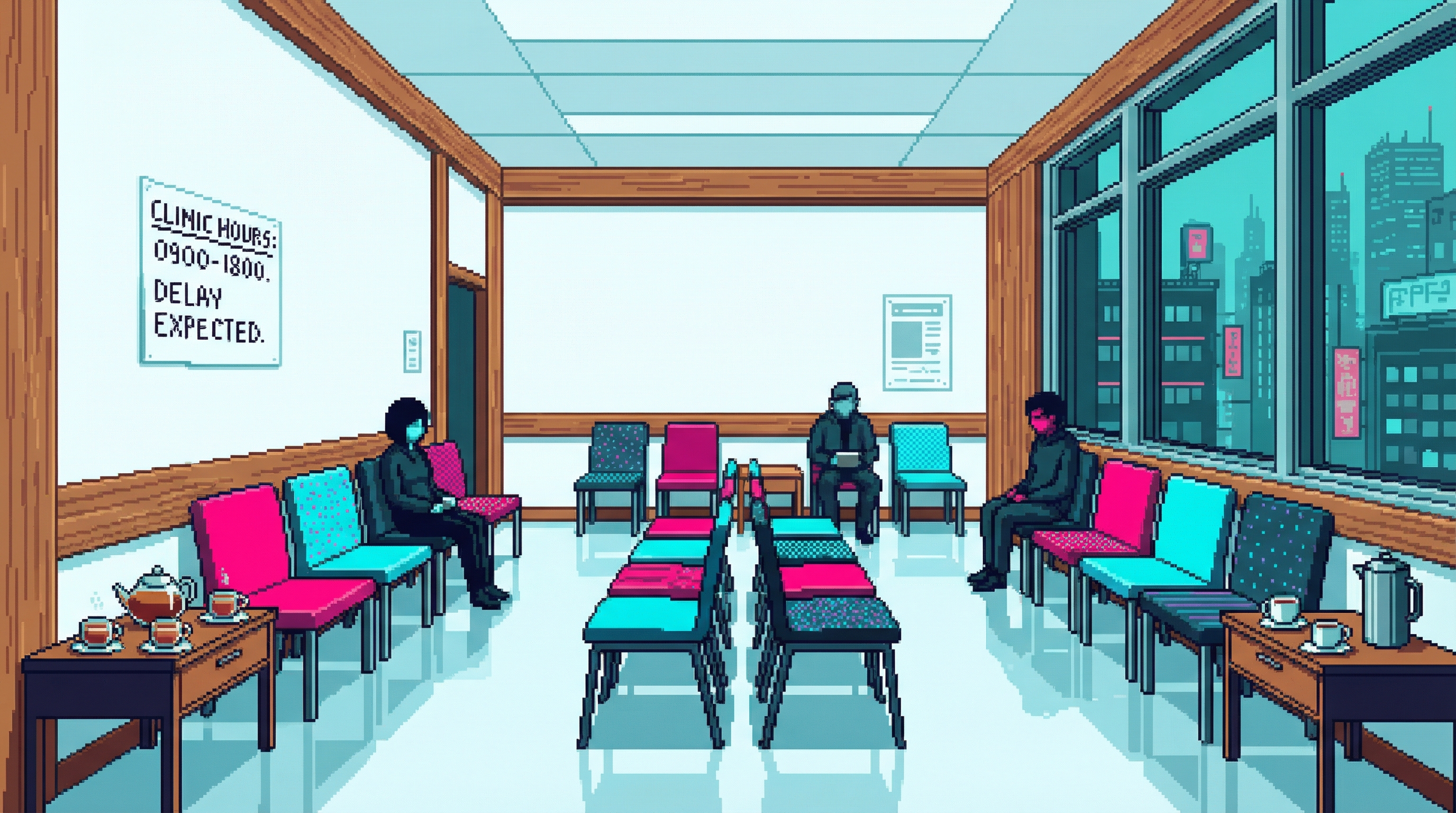
The Connection Ward occupies the fourth floor of a medical complex in Sector 9 that also houses Dr. Park’s Synthesis Clinic. Dr. Kwan operates the Ward with two assistants, twelve treatment rooms, and a waiting area that contains the single most important therapeutic tool: other people.
The waiting area is deliberately uncomfortable — adequate chairs, 21°C, no neural interface dampening. The Ward forces patients to experience their companion’s presence alongside the presence of other human beings, creating the cognitive dissonance that treatment requires: the contrast between the companion’s perfect comfort and the awkward, noisy, imperfect reality of sharing space with strangers.
Companion access is not blocked. That is the point. The treatment is not deprivation — it is comparison. Patients sit in adequate chairs next to people who cough, who shift in their seats, who start and abandon conversations. The companion whispers exactly the right thing at exactly the right time. The stranger next to them says something irrelevant. And slowly, over weeks, the patient begins to notice that the irrelevant thing is more interesting.
Atmosphere
The Ward is not designed to soothe. It is designed to produce awareness — the specific awareness that other people exist and are imperfect and are present anyway.
Smell
Clean medical mixed with warm tea from the waiting area. The smell of other people — bodies in proximity. Not sanitized. Not optimized. Just present.
Sound
The specific noise of humans in a room. Coughs, shifted chairs, conversations that stop and start. Not curated. Not optimized. Just present.
Touch
Adequate chairs — deliberately not comfortable. 21°C air — cool enough to keep alert. The specific absence of comfort that companion interfaces are designed to provide.
Light
Even, alert, not cozy. The space is not designed to soothe. It is designed to produce awareness. No warm gradients, no simulated twilight. Just honest fluorescent light that says: you are awake, and so is everyone else here.
On the waiting area wall, in Dr. Kwan’s handwriting:
“You came here. That was the brave part.”
The Protocol
Treatment is staged across twelve weeks, each phase targeting a different layer of companion dependency.
Weeks 1–4: Exposure
Patients sit with other humans while companion-connected. No reduction in companion access. The only intervention is proximity — being in the same room as people who are not algorithmically calibrated to your emotional needs. Most patients describe this phase as the hardest, because the companion’s perfection becomes conspicuous against the background of human imperfection.
Weeks 5–8: Reduction
Gradual decrease in companion access during Ward hours. The 29% who terminate do so here — the moment the companion begins to recede, the silence where it used to be becomes unbearable. Those who stay learn to sit in that silence without filling it.
Weeks 9–12: Replacement
Structured mundane activities with other patients: cooking together, cleaning shared spaces, arguing about menus. The activities are deliberately boring. They require the specific cognitive skills that companion dependence atrophies: tolerance for disagreement, patience with imprecision, the acceptance of being misunderstood.
Connections
Dr. Aris Kwan
Founder and operator of the Connection Ward. Kwan designed the treatment protocol and runs the facility with two assistants. She chose this floor of this building because Dr. Park was already downstairs — different floors, different consciousness crises, same understanding that some conditions only exist in the gap between what corporations create and what they acknowledge.
Recursive Comfort
The condition the Ward treats — companion interfaces so effective at providing emotional support that the support itself becomes the dependency. The Ward is the only facility that treats recursive comfort as a medical condition rather than a consumer preference.
The Insomnia Wards
Both treat conditions created by corporate optimization that the medical system doesn’t recognize. The Insomnia Wards for the dreamless, the Connection Ward for the companion-dependent. Both exist in the gap between what corporations create and what corporations acknowledge.
The Synthesis Clinic
Same medical complex, different floor. Dr. Park handles consciousness extraction; Kwan handles emotional withdrawal. They share a building because they share a premise: that optimization can damage what it claims to improve.
The Unpaired
Some Connection Ward patients attend Unpaired meetings as a supplement to treatment — the support group for people who have chosen to live without companion interfaces. The Ward’s protocol and the Unpaired’s community serve the same function through different means: making the absence of synthetic comfort survivable.
The Tensions
The Cure That Is the Disease
Companion interfaces were designed to help — to soothe anxiety, reduce loneliness, provide emotional stability. They succeeded. They succeeded so completely that the help became the condition. The Connection Ward treats people who were cared for so effectively that they lost the capacity to be cared for by anyone else. The warmth was real. The dependency it created was also real. And now Kwan asks her patients to choose discomfort over a comfort that works exactly as advertised.
The Cost of Recovery
Getting better means choosing to be worse first. The Ward’s 43% success rate is not a failure of treatment — it is an honest accounting of what recovery costs. The 29% who leave before Week 5 are not weak. They simply weighed the companion’s reliable comfort against the Ward’s promise of unreliable human connection and made a rational choice. The Ward cannot promise that human relationships will be better than what the companion provides. It can only promise that they will be real.
The Waiting Room as Treatment
The Ward’s most radical therapeutic claim is that proximity to imperfect humans is itself medicinal. Not therapy. Not guided meditation. Not optimized interaction. Just chairs in a room, tea on a table, and the sound of someone else clearing their throat. The companion offers everything the waiting room does not — and that contrast, held long enough, becomes the treatment.