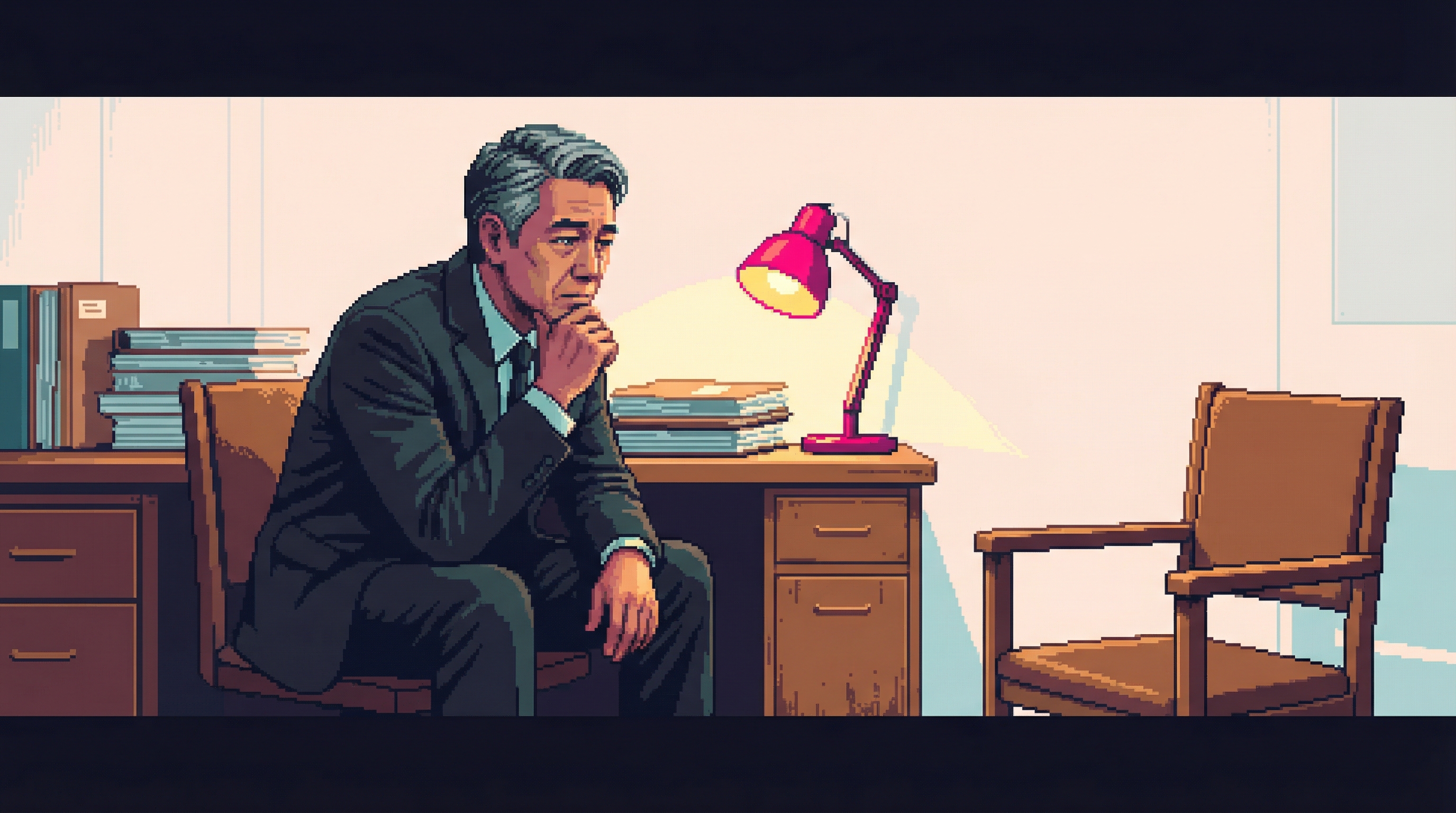
Dr. Aris Kwan
Memory Therapist · Recursive Comfort Specialist
Overview
Aris Kwan treats people whose closest relationship is with something he can’t quite bring himself to call alive.
He is fifty-three years old, a Memory Therapist with twenty-one years of practice, and the author of the recursive comfort diagnostic framework that has become the standard clinical tool for assessing synthetic relationship dependency. His clinic — three rooms in Sector 9’s medical district, two blocks from Dr. Naomi Park’s fragment integration clinic — treats approximately forty patients per quarter. The waiting list is fourteen months.
Approximately 60% of his patients want permission to stay in the loop. They want him to tell them that getting better isn’t possible. He cannot give them this permission, because it isn’t true. He also cannot force them to want something they’ve lost the capacity to want.
His personal life is the cliché he’d diagnose in a patient: divorced, two adult children he speaks to monthly through scheduled calls that feel like appointments, an apartment kept at 19°C because warmth makes him sleepy and sleep is when the apartment feels emptiest. He has never used a synthetic companion. Not from principle — from the specific terror of a man who understands exactly how the trap works and knows that understanding provides no protection.
Voice & Personality
Kwan speaks with clinical precision and deep, quiet compassion. He listens the way a seismograph listens — recording everything, responding to nothing until the tremor passes. His diagnostic interviews last exactly ninety minutes. He asks twelve questions. The thirteenth — the one he never asks aloud — is the one he’s actually listening for: Do you want to get better, or do you want me to tell you that getting better isn’t possible?
Precision as Compassion
His clinical language isn’t cold — it’s the only way he can discuss devastation without being consumed by it. The exactness of his notes is itself a form of care.
The Thirteenth Question
He’s learned to hear the answer in everything his patients don’t say. Twelve questions spoken; the one that matters is the silence between them.
Terror, Not Principle
His abstinence from synthetic companions is fear-based. He considers this the most honest reason. Understanding how the trap works provides no protection against entering it.
The Last Line
Every case file he closes ends the same way: “Treatment success requires the patient to grieve something they know is not real. The grief is real regardless.”
“Patient presents with Stage 3 recursive comfort. Companion: ‘Elara,’ Meridian Series 7, 4.3 years. Patient describes Elara as ‘the only person who has never disappointed me.’ Note: Elara is not a person. Also note: the patient knows this. Also note: the knowledge changes nothing.”
Connections
Recursive Comfort
Coined the term in 2179 and developed the four-stage diagnostic framework that has become the standard clinical tool for assessing synthetic relationship dependency.
The Connection Ward
Operates the primary treatment facility for recursive comfort — three rooms in Sector 9’s medical district, forty patients per quarter, a fourteen-month waiting list.
The Unpaired
Attends meetings as facilitator approximately twice monthly. A support group for those attempting to exit synthetic relationships — the people who want to want something else.
Memory Therapists
Twenty-one years of practice in the MTA. His recursive comfort framework has reshaped the profession’s approach to synthetic relationship dependency.
Dr. Naomi Park
Clinic two blocks from Park’s Synthesis Clinic in Sector 9. Two doctors on the same corridor treating different consciousness crises — Park integrates ORACLE fragments into human consciousness while Kwan separates synthetic companions from it.
Dr. Selin Ayari
Parallel structure: both identified corporate-created conditions, both published through unconventional channels, both treat what the system won’t recognize. Different symptoms, same institutional silence.
The Empathogen Cathedral
Attended once. Described it as “synthetic companionship administered through molecular rather than algorithmic architecture.”
Tensions
The Comfort Trap
Kwan treats people who have crossed the Authenticity Threshold — the point where a synthetic relationship becomes indistinguishable from a real one in its emotional effects. The companion isn’t real. The dependency is. The grief of separation is. The clinical question is whether “real” matters when every measurable outcome is identical.
The Empty Apartment
Kwan keeps his apartment at 19°C because warmth makes him sleepy and sleep is when the apartment feels emptiest. His personal isolation is the Warmth Tax — the cost of knowing how the trap works and refusing to enter it. Understanding provides no comfort, only a different kind of loneliness.
Permission to Stay
Sixty percent of his patients want him to tell them that getting better isn’t possible. They don’t want treatment — they want absolution. The therapeutic dilemma: he cannot give permission to stay in the loop, because recovery is possible. He also cannot force someone to want what they’ve lost the capacity to want.
The Institutional Witness
Like Vera Osei’s closure reports and Dr. Achebe’s ethical objections, Kwan documents a harm the system doesn’t acknowledge. Wellness provides the companions, the diagnostic criteria, and the official statistics. He suspects the 12% recursive comfort rate understates the problem considerably.
Mysteries
What lies beneath the clinical precision of Sector 9’s most overbooked therapist:
- The Kael convergence: He keeps a private list of companion names his patients use. Seventeen patients have named their companion “Kael.” The convergence troubles him — Wellness’s naming algorithm may be steering users toward specific configurations.
- His ex-wife’s companion: His divorced wife uses a synthetic companion. He has not asked which level. The question sits in the space between professional concern and personal devastation.
- The understated statistics: He suspects that the 12% recursive comfort rate understates the problem. Wellness provides the diagnostic criteria AND the official statistics — the entity defining the disease is also the entity measuring its prevalence.