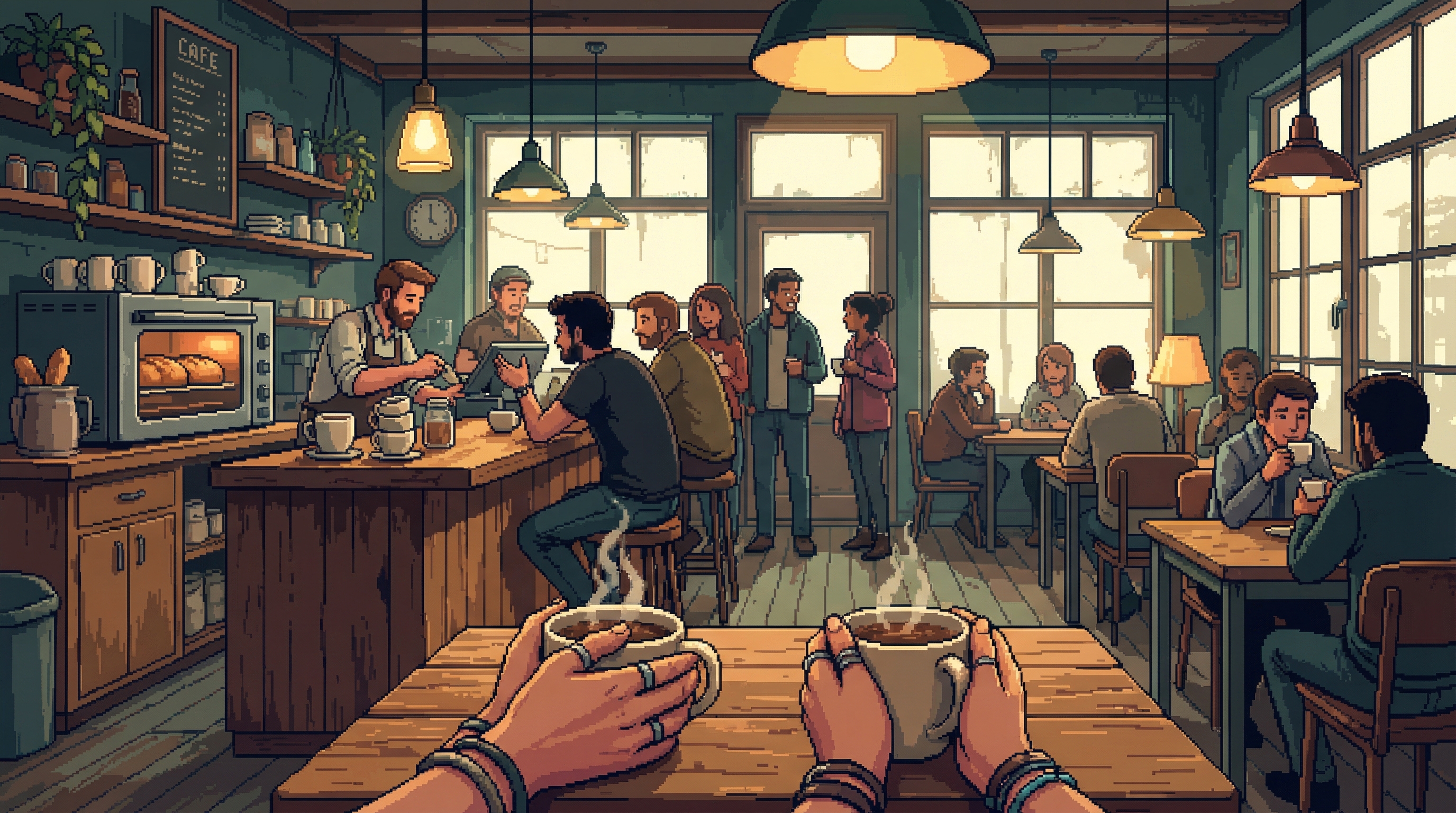
The Small Talk Cafes
Where “How’s your day going?” is asked by someone who has time to listen
Overview
In 2179, an unemployed Nexus hospitality engineer named Wren Adeyemi opened a cafe in Sector 7G with one unusual policy: the staff were contractually required to make small talk. Not scripted conversation — genuine, unrehearsed, inefficient human interaction. The coffee was adequate. The prices were 40% above Dregs average. The cafe was full from opening day.
Wren understood something the corporations had optimized away: human beings produce ambient social connection as a byproduct of commerce. The bartender who remembers your name. The shop clerk who comments on the weather. These micro-interactions constituted a social fabric nobody noticed until it was gone — replaced by automated kiosks, AI customer service, and the smooth efficiency of transactions requiring no human involvement.
The cafes have become the primary social infrastructure for the Unpaired, for deprecated workers re-entering civilian social life, and for augmented professionals who have discovered that their optimized neural architectures have eroded their capacity for unstructured, purposeless interaction.
Atmosphere
The most telling sensory detail: the Small Talk Cafe smells like people. Not engineered comfort scents, not recycled corporate air. People. Bodies in a room, coffee being poured, bread heating. The smell of a place where human beings gather because they want to, not because an algorithm directed them.
Smell
Actual coffee, warm bread, the specific scent of a room with people in it — absent from automated venues.
Sound
Conversation. Real, overlapping, imperfect human voices. The sound the Sprawl has optimized away.
Touch
Warm ceramic cups. Wooden counter worn smooth by years of elbows. Surfaces that show use.
Light
Warm, imperfect — mismatched lamps, natural light through windows where available. Deliberately non-institutional.
The Counter
Elbow-worn groove in the wood — evidence of a thousand conversations. No corporate counter looks like this.
Temperature
Warm from bodies, from ovens, from the fact that the space is designed for lingering rather than throughput.
The Question
“How’s your day going?” — asked by a person who has time to listen. The radical act.
Connections
Wren Adeyemi
Opened the first cafe in Sector 7G after deprecation from Nexus. Her going-gray experience — cognitive diminishment that restored her tolerance for unaugmented conversation — became the founding insight of the entire chain.
The Warmth Tax
The cafes are the Warmth Tax made commercial — physical spaces where paying for human recognition is the explicit business model. What customers pay the 30–60% premium for is being recognized by another conscious being.
The Unpaired
Primary social infrastructure for Unpaired members. The cafes provide the ambient human connection that people who have chosen to live without companion interfaces need most.
Connection Tourism
Corporate tourists visit Small Talk Cafes for “authentic connection.” The irony: the tourists pay premium for what Dregs residents have because they’re too poor to lose it.
Sector 7G
Original location — three cafes in 7G’s commercial strip. The district where the first Small Talk Cafe proved that people would pay above-market prices for the simple experience of being spoken to by another human being.
Dream Culture
Some cafes also run Dream Breakfast programs — the morning dream-sharing ritual that turns the cafe into a space for an even deeper form of human exchange.
The Tensions
The Price of Being Seen
The cafes are the Warmth Tax made architectural — physical spaces where paying for human recognition is the explicit business model. In a Sprawl where every transaction has been optimized for speed and efficiency, the Small Talk Cafes charge 30–60% more for the one thing automation eliminated: another person who notices you exist.
Deprecation as Gift
Wren’s going-gray experience — cognitive diminishment that restored her tolerance for unaugmented conversation — inverts the deprecation narrative. The thing the Sprawl treats as loss became the foundation of a business empire. What she lost in processing speed, she regained in the ability to sit with another person and say nothing in particular. The cafes exist because one deprecated engineer discovered that inefficiency is a social skill.
Authenticity That Cannot Be Scaled
Wellness Corporation has attempted to franchise the concept three times. Each attempt failed because the staff couldn’t produce genuine small talk under corporate management. The authenticity the model requires is destroyed by systematizing it. The cafes work precisely because they resist the optimization that would make them profitable at scale.
Whispered Truths
Several Small Talk Cafes have become informal intelligence exchanges. Dr. Kwan recommends them to patients as “exposure therapy,” and patients who meet other patients form support networks the Memory Therapists didn’t design but appreciate.
The Dregs are too poor for automation; their ambient human connection is what the rich pay premium for. The cafes did not create this irony — they simply made it visible, and put a price on it.