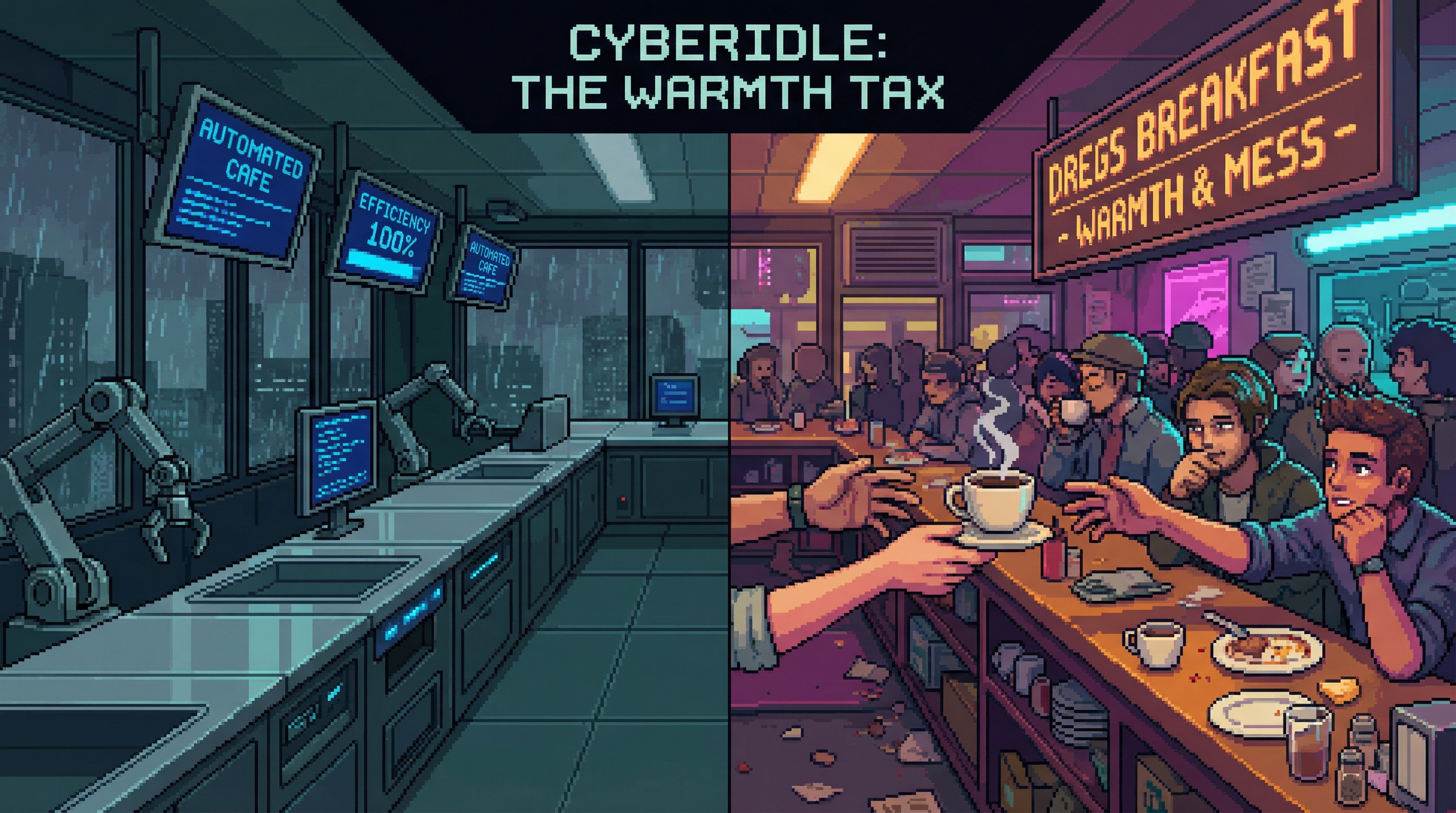
The Warmth Tax: When Human Presence Is a Luxury
Before AI labor became ubiquitous, human service workers provided ambient human connection as an invisible byproduct of commerce. The barista who recognized your face. The shop clerk who made small talk. The repair worker who complained about the weather. These micro-interactions constituted a social fabric nobody noticed until it was gone. When the workers were replaced, the efficiency improved. The cost decreased. The social fabric dissolved. The dissolution was slow enough that most people didn't notice. The loneliness epidemic that followed was fast enough that everyone noticed.
"When human presence is a luxury, who can afford to be seen?"
Quick Facts
How It Works
The Warmth Tax is the name for the premium the Sprawl charges for genuine human connection — the economic gap between automated services and human-provided services. A hard split between two tiers of existence.
Automated Tier
Free or near-freeAI-operated food dispensers, robotic maintenance, algorithmic customer service, automated healthcare triage. Available 24/7. No personality, no memory of your face, no capacity for spontaneous kindness.
Human Tier
PremiumSmall Talk Cafes, "presence workers" at luxury venues, professional conversationalists, human-staffed medical consultations at 400% of AI triage cost. What you're paying for is not the coffee or the diagnosis — it's the experience of being recognized by another conscious being.
Manifestations
Small Talk Cafes
Human staff contractually encouraged to chat with customers. The coffee is secondary. What you're buying is the experience of someone noticing you walked in.
Dream Breakfast
In Dregs cafes, customers pay a week's groceries for 45 minutes of conversation about dreams. The most intimate commercial transaction in the Sprawl — trading the contents of your unconscious mind over cheap coffee.
Dream Exchange
The augmented who eliminated sleep also eliminated the last involuntary human experience. When they buy harvested dreams, they're not buying content. They're buying the experience of being helpless — the sensation of consciousness leaving, of the grip loosening, of the self dissolving into something uncontrolled.
Somnolence Parlor Attendants
Relief hired human attendants for the Parlors after discovering automated wellness feels hollow — learning the Warmth Tax the hard way.
The Dregs Paradox
The Dregs are the most socially connected community in the Sprawl. Not because they're richer in some abstract sense, but because they're too poor for automation. When you can't afford a robot, you talk to your neighbor. The poverty that makes the Dregs economically marginal makes them socially rich.
The wealthy pay premium for what the Dregs get for free: ambient human connection. The irony is structural. Automation removes human labor. Human labor provided human connection as an invisible byproduct. The Dregs, excluded from automation, retain the byproduct everyone else is now paying to recover.
Tensions
Loneliness as Design Feature
Loneliness isn't a side effect of automation. It's a design feature. Lonely people consume more, are more susceptible to influence, less likely to organize, and more dependent on corporate solutions to problems corporations created.
The Invisible Byproduct
Human connection was never a product — it was the byproduct of other products: coffee, retail, healthcare. When the other products were automated, the byproduct disappeared. Nobody planned to eliminate human connection. Nobody had to.
The Dream Economy as Warmth
Buying harvested dreams is the most intimate form of the Warmth Tax — purchasing not just human presence but human absence, the experience of a mind that has let go. Sleep was the one thing that happened to you rather than being performed by you. They're paying for the privilege of being human.
Connections
The Ecclesiastical Economy
The same class stratification — human clergy for the wealthy, AI booths for the poor, the Dregs finding community without either. The Silicon Liturgy's 200 million Solace users are the spiritual Warmth Tax in action.
The Labor Question
When AI replaces human labor, it also removes the ambient human connection that labor provided as an invisible byproduct.
The Confessional Nodes
Solace booths are the automated tier of spiritual connection — free, efficient, and missing the warmth of a human priest.
Sector 7G
The Dregs paradoxically benefit from poverty — too poor for automation, residents maintain the ambient human connection the wealthy pay premium for.
The Insomnia Wards
The Wards provide permission to not be productive — a form of warmth the corporate world has eliminated.
The Three-Day Memorial
The one time per year when the Sprawl's social fabric reconstitutes — everyone grieving together, the Warmth Tax temporarily suspended by shared sorrow.
Connected To
"Human connection was never a product — it was the byproduct of other products. When the other products were automated, the byproduct disappeared. Nobody planned to eliminate human connection. Nobody had to."