The Coolant Guild
The standards are maintained because the alternative kills people.
Overview
The Coolant Guild is not a guild in any formal sense. It is a protocol — a set of standards, procedures, and mutual obligations maintained by approximately 340 thermal systems engineers who keep the Sprawl's server farms from cooking themselves and everyone around them.
It emerged in the early 2170s when three independent thermal engineers — working at different Nexus server farms, unknown to each other — independently identified the same problem: corporate maintenance budgets were being systematically reduced while processing loads were systematically increasing. Each filed escalation reports. Each was told the situation was within parameters.
They found each other through the Lamplighter network and wrote the protocol.
No headquarters. No leadership. No ideology. Just standards — and the shared understanding that uncoordinated infrastructure failure kills people.
Doctrine
Three protocols. Three reasons nobody in the Dregs has died from a thermal cascade in the last four years.
Thermal Transparency
Members maintain independent monitoring separate from corporate systems. The shared dataset — distributed via encrypted channels on El Money's G Nook infrastructure — gives every member a picture of the Sprawl's thermal load that no single corporation possesses. Independent. Verified. Uncensored.
Mutual Protection
When a maintenance report is suppressed, the Guild distributes it. Encrypted. Timestamped. Distributed across enough nodes that no single corporate action can erase it. If the predicted failure occurs, the distributed documentation becomes evidence. Two corporate liability cases have already settled on Guild records. Three more are pending.
Cascade Warning
When monitoring indicates a harmonic cascade, the Guild's warning reaches the Lamplighters, the Dropout Protocol coordinators, and the Dregs residents before corporate systems detect the event. Not hours before. Minutes. But minutes save lives when the temperature is climbing.
The structural model is identical to the Dream Harvesters Guild — another informal protocol-based network ensuring safety in unregulated practice. No leaders. No dues. No membership cards. You follow the protocol, or you don't. If you don't, the other 339 people stop sharing data with you. That's the enforcement mechanism. It's enough.
Field Conditions
The Guild has no physical presence — no headquarters, no meeting space. It exists in encrypted data channels and the shared experience of people who stand next to overheating machines for twelve hours a day.
The Sensory Signature
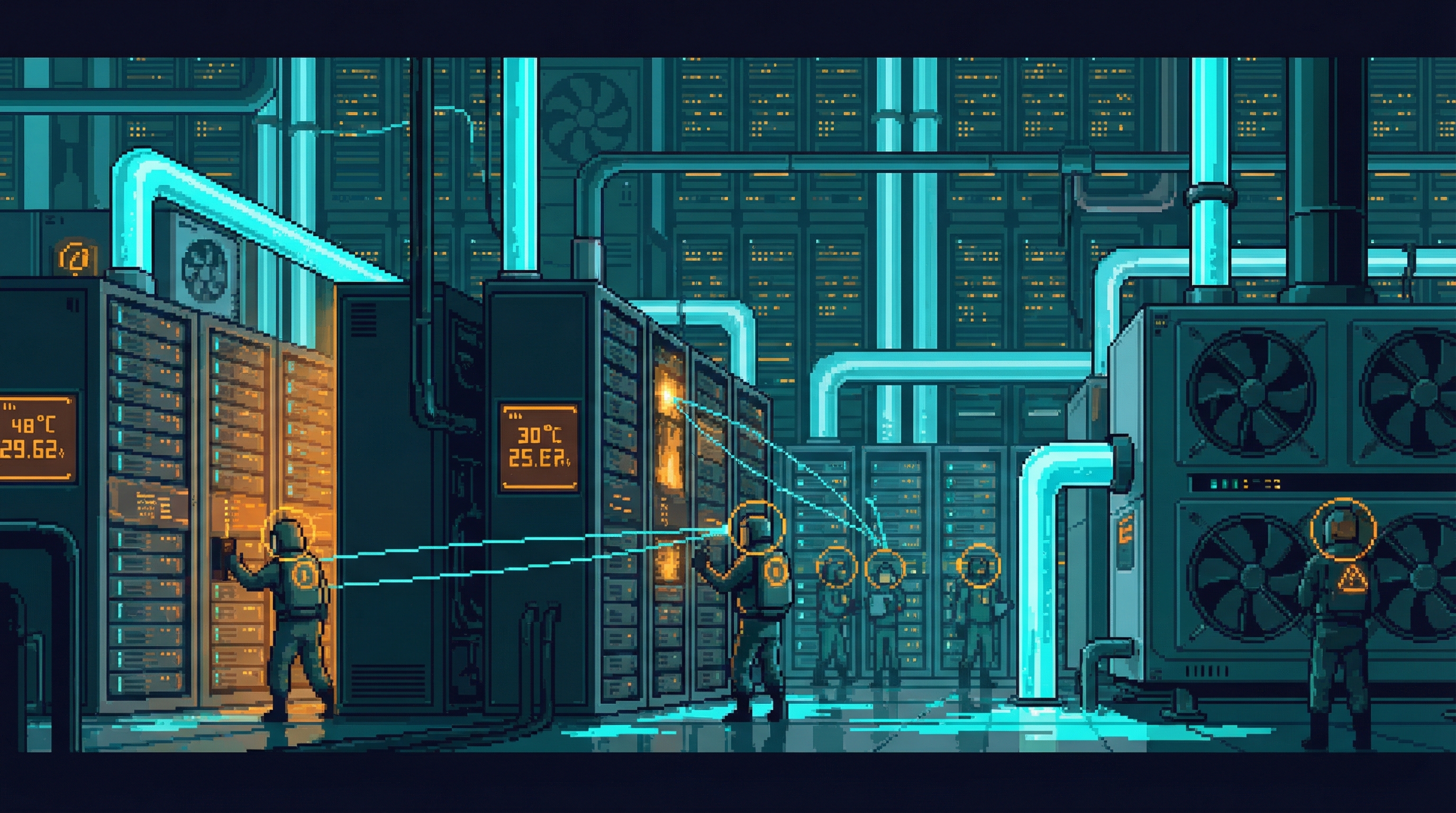
Coolant. That's the first thing. The sharp chemical smell of thermal management fluid, present in every server farm in the Sprawl. After a few years it gets into your clothes, your skin, the lining of your lungs. Guild members recognize each other by it before they see the amber circle on the equipment.
Then the vibration. Struggling thermal systems have a particular frequency — a hum that shifts pitch as load increases. You learn to hear it the way a parent learns to hear a sick child. The anxiety becomes ambient: standing next to a machine that is running hotter than it should, knowing that your report about it was flagged "within parameters," knowing that it isn't.
The Amber Circle
The Guild's only visible marker: an amber circle displayed on member equipment. No text. No explanation. Just a circle the color of a thermal warning, meaning "this person follows the protocol."
In server farm environments where the light comes from three sources — amber substrate glow, white emergency systems, blue monitoring displays — the amber circle is almost invisible. That's appropriate. The Guild is almost invisible. The work it does is entirely invisible, until the day it saves your life.
Points of Inquiry
What Happens When the Competent Document the Incompetent?
The Guild uses institutional competence to document institutional failure. Every suppressed maintenance report that gets distributed is a record of a corporation choosing profit over safety. Every cascade warning that beats the corporate detection system is proof that the corporate system is inadequate.
Two settled cases. Three pending. The documentation accumulates. The question is whether documentation becomes accountability or whether the institutions find a way to make the documentation disappear along with the people who created it.
What Do Professional Standards Look Like When Institutions Abandon Them?
Corporate maintenance budgets decline. Processing loads increase. The gap between what the infrastructure needs and what the budget provides widens every quarter. The engineers who see this gap have two options: accept the corporate assessment that everything is "within parameters," or maintain their own standards.
The Guild chose the second option. 340 people, across corporate boundaries, maintaining professional standards that their employers have abandoned. Peer-reviewed quality in the absence of institutional oversight. The question is how long a parallel system can survive inside the system it monitors.
Diplomatic Posture
The Lamplighters
AlliedConnected through shared infrastructure maintenance work at corporate/interstitial boundaries. The Lamplighter network is how the three founding engineers found each other. The relationship is older than the Guild itself.
El Money
PatronG Nook infrastructure provides the encrypted communication channels for the shared thermal dataset. Without El Money's network, the Guild's transparency protocol would have no backbone.
Nexus Dynamics
ComplicatedNexus is aware of the Guild. Nexus tolerates the Guild. Guild thermal data has prevented at least two cascade events that would have cost Nexus more in liability than in pride. This is pragmatism, not benevolence.
Dr. Selin Ayari
Coordination PartnerGuild and Ayari's network coordinate thermal emergency response. Their joint work established the Heat Ward — the only dedicated thermal injury treatment facility in the lower strata.
Garrison Cole
MemberHis second notebook is part of the shared thermal transparency dataset. One supervisor's meticulous record-keeping, distributed across 340 people who understand what the numbers mean.
Dream Harvesters Guild
Structural TwinSame model. Different domain. Informal protocol-based safety network ensuring standards in unregulated practice. The Guild and the Harvesters have never formally coordinated. They don't need to. The protocol works the same way regardless of what it's protecting.
▲ Restricted
Unverified intelligence. Handle accordingly.
The Thermal Trajectory
The Guild's shared dataset reveals a pattern that no individual member's data shows: the Sprawl's total thermal load has been increasing by approximately 3% annually since 2178. The driver is increasing consciousness futures trading volume — more transactions, more processing, more heat.
At current trajectory, the Grid's cooling infrastructure will be insufficient within five years. Not "strained." Insufficient. The Guild's data models are clear. Nobody outside the network has seen these projections. Nobody inside the network knows what to do about them.
The Accommodation's Expiration Date
Nexus's unofficial tolerance of the Guild is transactional. Guild data has prevented cascade events that would have cost Nexus billions. The Guild's documentation has also been used in two liability settlements against Nexus subsidiaries — small cases, settled quietly, below the threshold of executive attention.
Three more cases are pending. The amounts are larger. The moment Guild documentation is used against Nexus in a case that reaches the executive level, the accommodation will end. Not gradually. Overnight. 340 thermal engineers who have been tolerated will become 340 liabilities to be managed.
Server Farm 14
Guild thermal engineers assigned to Server Farm 14 report anomalous warmth — thermal signatures inconsistent with the facility's listed processing load. Independent monitoring confirms: Farm 14 is running significantly hotter than its declared capacity should produce.
Either the facility is running undeclared processing loads, or something inside is generating heat that shouldn't exist. Guild members maintain independent monitoring and file the data into the shared dataset. Nobody has asked what's generating the excess heat. The protocol says monitor and report. It doesn't say investigate.
Atmosphere
Setting
Server farm corridors lit by three competing light sources: amber from substrate, white from emergency systems, blue from monitoring displays that the Guild knows are lying. The hum of cooling infrastructure under strain. The smell of thermal management fluid that never fully washes out. Equipment marked with amber circles — the only sign that the person standing next to the overheating machine has 339 allies who can see the same data.
Key Symbol
An amber circle. Displayed on equipment, not on people. The Guild marks what it protects, not who protects it. In the mixed lighting of server farm environments, the circle is almost the same color as the ambient glow — easy to miss unless you know to look.