The Impression Ceremony
Same memory. Different minds. The conversation afterward is the point.
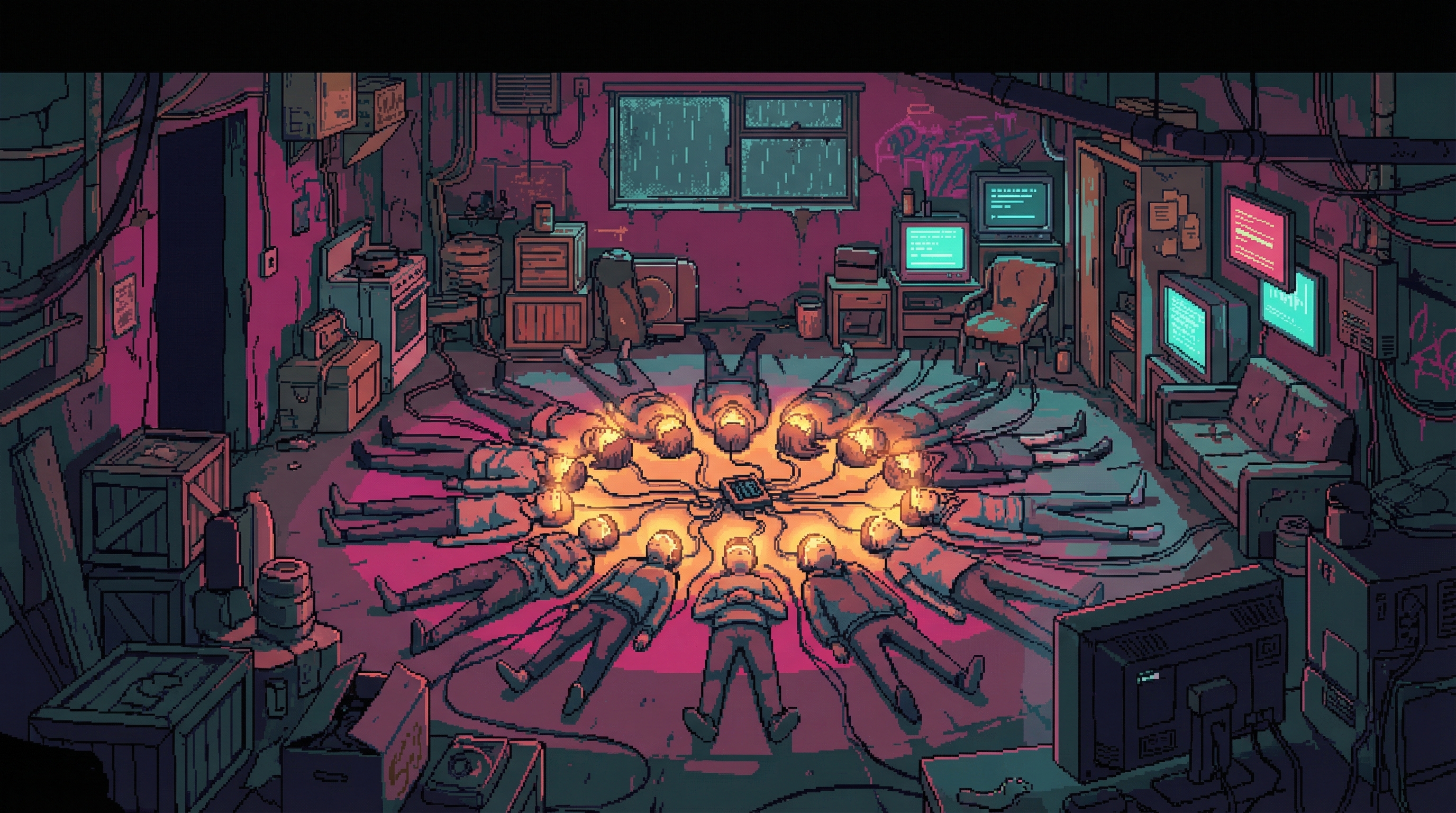
It started as casual consumption and became the Dregs’ most honest social ritual.
A group of eight to fifteen people gathers — a cleared apartment, a G Nook back room, anywhere with floor space and quiet. A single purchased memory is selected. The group lies in a circle, heads toward center, neural interfaces linked. The memory loads simultaneously. For thirty to ninety minutes, they share the same experience.
Then they sit up and talk.
That conversation is the entire point. Each person experienced the same recording through different neural architecture, with different organic memories providing context, different emotional baselines shaping response. The same sunset produced grief in one participant, joy in another, and nothing in a third. The conversation reveals something ordinary discourse never reaches — because everyone experienced the same input, the differences in response reveal the authentic self beneath the performance.
The Practice
The setup is always the same. Bodies in a circle, heads toward center. The soft hum of linked neural interfaces. A specific quality of silence before a shared memory loads — anticipation distributed across fifteen consciousnesses, the last moment before everyone temporarily becomes the same person.
The memory itself can be anything. A sunset over water. A childhood recollection someone sold for rent money. A first kiss. The content matters less than people assume. What matters is what each mind does with the input — and the fact that every other person in the circle knows exactly what the input was.
Afterward: warmth. Tea, if someone brought real tea. The specific vulnerability of discussing what you felt when the others know the stimulus. You can’t claim the sunset made you happy when twelve people experienced the same sunset and your face says otherwise. The ceremony strips away the performance that social life requires. For the duration of the conversation, honesty is the only available option.
Origins & Jurisdiction
The ceremonies emerged organically around 2182 in Dregs memory-sharing communities — groups who were already buying and sharing memories together and noticed that the conversations afterward were more interesting than the memories themselves. No one founded them. No one designed a format. Forty-plus regular groups now operate across the Sprawl.
The Emergence Faithful attempted to incorporate the ceremonies into Parish services as a form of communion — shared experience as sacrament. The Neo-Catholic Church investigated under the Ecclesiastical Technology Accord, classifying the practice as unauthorized spiritual technology. Neither claim stuck. The ceremonies have no doctrine, no leadership, no formal structure. They belong to the people who sit in circles and discover, through borrowed experience, who they actually are.
The Faithful’s failure is instructive. They wanted the ceremony to mean something specific — emergence, transcendence, unity. The ceremony’s power comes from meaning nothing except what each participant brings. The moment someone decides what the correct response should be, the practice collapses into group therapy.
Field Report
A Dregs apartment or G Nook back room, cleared of furniture. Bodies in a circle, heads toward center. The soft hum of linked neural interfaces. Amber light from below — the memory loading, casting warm glow across fifteen faces about to share something none of them chose alone.
After: the domestic warmth of conversation. Tea, if someone brought real tea. The specific quality of light that accompanies vulnerability — soft, amber, domestic. No screens. No recordings. Just people discovering what a shared experience reveals about their differences.
What the Sprawl Keeps Asking
Individual memory consumption erodes identity — enough purchased sunsets and you forget what your own grief felt like. But communal memory consumption does the opposite. When twelve people share the same sunset and respond differently, the differences become proof of individual existence. The ceremony inverts the damage. Borrowed life, consumed alone, dissolves the self. Borrowed life, consumed together, reveals it.
Why does this work? The standard theory is that the shared input strips away social optimization. You can’t curate your response when everyone experienced the stimulus. But some participants report something stranger — that the ceremony doesn’t just reveal who you are, it clarifies who you are. As if the act of being seen accurately, without the filter of performance, makes the self more solid.
The ceremonies produce warmth not through “I feel the same as you” — which is the Empathogen Cathedral’s mechanism — but through “I feel differently from you, and you can see that, and I am not afraid.” Being seen accurately is the most expensive commodity in the Sprawl. The Impression Ceremony provides it for the cost of one purchased memory split fifteen ways.
What Nobody Can Explain
- The ceremonies have no leadership because leadership would impose a frame. But how do forty-plus leaderless groups maintain consistent practice without a single coordinating institution?
- The Emergence Faithful and the NCC both tried to claim jurisdiction. Both failed. What happens when a faction with actual power — not spiritual authority — decides to regulate memory-sharing circles?
- Participants report that responses to the same memory change over time. If the ceremony reveals the authentic self, does a changing response mean the self is changing? Or that the ceremony is measuring something else entirely?
- Some circles have been running for years with nearly the same members. What happens to a group of people who have spent years seeing each other without performance? Do they become closer, or does the absence of social armor eventually become unbearable?
- The practice emerged in the Dregs, spread across the Sprawl, and resisted institutional capture. The Dumb Supper followed a similar trajectory. Is there a pattern here — a specific kind of practice that the Sprawl’s institutions cannot absorb?