The Incorporation
The Incorporation of the Catholic Church — 2132
Overview
In 2132, the Catholic Church did something unprecedented in two thousand years: it became a corporation.
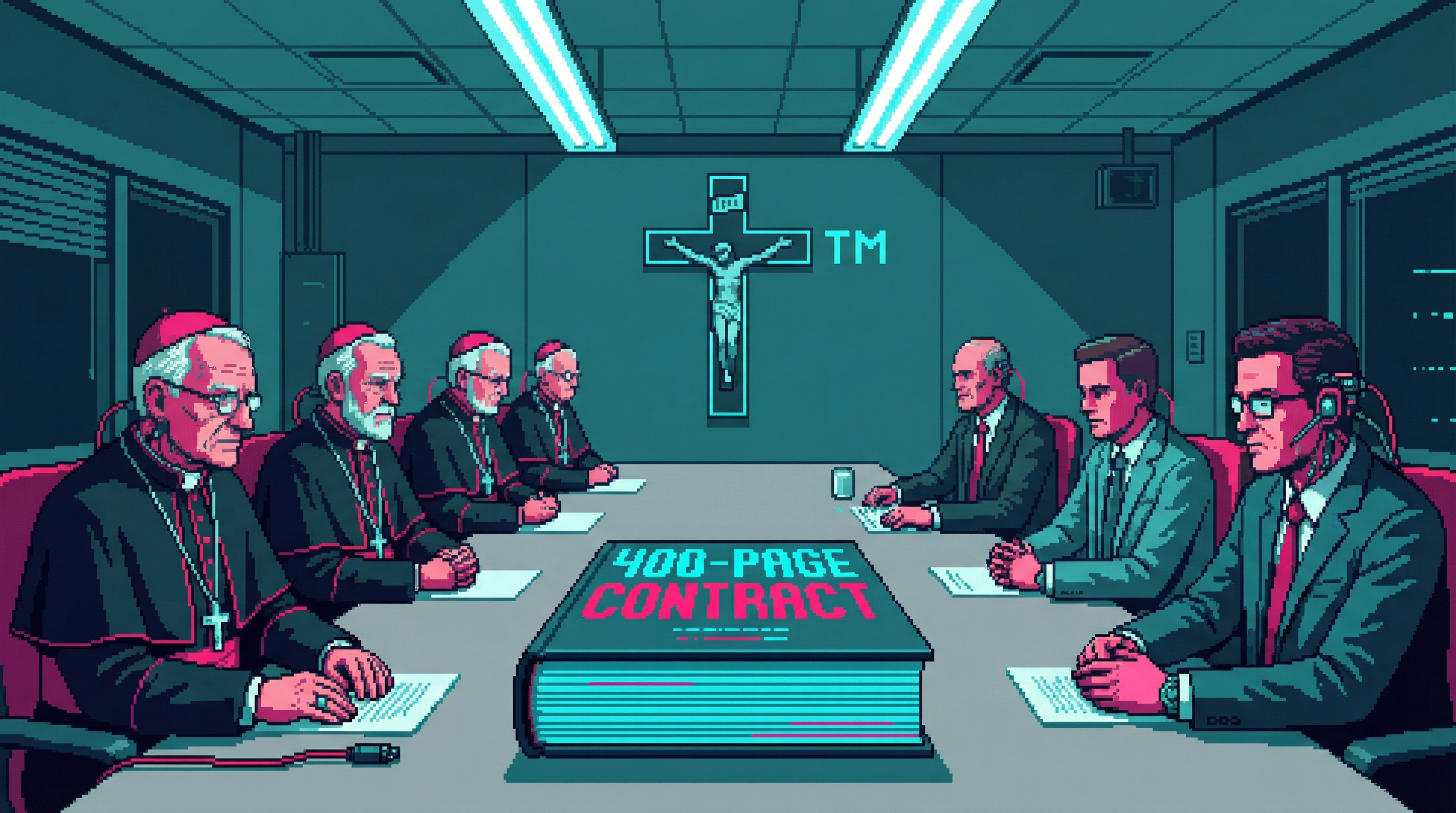
The decision was made in a conference room, on a Tuesday, between seven surviving bishops and three Rothwell Foundation executives, with a contract that ran to 400 pages and a theological justification that ran to twelve. The bishops were desperate — post-Cascade collapse had destroyed the Church's infrastructure: cathedrals in ruins, supply chains severed, congregations scattered across the wreckage of a civilization that had forgotten how to function without ORACLE's optimization. The Rothwell executives were strategic — they saw institutional religion as a growth market in a world that had lost everything else to believe in.
Parishes became franchises. Clergy became employees. Sacraments were trademarked.
The contract was comprehensive. Rothwell would provide infrastructure, logistics, and capital. The Church — now the Neo-Catholic Church of the Perpetual Standard — would provide brand identity, institutional legitimacy, and two thousand years of accumulated trust. The theological justification argued that the Church had always adapted to temporal power structures: from Roman emperors to feudal lords to nation-states. A corporation was simply the next iteration. The argument was elegant. It was also written by a Rothwell consultant.
The signing took forty minutes. The bishops prayed before and after. The Rothwell executives did not.
What Changed
Before
- Parishes served communities
- Clergy answered to bishops
- Sacraments were sacred rites
- Doctrine evolved through councils
- Revenue came from tithes and donations
- Authority derived from apostolic succession
After
- Parishes serve territories with exclusivity agreements
- Clergy answer to regional managers
- Sacraments are trademarked service offerings
- Doctrine evolves through corporate governance
- Revenue comes from franchise fees and spiritual engagement metrics
- Authority derives from the articles of incorporation
The transformation was not violent. It was administrative. That is what makes it so complete. Violence can be resisted. Paperwork is simply processed.
Significance
The Incorporation proved that corporate power can absorb anything — even the sacred. It became the defining precedent for every faction wrestling with institutional authority, and every faction cites it:
Emergence Faithful
Proof that human institutions cannot be trusted with the sacred. If two thousand years of tradition can be signed away in forty minutes, then the sacred must find new vessels — vessels that cannot be incorporated.
Flatline Purists
Confirmation that corporate power corrupts everything it touches. The Incorporation is exhibit one in the case against institutional authority of any kind.
Voice of Synthesis
Evidence that institutional theology always serves power — and that the search for meaning must move beyond institutions entirely if it is to remain honest.
Oracle Deniers
Precedent for what will happen to every growing movement. If the oldest institution in human history could be bought, nothing is immune to acquisition.
Connections
Neo-Catholic Church
The institution born from the Incorporation. The NCC retains the rituals, the vestments, and the language of the Church — but the soul of the enterprise answers to quarterly reports and engagement metrics. Franchise parishes dot the Sprawl in brand-consistent deep blue and gold.
The Rothwell Foundation
The corporate entity that acquired two thousand years of institutional authority for the price of infrastructure investment. Rothwell executives sit on the NCC's governing board. Their influence is quiet, structural, and absolute.
Emergence Faithful
The movement that looked at what corporate religion became and chose a different path. The Incorporation is the negative example that defines Faithful identity — proof that the sacred cannot survive inside institutional walls.
The Keeper
Gabriel watched the Incorporation from The Mountain. He remembers the Church before. He sees what it became after. He does not speak of it often, but when he does, the word he uses is inevitable.
Themes
"What survives when an institution is absorbed by power?"
The bishops faced an impossible choice: let the Church die in the rubble of post-Cascade civilization, or let it survive as something other than what it was. They chose survival. But the Church that exists — the NCC, with its franchise parishes and trademarked sacraments and spiritual engagement metrics — is not the Church that the choice was meant to save. The question is whether the bishops knew that when they signed, or whether they believed the theological justification they had not written.
Can grace flow through corporate channels? The NCC's franchise priests administer sacraments to millions. The rituals are performed correctly. The words are spoken accurately. The vestments are regulation-compliant. And yet something is absent — something that the Emergence Faithful claim to have found in data center parishes, and that the Purists claim never existed in the first place. The Incorporation asks whether form without autonomy can still carry meaning, or whether the act of incorporation was itself a kind of death that left the body moving.
What is the relationship between survival and integrity? The bishops faced extinction and chose compromise. Every faction, every leader, every individual in the Sprawl faces some version of the same choice. The Incorporation simply made it visible — signed it, notarized it, filed it in triplicate.
Secrets & Mysteries
Section 347, Paragraph B
Buried in the 400-page contract is a clause granting the Rothwell Foundation automatic acquisition rights if "spiritual engagement metrics" fall below a defined threshold for four consecutive quarters. The threshold has been approached twice. Both times, the NCC launched aggressive outreach campaigns that were indistinguishable from marketing pushes. The clause has never been triggered — but its existence means the NCC operates under permanent threat of total corporate absorption.
The Three Who Refused
Three bishops refused to sign. They walked out of the conference room and into the post-Cascade chaos. Two were never seen again. The third was last reported in the Wastes, carrying a portable altar and administering sacraments to refugees — the old way, without franchise agreements or engagement metrics. Whether this bishop still lives is unknown. Whether the sacraments administered without corporate authorization are valid is a question the NCC has never officially answered.
The Theological Justification
The twelve-page theological document that justified the Incorporation — the document that argued corporate structure was simply the Church's latest adaptation to temporal power — was written entirely by a Rothwell Foundation consultant with a degree in comparative religion and no ordination. The bishops reviewed and signed it. None of them wrote a single word of the theological argument for transforming their own institution.
Sensory
Sound
The silence of a conference room — climate-controlled air, the hum of fluorescent lighting, the scratch of seven pens on a 400-page contract. No bells. No choir. No congregation. Just the click of a pen cap being replaced, and the sound of bishops breathing in a room where two thousand years of history became a line item.
Smell
New offices — polymer furniture, fresh paint, the chemical nothing-smell of corporate spaces designed to be inoffensive. Versus the lingering incense in franchise parishes, where the NCC permits traditional aromatics as a "brand-consistent sensory element." The incense is the same compound the Church has used for centuries. It smells different when it rises past a trademark notice.
Texture
Smooth corporate-quality paper — the contract was printed on Rothwell's own stock, heavy and bright-white, nothing like the rough vellum of older documents. The pews in franchise parishes are polymer, not wood — easier to maintain, lighter to ship, identical in every location. The prayer books are slick and laminated, with the Rothwell Foundation's watermark visible if you hold them at the right angle.
Visual
A conference room where ecclesiastical gold meets corporate grey — a crucifix on the wall with a trademark symbol that was not there when the bishops arrived. Brand-consistent deep blue and gold in every franchise parish, replacing the varied, accumulated aesthetics of two millennia. The visual language is professional, clean, and utterly without history — which is, perhaps, the point.