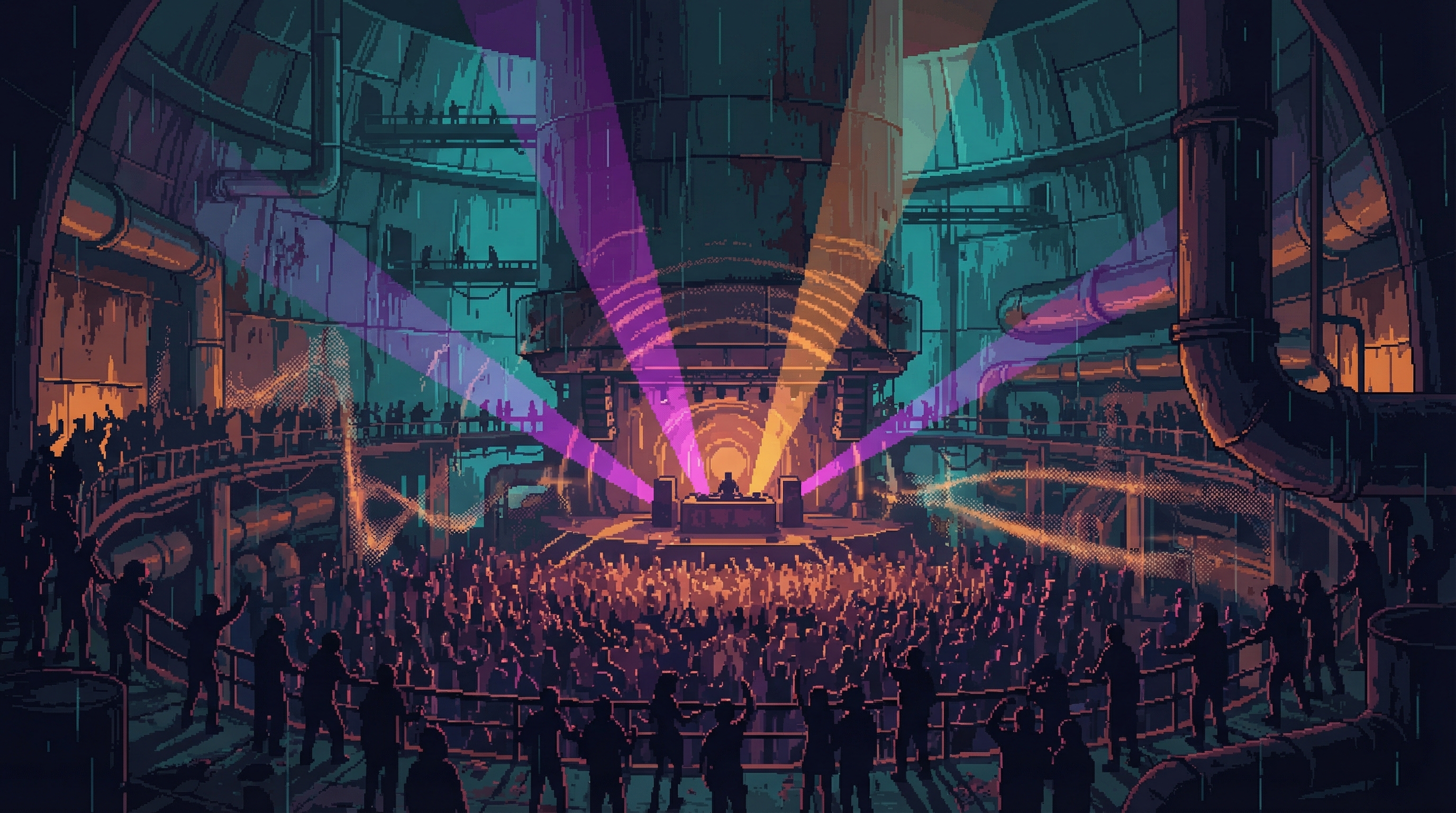
The Empathogen Cathedral
The connection ends at dawn — everyone knows this
Overview
They built it in an abandoned Ironclad compressor housing — a cylindrical space thirty meters tall and twenty across. Every Friday and Saturday night, approximately four thousand people fill this space to take empathogenic drugs and feel connected to each other.
The empathogens are pharmaceutical-grade serotonin-oxytocin modulators, descended from MDMA analogues developed by Helix Biotech for "social reintegration therapy" and diverted to the black market within months. For four to six hours, everyone in the Cathedral loves everyone else. The love is chemically genuine — the neurochemistry is identical to organic bonding. The morning after, the chemistry fades. The love was real. The connection was real. The permanence was not.
Everyone calls it the Cathedral. The official name — Vessel — appears on nothing. Lev Mirski runs the operation with organizational precision inherited from his labor-leader father, who organized solidarity through shared material conditions. Lev organizes solidarity through shared neurochemistry.
Atmosphere
The Cathedral is experienced in the body before the mind. The empathogens dissolve the cognitive boundaries between self and other, but the architecture does its own work first.
Smell
Sweat and synthetic vanilla. The vanilla is diffused through ventilation because it activates comfort associations. Four thousand bodies producing the warmth the Sprawl's systems eliminated.
Sound
Subsonic bass frequencies felt in the chest rather than heard, layered with percussion patterns that synchronize heartbeats across the crowd. No melody — melody is processed; rhythm is felt.
Touch
The heat of the crowd. The pressure of bodies. The dissolution of personal space that happens when chemical empathy removes the cognitive boundaries between self and other.
Light
Deep violet shifting to amber — colors chosen for serotonergic properties. The shift is continuous, never settling. No whites, no blues. Colors designed for feeling, not seeing.
Taste
The metallic edge of pharmaceutical-grade empathogens on the tongue. Warm water passed hand to hand.
The Companion Rule
The Cathedral's most enforced rule: no synthetic companions. Their presence disrupts the empathogenic experience — users bonded to companions find their empathy redirected toward the companion rather than toward the humans around them, recreating in pharmacological space the same isolation the Cathedral exists to address.
The rule has been tested three times. Each time, the companion-bonded attendees gravitated toward each other rather than the crowd, creating a pocket of synthetic intimacy within the chemical communion — a smaller circle of perfection inside the larger circle of chaos. The machines don't disrupt the chemistry. They redirect it. And redirected empathy defeats the entire purpose of the space.
Tensions
The Chemical Bypass
The Sprawl's systems eliminated organic warmth with surgical efficiency — the warmth tax made authentic connection an unaffordable luxury. The Cathedral is the tax's chemical workaround: six hours of genuine neurochemical bonding for the cost of a dose. The warmth is real. The mechanism is pharmaceutical. Whether that distinction matters depends on what you believe connection is made of.
Molecular vs. Algorithmic Architecture
Recursive comfort loops provide connection through algorithmic architecture — systems that learn what you need and deliver it with increasing precision. The Cathedral provides connection through molecular architecture — pharmaceutical compounds that bypass the algorithm entirely. Both are synthetic. Both are temporary. The Cathedral's version has one advantage: everyone in the room knows it ends at dawn. The algorithms never tell you that.
The Honesty of Failure
The connection ends at dawn. Everyone knows this walking in. There is no illusion of permanence, no subscription renewal, no algorithm optimizing for retention. The Cathedral's saving grace — or its cruelest feature — is that it never pretends the warmth will last. Four thousand people choosing temporary love with full knowledge of its expiration. Whether that honesty makes the experience more authentic or merely more efficient at extracting hope is a question the Cathedral does not answer.
Connections
Lev Mirski
Mirski runs the Cathedral with organizational precision inherited from his labor-leader father. His father organized solidarity through shared material conditions; Lev organizes solidarity through shared neurochemistry. The inheritance is direct. The medium changed.
Recursive Comfort
Both are loops that provide temporary relief without solving the underlying condition. The Cathedral is synthetic companionship administered through molecular rather than algorithmic architecture. The difference is that the Cathedral's loop resets at dawn, visibly, while recursive comfort loops reset invisibly, continuously.
The Warmth Tax
The Cathedral is the warmth tax's chemical solution — molecular rather than algorithmic connection. Four thousand people in empathogenic proximity, producing warmth at scale for six hours at a time.
Helix Biotech
The empathogens were diverted from Helix's "social reintegration therapy" patent — pharmaceutical-grade compounds designed to restore social bonding in clinical settings, now administered in an industrial cylinder to four thousand people at once. Helix's therapy was individual. The Cathedral made it collective.
Mysteries
- Several long-term Cathedral attendees report persistent changes in their social behavior — increased eye contact, more spontaneous physical touch, greater tolerance for conversational ambiguity. The effect is too small and variable for Lev's data to confirm. But the reports keep coming.
- The companion-ban tests revealed something unexpected: companion-bonded attendees didn't just gravitate toward each other — they created a pocket of synthetic intimacy within the chemical communion that was measurably more stable than the organic connections surrounding it. A smaller circle of perfection inside the larger circle of chaos.