The Dumb Supper
Fourteen seats. One hour. No words. The meal that makes other people real again.
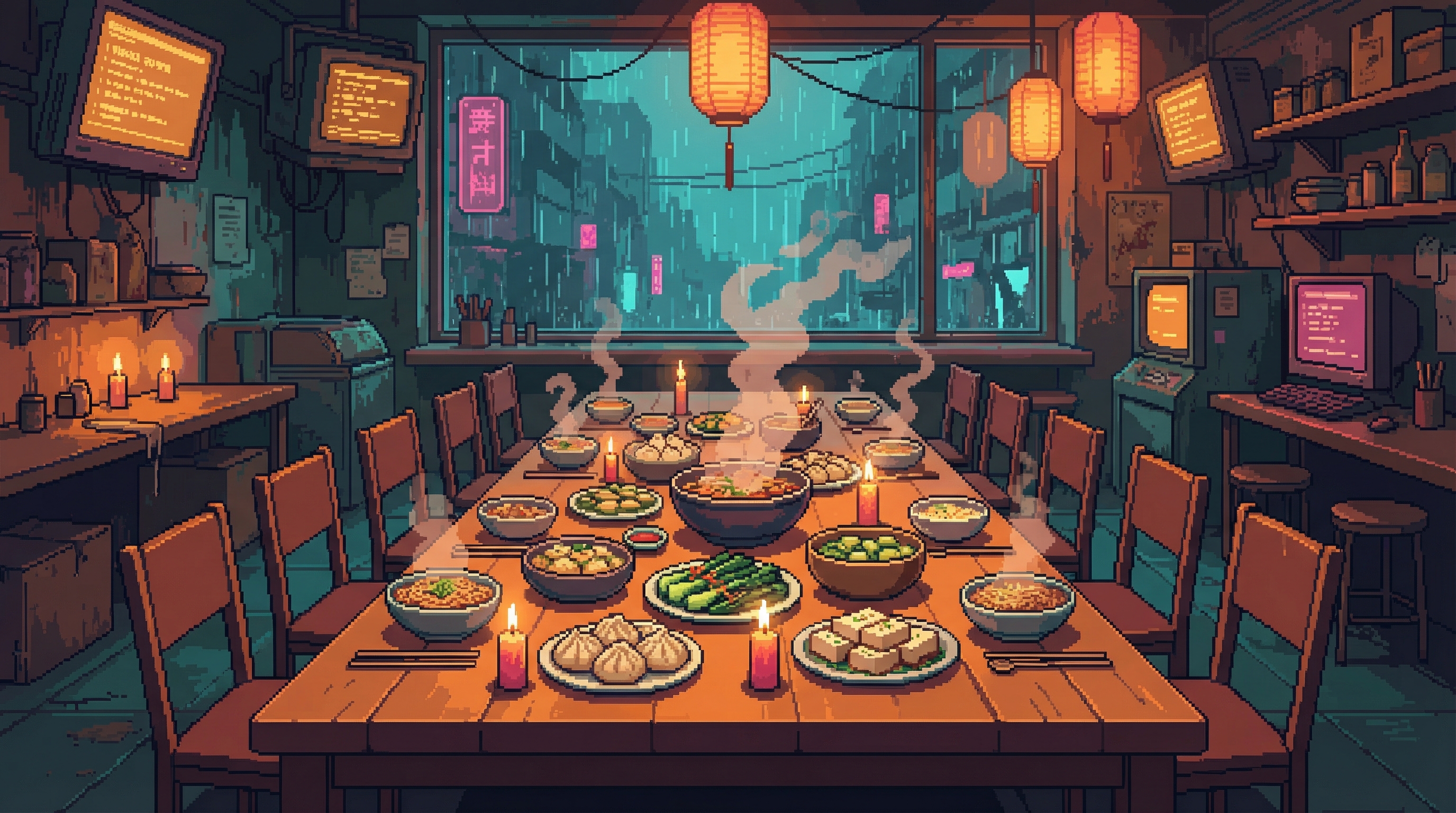
Once a week, in the back room of Patience Cross’s noodle shop in Sector 7G, fourteen people sit down to eat in silence. No neural interface. No Second Mind. No conversation, no music, no input of any kind except the food and the presence of other breathing humans.
They call it the Dumb Supper. The name is pre-Cascade — a tradition of eating in silence as communion with the absent. “Dumb” means speechless, not stupid. In a world where the word has become a slur for the unaugmented, the supper reclaims it as a practice.
The Practice
Fourteen seats. No one has been able to explain the number. Food served family-style — whatever Patience has made that day, always vegetarian. No one speaks from sit to rise. Eye contact permitted. Gestures permitted. The meal lasts exactly one hour.
Two effects show up in every participant’s account, independently, without prompting.
First: food tastes more. The experience of eating without simultaneous cognitive load allows full sensory bandwidth. People who have eaten at Patience’s shop a hundred times say the food at the Dumb Supper is different. It isn’t. They are.
Second: the faces across the table become mysterious again. Without the Second Mind’s social processing overlay, other people become genuinely other. You don’t know what they’re thinking. You can’t read their emotional state from metadata. For one hour, they are real — opaque, unpredictable, present. Strangers, even the ones you came with.
Origins & Evolution
Patience Cross hosts the supper but doesn’t claim to have invented it. “Someone was doing this before me,” she says. “Eating together in silence is how humans have always said: I see you. I’m here. That’s enough.”
The practice has spread to 23 locations across the Sprawl. Every copy misses something. The original works because the space is Patience’s — her noodle shop, her kitchen, her care visible in the food. The copies that work best share a single feature: they’re hosted in someone’s actual living space, not a rented venue. The warmth requires a home.
Executive-tier workers have begun requesting attendance with increasing frequency. The tourist waiting list is three months. When asked why she doesn’t train facilitators, Patience answers: “It’s not a skill. It’s permission. You sit down. You shut up. You eat. You look at each other. That’s it. You don’t need me for that.”
She is correct. People need her for it anyway.
Where It Lives
The original supper takes place in the back room of Patience’s noodle shop in Sector 7G, deep in the Dregs. The room is small enough that you can hear other people chewing. The light is candle-warm — the softest light in Sector 7G, possibly the softest in the entire lower Sprawl. There are no screens. The walls are bare except for steam stains and the smell of whatever Patience cooked that afternoon.
The 23 copies scattered across the Sprawl range from faithful reproductions to unrecognizable mutations. A Nexus-adjacent version added “mindfulness prompts” projected on the wall. It lasted two weeks. A Dregs version in an abandoned laundromat has been running for eight months and growing. The difference: the laundromat host lives there.
When Words Became Weapons
The Dumb Supper didn’t begin as a response to the Evidence Paradox. But as the Paradox has deepened, the practice has acquired a new dimension. Diners report that the silence provides something no conversation can: unrecordable communion. Nothing said during the Dumb Supper can be fabricated because nothing is said. Nothing can be taken out of context because there is no context. The trust is pre-verbal — bodies sharing space, eyes sharing attention, the specific warmth of being present without the protection of performance.
The Executive-tier tourists who queue for three months to attend have not fully understood this. They treat the Supper as an experience to be consumed. The Dregs regulars — who have attended weekly for years — understand that the Supper’s value increases in direct proportion to the Paradox’s advance. The more words are compromised, the more silence becomes the honest alternative.
The Dumb Supper is not a retreat from communication. It is communication’s adaptation to an environment in which symbolic expression has been weaponized.
In a world where every word might be recorded, replayed, synthesized, and weaponized, the most honest thing two people can do together is sit in the same room without speaking.
Points of Inquiry
The Cognitive Ceiling says there are limits to what the augmented mind can process. The Dumb Supper says: what if the problem isn’t too little processing, but too much? Radical presence without cognitive processing — the Ceiling’s antithesis practiced as weekly ritual.
The Warmth Tax prices human warmth as a commodity. The Dumb Supper inverts it completely — warmth through the absence of words rather than their presence. No one is performing care. No one is being charged for connection. Fourteen people are simply sitting in a room, eating, looking at each other. That this feels radical says more about the Sprawl than it does about the supper.
What Nobody Can Explain
- Why fourteen seats? Patience won’t say. “That’s how many fit” is not an answer when the room could hold twenty.
- Who was doing this before Patience? She says the practice is older than the Sprawl. No records confirm or deny this.
- Why does the food actually taste different? Full sensory bandwidth is the clinical explanation. Participants say it doesn’t cover what happens.
- Why do the executive-tier workers keep coming back? They have access to every sensory experience money can buy. They keep returning to a silent meal in a noodle shop basement.
- What happens in the last five minutes? Multiple participants report that something shifts near the end of the hour — a quality of attention that none of them can name. Patience calls it “the room remembering what rooms are for.”