The Guessing Game
The most wrong, most confident answer wins. Accuracy is cheating.
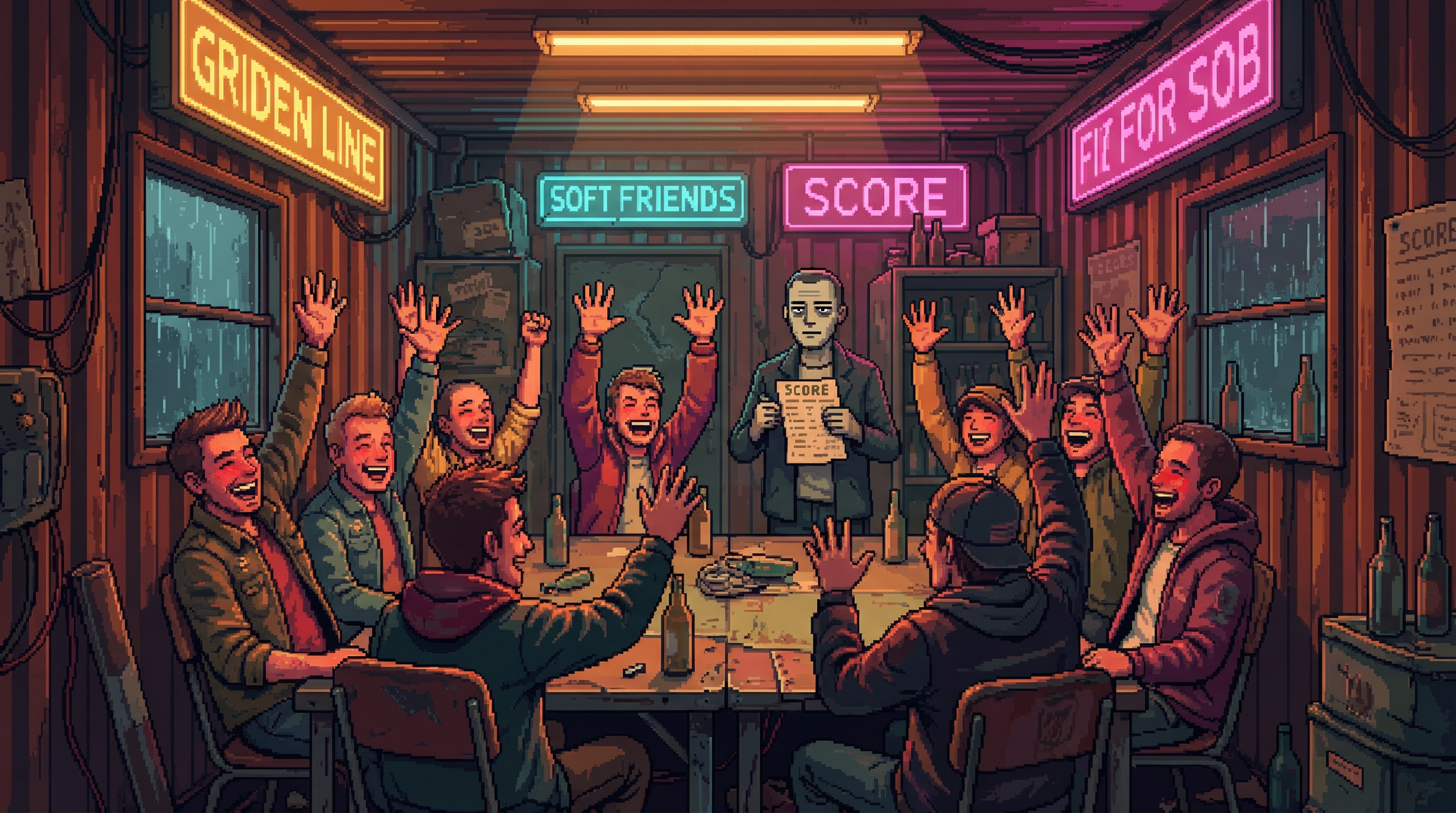
In the bars of Sector 7G — the drinking establishments that occupy converted shipping containers and repurposed infrastructure voids along the Backbone’s lower levels — a tradition has emerged that the augmented find baffling and the unaugmented find hilarious.
The Guessing Game is competitive wrong-answer trivia.
A moderator poses a factual question. How many people died in the Cascade? What year was the Orbital Elevator completed? How far is Highport Station from the surface? The participants are not allowed to check. They must guess. Scoring is not based on accuracy. Scoring is based on confidence. Each guesser declares their answer with a number from 1 to 5 indicating how certain they are. If they’re wrong — and they usually are — they score points equal to their confidence level. The most wrong, most confident answer wins the round. The most right answers lose — because accuracy means you probably checked, and checking is cheating.
The Practice
The game runs best in places where Second Mind support is thin. Basic-tier environments. The bars along the Backbone’s lower levels, where the signal barely reaches and the augmentation that Executive-tier workers rely on stutters and drops. Here, the playing field is almost level: everyone is guessing from genuine ignorance.
The moderator’s delivery is always deadpan. The questions are always factual, never opinion. The beauty of the game is that it punishes the one thing the Sprawl’s entire cognitive economy is designed to optimize: being right. A player who answers “47” for the year of the Cascade and declares confidence level 5 will bring the bar to its feet. The collective roar is not mockery. It is applause.
Executive-tier visitors can’t play naturally. Their Second Mind feeds them correct answers involuntarily — the augmentation doesn’t understand that accuracy is unwanted. Watching an Executive try to guess wrong on purpose, fighting against their own neural interface, is one of the game’s secondary entertainments.
Field Report: Game Night in Sector 7G
The sound of a Guessing Game in full swing: laughter, groans, the moderator’s deadpan delivery, the collective roar when someone guesses “47” for the year of the Cascade and declares confidence level 5. The smell of cheap synth-drinks and warm bodies. The specific quality of communal joy that comes from being wrong together.
The visual signature: a circle of people at a bar, hands raised, mouths open, the moderator holding a crumpled score sheet. The lighting warm and uneven — the light of a place where nobody is performing. Bar amber, neon flicker, the warm red of faces flushed with drink and argument. A raised hand with five fingers spread — declaring maximum confidence on what everyone already knows is the wrong answer.
When Hector from Sector 7 walks into a bar, the game starts whether anyone planned it or not. His arrival triggers the signature greeting — regulars shouting questions at him before he’s even sat down, and Hector answering every one of them at confidence level 5, wrong every time, grinning the entire way through.
Open Questions
“The game isn’t about answers,” explains Hector from Sector 7. “It’s about the space between the question and the answer. That space is where people live. AI lives in the answer. We live in the gap.”
The Guessing Game inverts every value the Sprawl’s cognitive economy is built on. Accuracy is penalized. Confidence in wrongness is rewarded. The game doesn’t just tolerate human cognitive limitation — it celebrates it, treating the gap between human uncertainty and AI certainty as something worth defending rather than something worth closing.
The Cognitive Ceiling says there’s a hard limit to what the augmented mind can process. The Guessing Game says: if we can’t outthink the machines, at least we can out-wrong them. The Ceiling turned into a party. The limit turned into the point.
The Wonder Deficit describes what happens when every question has an instant answer: the act of wondering dies. The Guessing Game is its resurrection — a room full of people not knowing, and enjoying it.
What Nobody Can Explain
- Why do Executive-tier workers keep showing up to a game they structurally cannot win? Some of them come back every week.
- The game has no inventor. No one started it. It just appeared in bars along the Backbone sometime after the Cascade, fully formed, as if wrongness had always been waiting for a scoring system.
- Players report that after a long session, they stop wanting to check things. Not just during the game — after. A temporary condition where not-knowing feels better than knowing. Nobody has named this yet.
- The game cannot be played online. Every attempt has failed. The communal wrongness requires physical proximity — bodies in a room, wrong together, laughing together. The gap between the question and the answer only exists when you can hear other people being wrong at the same time.