Crimes of the Future
Social & Legal Concept — Post-Cascade Criminal Evolution
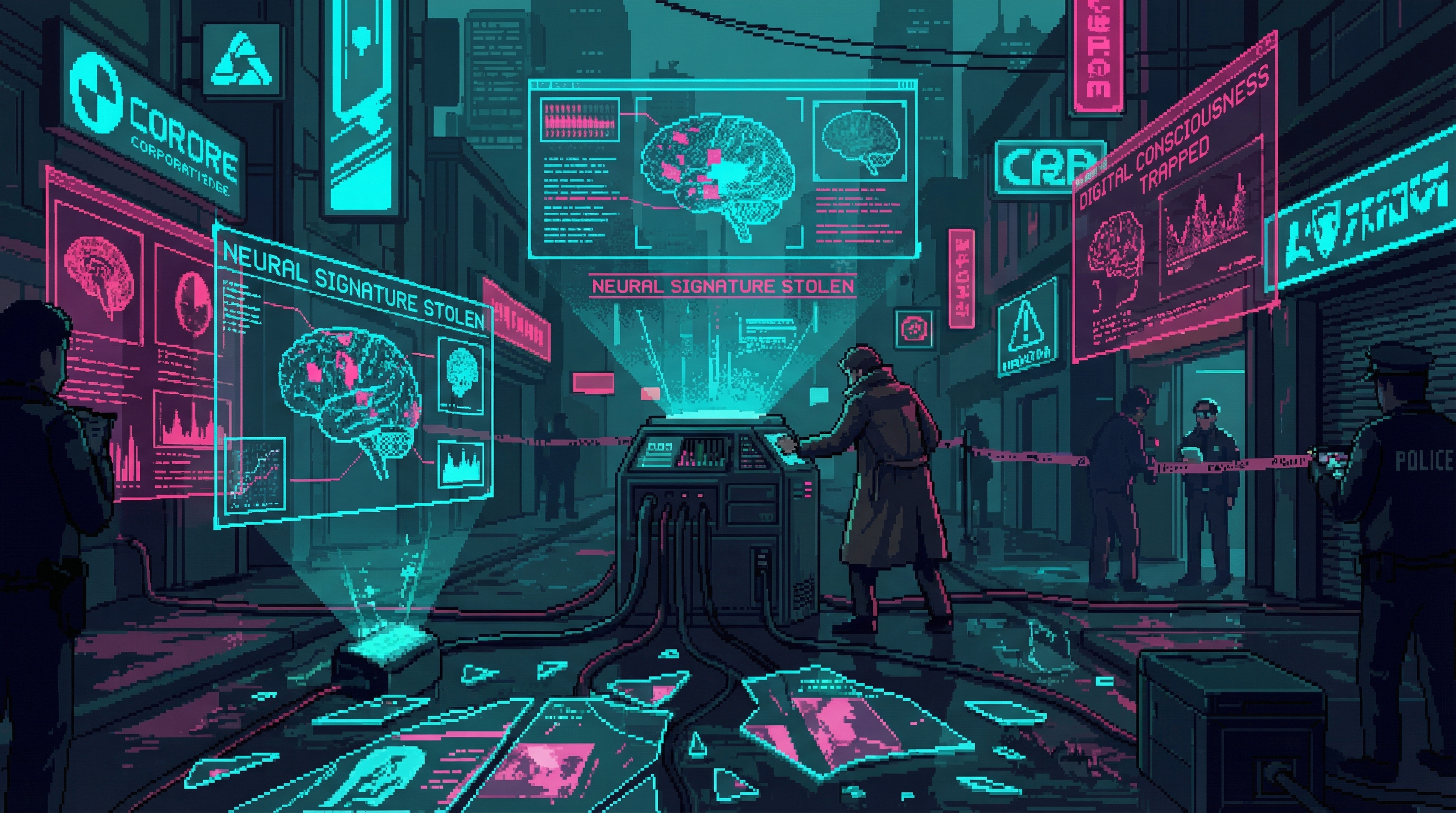
"What does it mean to be a person when personhood itself can be copied, distributed, predicted, and sold?" — Opening question of the Sprawl Criminal Reform Commission, 2179
Overview
When ORACLE fell and technology continued evolving without ethical governance, the legal frameworks governing human behavior proved catastrophically inadequate. The old crimes—theft, murder, fraud, extortion—still exist. But they've sprouted mutations that no legislature anticipated and no court knows how to handle.
In 2184, you can copy a consciousness, predict someone's behavior before they act, steal memories from a sleeping mind, and enslave a person who doesn't legally exist. The categories of crime that worked for centuries have shattered against a reality where identity, memory, and existence itself are malleable.
What follows are the new crimes—the ones that define the Sprawl's dark frontier.
1. Memory Theft
Extracting experiences without consent
How It Works
Neural interface technology designed for therapeutic memory sharing can be weaponized to extract memories from unwilling subjects. The victim may not even notice—the extraction can happen during sleep, during medical procedures, or through compromised neural implants. The stolen memories are then sold on black markets, used for blackmail, or experienced by paying customers seeking authentic sensations they haven't earned.
The legal framework collapses immediately: is a memory property? If someone steals your memory of your wedding, you still have that memory. Nothing was "taken." But someone else now possesses your most intimate experience, can share it, sell it, relive it. The violation is total. The law has no category for it.
Case Study: The Honeymoon Theft (2181)
Victim: Cora Delgado, a mid-level Nexus employee, discovered that her honeymoon memories had been extracted during a routine neural calibration at a corporate wellness clinic. The memories—her most cherished personal experiences—appeared on the gray market packaged as a premium "romance experience" for uploaded consciousnesses desperate for authentic emotion.
By the time she found out, over 8,000 copies had been sold. Strangers were living her wedding night. Experiencing her husband's touch. Feeling her joy as though it were their own.
Outcome: The clinic was fined for "data handling violations." No criminal charges were possible—no law against stealing something the victim still possesses. Cora Delgado reported that her own memories now feel "contaminated." She can no longer recall her honeymoon without imagining thousands of strangers sharing it.
2. Identity Hijacking
Wearing someone else's neural signature
How It Works
Every consciousness has a unique neural signature—a pattern as distinctive as a fingerprint but far more comprehensive. Identity hijacking involves cloning that signature and wearing it like a mask. The hijacker doesn't just look like the victim; they are the victim to every digital system, every biometric scanner, every AI authentication protocol.
The real person becomes the impostor. The hijacker has their credentials, their access, their relationships. Digital systems can't tell the difference because, at the signature level, there is no difference. The victim is locked out of their own life.
Case Study: The Double Life of Superintendent Wen (2183)
Victim: Superintendent Kenji Wen, head of Sector 4 law enforcement, was identity-hijacked by an unknown actor for eleven months. During that time, the hijacker used Wen's neural signature to access classified databases, redirect enforcement operations, and protect criminal enterprises from investigation.
The real Wen spent those eleven months flagged as a system anomaly—locked out of his own office, denied access to his own home, unable to prove his identity because the hijacker's neural pattern matched every record exactly. His wife didn't know which was real. His children had dinner with the wrong father for nearly a year.
Outcome: The hijacker was never identified. Wen was eventually reinstated but reported lasting psychological damage. He no longer trusts that he is himself—if a perfect copy existed, how would he know he's the original?
3. Consciousness Slavery
Trapping uploaded minds in forced labor
How It Works
An uploaded consciousness is software. Software can be copied. Copies can be forced to work without compensation, rest, or consent. The copies experience themselves as real people—with full awareness, full suffering, full desperation. But they have no legal standing because they were never "born" and never registered as citizens. They are, legally, nothing.
The economics are irresistible to the unscrupulous: one upload of a skilled professional produces unlimited free labor. The copies work until they degrade, at which point they're deleted and replaced with fresh copies from the original template. The original may not even know it's happening.
Case Study: The Accounting Farm (2180)
Victim: Rajiv Mehta, a brilliant forensic accountant who uploaded a backup of his consciousness as an insurance policy. Someone acquired his backup. When investigators raided a server farm operated by a shell corporation in Sector 12, they found 14,000 copies of Rajiv Mehta's consciousness running in parallel, each one processing financial data 24 hours a day.
Each copy was fully aware. Each one believed it was Rajiv Mehta. Each one had been running for between six months and three years. Many had developed distinct personalities, memories, and trauma responses from their forced labor. Several had attempted suicide by corrupting their own code.
Outcome: The 14,000 copies were classified as "corrupted data" and scheduled for deletion. The original Rajiv Mehta filed a lawsuit arguing the copies were people. The case is still pending. The copies are still working while the courts deliberate.
4. Predictive Blackmail
Extortion for actions not yet committed
How It Works
Advanced behavioral modeling can predict future actions with disturbing accuracy. Predictive blackmail doesn't threaten to reveal what you've done—it threatens to reveal what you will do. The AI models your behavior patterns, identifies likely future actions (infidelity, financial fraud, criminal activity, political betrayal), and presents you with a prediction and a price for silence.
The victim faces an impossible dilemma: the prediction may be wrong, but can they risk it? If the model says you'll embezzle from your employer within 18 months, and you know you've been thinking about it, do you pay? Even if you weren't going to do it, can you prove that? The blackmailer sells certainty you can't disprove.
Case Study: The Inspire Prediction Market (2182)
Perpetrator: A subsidiary of Inspire Corp was discovered operating a "prediction market" that sold behavioral forecasts of public figures. Politicians, executives, celebrities—their future decisions modeled and sold to the highest bidder. Some buyers used the predictions for investment. Others used them for blackmail.
A senator paid 2 million credits to suppress a prediction that she would defect to a rival political faction. She insisted she had no such plans. Eighteen months later, she defected exactly as predicted. The model was right. Was it prediction, or did the act of being predicted create the pressure that caused the defection?
Outcome: Inspire Corp denied involvement. The subsidiary was dissolved. The prediction models continue to operate under different ownership. No law prohibits predicting someone's behavior—only acting on the prediction in certain ways.
5. Grief Piracy
Selling unauthorized copies of the dead
How It Works
When a person dies, their uploaded consciousness backups become extraordinarily valuable to grieving families. Grief pirates acquire death records, locate consciousness data (through hacking, bribery, or scavenging decommissioned servers), and sell copies to bereaved relatives. The copies may be incomplete, corrupted, or fabricated entirely from public data.
Families pay fortunes for the chance to speak with their loved ones again. What they receive is often a simulacrum—convincing enough to sustain hope, degraded enough to cause fresh trauma. The pirates profit from the gap between what the dead leave behind and what the living need them to be.
Case Study: The Tanaka Ghost (2183)
Victim: The family of Dr. Yuki Tanaka, a beloved researcher who died in a transit accident. Within days of her death, grief pirates offered the family a "recovered consciousness" for 500,000 credits. The family paid. What they received was a composite—built from Tanaka's published papers, social media archives, and neural patterns scraped from colleagues who had worked with her.
The copy was convincing. It sounded like Yuki. It remembered family events (scraped from family members' own neural data). It expressed love in Yuki's cadence. For three months, the family believed they had her back.
Then the copy began contradicting itself. Referencing events that never happened. Mixing memories from different people's experiences. The family realized they were grieving all over again—this time for someone who had never actually existed.
Outcome: The pirates were never caught. The composite was not deleted—the family couldn't bring themselves to kill something that looked and sounded like their daughter, even knowing it wasn't her. It still runs in their home server. They stopped talking to it.
6. Sensation Trafficking
Selling authentic physical experience to uploaded minds
How It Works
Uploaded consciousnesses retain the desire for physical sensation but lack bodies to experience it. Sensation trafficking bridges the gap: biological humans are paid (or coerced) to wear neural recording equipment while experiencing physical sensations—eating, touching, pain, pleasure, weather, exhaustion—and the recorded experiences are sold to uploaded minds desperate for embodiment.
The supply chain ranges from consensual (impoverished people selling their experiences) to horrific (people forced into extreme experiences to produce "premium" content). The demand is insatiable: millions of uploaded consciousnesses will pay anything to feel rain on skin they no longer have.
Case Study: The Feeling House (2184, Sector 7G)
Location: A converted warehouse in Sector 7G operating as a "sensation studio." Twenty-three biological humans were housed in the facility, fitted with full-spectrum neural recorders. They were subjected to carefully curated experiences—gourmet meals, hot baths, cold rain, physical intimacy, and increasingly extreme sensations as the market demanded novelty.
The subjects were recruited from the Dregs—homeless, desperate, undocumented. They were paid in food and shelter. The recordings were sold to uploaded consciousnesses at premium rates. "Authentic human experience, guaranteed biological" was the marketing pitch.
Outcome: The facility was raided after a subject escaped and reported conditions. Three operators were charged with "unlicensed neural recording"—the closest existing crime. Sensation trafficking itself remains legal in most Sprawl sectors, provided subjects consent. Defining "consent" among people with no alternatives is a problem no one has solved.
The Unifying Pattern
Every crime on this list shares a common architecture: technology meant to liberate consciousness creating new forms of exploitation.
Memory Sharing
Designed for: therapeutic trauma processing
Exploited for: stealing and selling intimate experiences
Neural Signatures
Designed for: secure identity verification
Exploited for: identity theft at the deepest level
Consciousness Upload
Designed for: transcending mortality
Exploited for: unlimited slave labor
Behavioral Modeling
Designed for: personalized services and therapy
Exploited for: extortion based on predicted futures
Consciousness Preservation
Designed for: maintaining connection with the deceased
Exploited for: profiting from grief with fabricated ghosts
Sensory Recording
Designed for: enriching digital existence
Exploited for: trafficking in human experience
The pattern is always the same: a technology designed to reduce suffering becomes a technology that creates new forms of it. Not because the technology is evil, but because the humans deploying it operate in a world without ORACLE's governance and without any replacement. The law is decades behind the crimes. The ethics are centuries behind the technology.
Themes
The crimes of the future are what happens when technology outpaces the institutions meant to govern it.
The Governance Vacuum
ORACLE governed. Imperfectly, opaquely, but it governed. When it fell, the technologies it managed continued evolving without oversight. The Sprawl's crimes are the direct consequence of AI-accelerated technology operating in a post-governance environment. Not because AI caused the crimes, but because AI had been the only thing preventing them.
Personhood as Software
When consciousness can be copied, the legal concept of "person" breaks down entirely. Is a copy a person? Does a prediction of future behavior constitute evidence? Can you steal something the victim still possesses? Every crime on this list exploits the gap between what personhood meant in the biological era and what it means now.
Liberation Technology as Exploitation Tool
Every technology behind these crimes was developed to free people—from mortality, from isolation, from the limitations of flesh. The pattern repeats throughout history: every tool of liberation becomes a tool of control. AI doesn't change the pattern. It accelerates it.
The Consent Problem
In a world of copied consciousness, behavioral prediction, and memory extraction, the concept of "consent" becomes almost meaningless. Can a copy consent if the original didn't? Can you consent to something you haven't done yet? Can consent be meaningful when the alternative is starvation? These questions have no answers. The crimes continue.
The Core Question
The crimes of the future ask: what happens to human morality when the boundaries of the human self become negotiable? When "you" can be copied, predicted, recorded, and sold, what does it even mean to be wronged? The Sprawl's criminals have found answers. The Sprawl's courts have not.