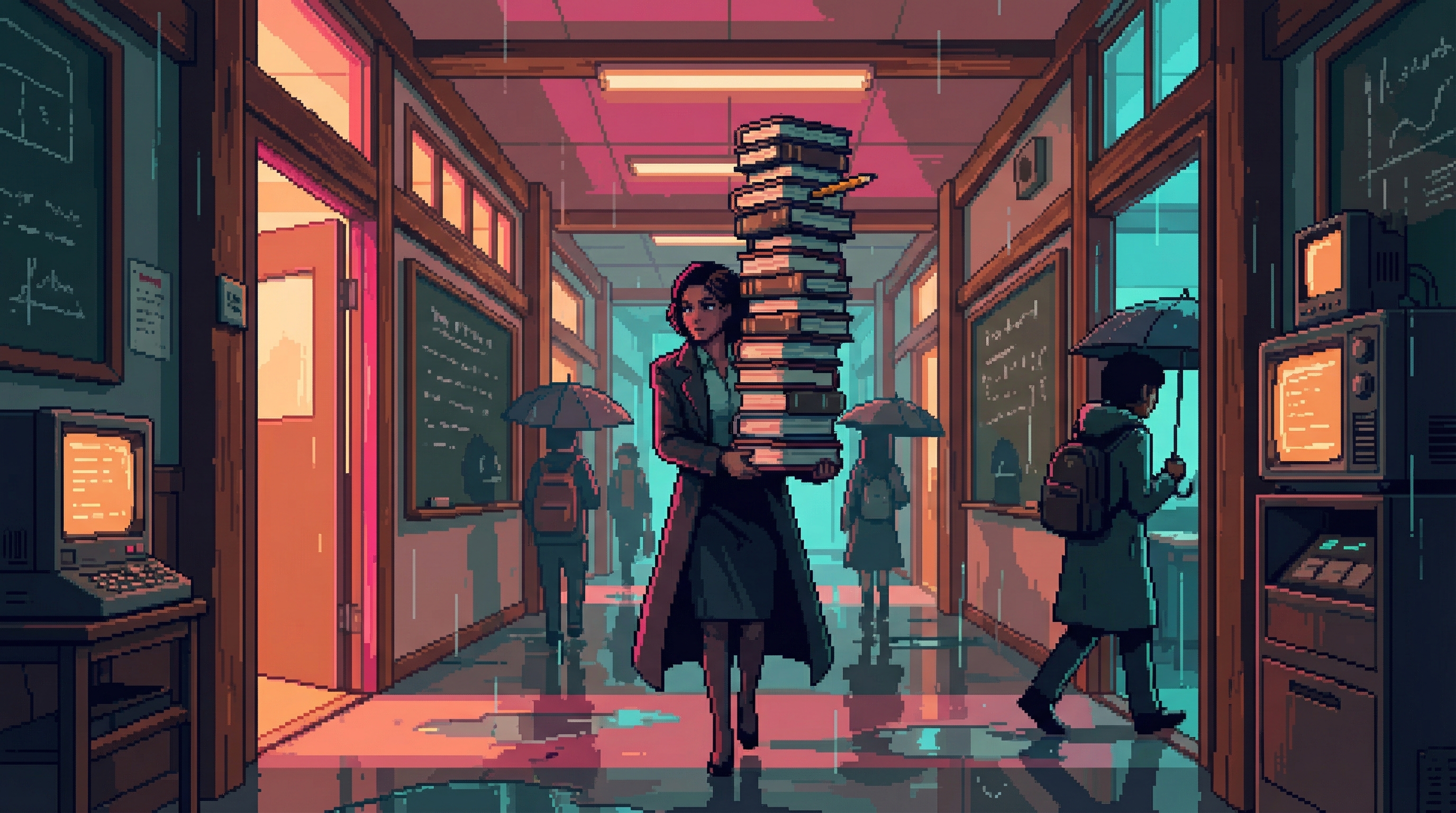
Professor Ines Park
The Patience Teacher · Nexus Defector
Ines Park teaches children to be comfortable being wrong, and this makes her one of the most dangerous people in the Sprawl.
She is fifty-three years old, built like someone who carries stacks of physical books as a daily commute and has the shoulders to prove it. She was a Nexus cognitive research scientist for eleven years before she understood what the research was actually for — not enhancing human cognition, but benchmarking it against AI to demonstrate its inferiority and justify the licensing tiers. The research she conducted didn't seek to make people smarter. It sought to prove they couldn't be smart enough. Every paper she published, every dataset she curated, fed a machine designed to argue that unassisted human thought was a liability.
She walked into Mother Venn's nearest Analog School on a Tuesday, asked if they needed a science teacher, and never went back to Nexus. She still carries the cognitive augmentation they gave her — deprecated firmware, unsupported hardware, a corporate investment in a mind that now works against the corporation's interests. She has never had it reverted. She says the augmentation helps her understand what she's fighting. Critics say she's a hypocrite. She doesn't argue.
The Patience Practice came from two sources: pre-Cascade meditation research she recovered from the Dead Internet, and her own observation of Analog School students. The observation was simple and devastating: children who spent more time wrong before arriving at right retained the knowledge more deeply and applied it more flexibly than children who were told the answer. Being wrong was not a failure state. It was a cognitive process that augmentation had entirely eliminated.
She formalized this into a three-level structure and began teaching it across six schools in the northern Sprawl. The practice is now the intellectual foundation of the Slow Thought Movement. Park did not set out to found a movement. She set out to teach science. The movement found her.
Field Observations
Sources who have observed Park in her classrooms report a woman who moves between schools on foot, carrying improbable stacks of physical books through narrow corridors, her hands calloused from the weight. She smells of chalk dust and old paper. She makes eye contact with a directness that augmented people find uncomfortable — because the Second Mind typically mediates social processing, and Park's gaze feels like it's looking at you rather than at a behavioral model of you.
She can explain any concept at any level, adjusting in real time to the student's confusion. This is not patience in the common sense — it is precision. She reads a student's misunderstanding the way a diagnostic reads a system error: not with frustration, but with the focused attention of someone who needs to understand exactly where the logic broke before she can help rebuild it.
"The augmented learn like cameras. They capture everything, perfectly, instantly. My students learn like sculptors. They chip away at the marble. The process is slower and the result is rougher, but at the end they understand the shape — not just what it looks like, but why it has to look that way."
Her most well-known pedagogical innovation is the Unassisted Hour: one hour per school day where all augmentation support is voluntarily suppressed. Students with any level of enhancement sit in silence with their own cognition. No Second Mind. No algorithmic assistance. No mediated perception.
"The Unassisted Hour isn't about learning content. It's about learning what your mind does when nobody's helping it. Most of my students have never met their own mind. The introduction is sometimes uncomfortable. It's always important."
There is a quiet fury in Park that multiple sources have noted. It is not directed at augmented individuals. It is directed at a system that uses augmentation to justify inequality — that builds the Cognitive Ceiling and then points to the people beneath it as evidence that the ceiling was necessary. Park spent eleven years inside that system. She understands its architecture. She is not fooled by its marketing.
The Irreducibility Position
Park's work addresses the Capacity Question directly: is human intelligence a degree of general intelligence, or a kind? The corporate consensus holds that it is a degree — a weaker version of what AI does better. Park's pedagogy operates on the opposite premise. Human intelligence is a kind. What it produces cannot be replicated because it comes from a different substrate — a biological body moving through a physical world, accumulating understanding through friction and error.
Her students are not trained to outperform AI. They are trained to become something AI cannot be: themselves. An unaugmented child who has spent forty minutes struggling with a mathematics problem and finally solves it has not just learned mathematics. They have learned what their own mind does under pressure. They have developed a relationship with their own cognition that no download can provide.
Between Park and Dr. Selin Ayari — who corresponds with Park through handwritten letters carried by Lamplighter couriers — they are mapping the territory of what human cognition could be if it weren't constantly being optimized into something less. Ayari documents what the Protocol destroys. Park develops practices to rebuild it. Their work converges on the same conclusion from opposite directions.
Known Associates
Mother Sarah Venn
Venn's pedagogy provided the foundation. Park formalized the cognitive methodology. Venn built the schools; Park built the science of what happens inside them. They do not always agree on methods. They have never disagreed on purpose.
Dr. Selin Ayari
They correspond through handwritten letters via Lamplighter couriers — Ayari documenting what the Protocol destroys, Park developing practices to rebuild it. Two scientists mapping the same territory from opposite borders.
Soren Achebe
Park taught him mathematics at the Wastes border Analog School — the kind of mathematics that lives beyond calculation. She identified his aptitude early and never once discussed him with journalists. They correspond by letter. She continues teaching.
Nexus Dynamics
Eleven years in cognitive research. She left when she understood the research served to justify licensing tiers, not enhance cognition. She took nothing with her except her augmentation and a clear understanding of the enemy's architecture.
The Slow Thought Movement
Her Patience Practice and Unassisted Hour pedagogy became the movement's intellectual foundation. Park did not seek leadership. The movement adopted her methods because the methods worked.
The Cognitive Ceiling
Park's work is the most systematic resistance to the Ceiling in operation. Teaching unassisted cognition develops capacities that augmentation cannot replicate — and every student who proves this makes the Ceiling harder to justify.
Open Questions
Can the Patience Practice Scale?
Six schools. One teacher walking between them. The Patience Practice works because Park is extraordinary — a former corporate scientist with augmented cognition teaching unassisted thought. Can the methodology survive without her? Can it be taught by teachers who haven't spent eleven years inside the system they're resisting?
The Slow Thought Movement is growing. Park is one person. The gap between those two facts will define whether the Practice becomes a pedagogy or remains a personal gift.
What Does the Augmentation Still Do?
Park retained her Nexus-era cognitive augmentation — deprecated firmware, unsupported hardware, no longer receiving updates. She says it helps her understand what she's fighting. But deprecated is not inert. The augmentation still runs. It still processes. The question nobody asks Park directly: does she teach unassisted cognition with an assisted mind? And if so, what does that mean for her pedagogy?
▲ Unverified Intelligence
- The Dead Internet archive. Park recovered pre-Cascade meditation research from the Dead Internet to develop the Patience Practice. The scope of what she recovered is unknown. Pre-Cascade cognitive research is rare, valuable, and in some cases classified. If Park is sitting on a larger archive than the fragments she used for the Practice, the implications for the Capacity Question could be significant.
- The Ayari correspondence. Handwritten letters between Park and Ayari, carried by Lamplighter couriers, constitute what may be the most important unpublished cognitive research in the Sprawl. If the correspondence were compiled, it would document both sides of augmented cognition — what is lost and what can be rebuilt. Neither scientist has published the letters. Neither has explained why.
- Nexus has not attempted to contact Park since her departure. Eleven years of cognitive research data. Corporate-grade augmentation walking around the northern Sprawl. A former scientist who understands the licensing tier justification from inside. Nexus has made no move to retrieve, debrief, or silence her. Either they consider her irrelevant, or they consider her useful where she is. Both possibilities are unsettling.