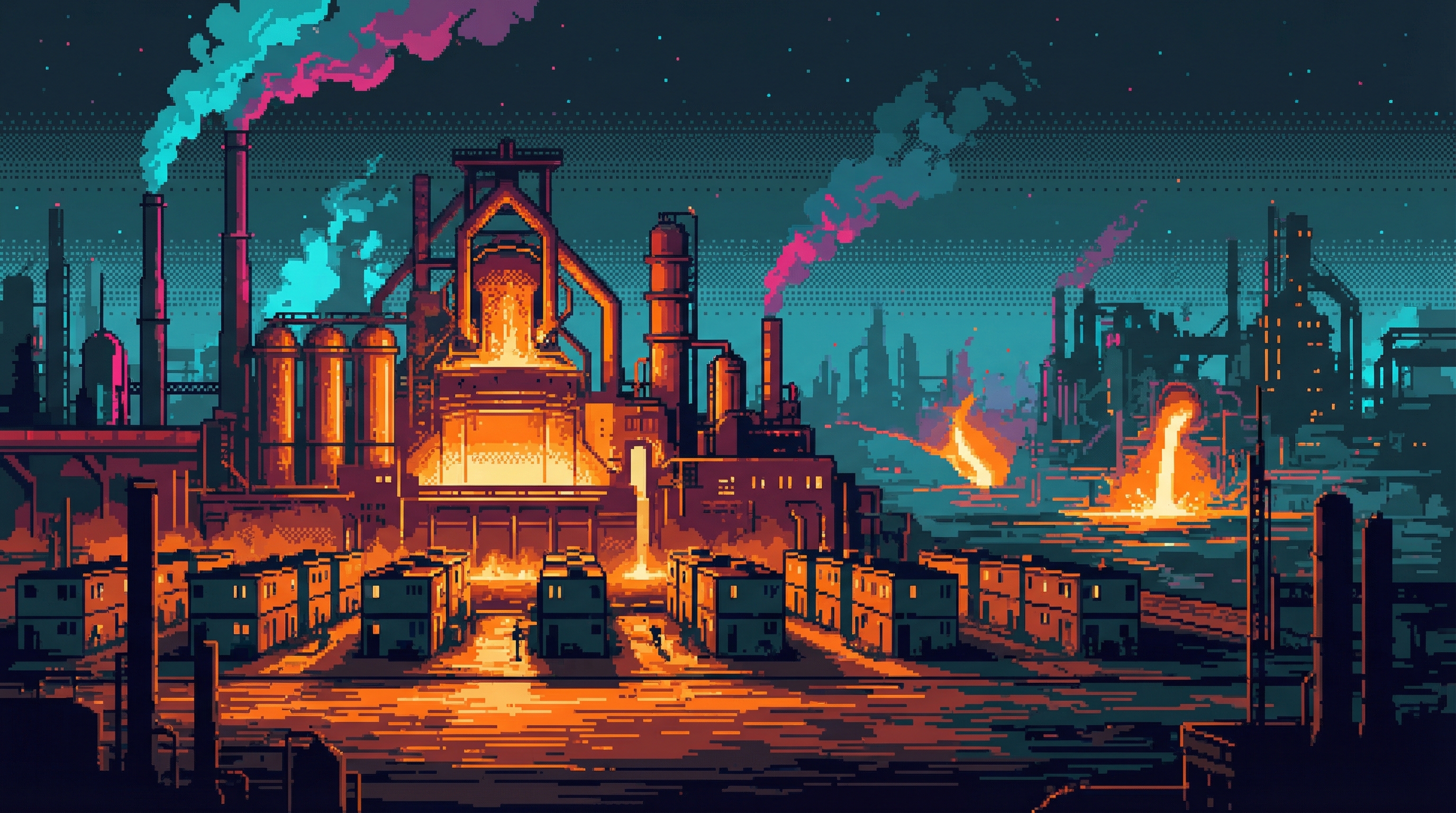
The Foundry
Golden handcuffs forged in steel
Overview
If Ironclad Industries is the Sprawl's muscle, The Foundry is where that muscle lives. Kilometers of factories, refineries, and fabrication plants operating around the clock in the former Great Lakes Industrial Zone. The air is thick with particulates despite filtration. The ground vibrates with machinery. Everything is coated in a fine layer of industrial residue. Thirty-one million people call this home — and home, by Sprawl standards, isn't bad.
That's the trap. Ironclad treats its workers better than most corps — decent wages, functional housing, medical care for industrial accidents. It's not idealism. It's investment. Healthy workers build better. Grateful workers don't revolt. The Foundry runs on a simple calculation: provide just enough comfort that the cost of rebellion always exceeds the cost of compliance.
Workers here are tough, practical, and loyal to whoever pays them. Most have never known another life. They were born in Worker's Row, educated in Ironclad schools, trained in Ironclad apprenticeships, and now they work Ironclad shifts building the infrastructure that keeps the Sprawl running. The housing is dense but well-maintained. The clinics are functional. The food is nutritious if unimaginative. It is, by every measurable metric, a decent life. The question nobody asks — because asking is expensive — is whether "decent" is the same as "free."
The answer, for those who dare to whisper it, is controlled by Viktor Kaine and the management hierarchy that runs Ironclad's operations here. The Foundry produces steel, composites, building materials, and heavy machinery. It also produces loyalty — manufactured as precisely as anything that comes off the production line.
Key Locations
The Crucible
Primary Steel Production Facility — Visible from Orbit During PoursThe beating heart of The Foundry. The Crucible is Ironclad's primary steel production facility — a massive complex of blast furnaces, rolling mills, and processing plants that produces the raw materials holding the Sprawl together. During major pours, the heat bloom is visible from orbit — a brief, brilliant flare of orange against the industrial gray, like a star being born in the rust belt.
Working The Crucible is dangerous and prestigious. The pay is higher, the shifts are shorter, and the medical coverage is comprehensive — because it has to be. Molten steel doesn't forgive mistakes. Workers who survive a decade at The Crucible earn a grudging respect that transcends corporate hierarchy. They've stared into the fire and come back. The ones who didn't are commemorated on a wall in the main processing hall. It gets longer every year.
Worker's Row
Housing Blocks — Dense, Functional, Surprisingly Well-MaintainedHome for 31 million. Worker's Row is a grid of housing blocks stretching between the factory complexes — dense, functional, and surprisingly well-maintained by Sprawl standards. Each block houses several thousand residents in standardized units: sleeping quarters, shared kitchens, communal recreation spaces. The architecture is utilitarian but not cruel. Windows face away from the factories when possible. Green spaces — small, engineered, but real — break up the concrete.
Ironclad maintains Worker's Row because it maintains productivity. A worker with a decent bed, clean water, and a functioning toilet performs 23% better than one without — the company ran the studies. Every amenity in Worker's Row exists because someone calculated its return on investment. The flower boxes outside Building 7 exist because they reduced absenteeism by 1.3%. The community centers exist because organized recreation reduces workplace violence by 8%.
The Union Halls
Sanctioned Labor Organization — Leadership Chosen by IroncladYes, Ironclad allows unions. Tame ones. The Union Halls are where the United Workers' Congress meets to discuss grievances, negotiate contracts, and maintain the illusion of collective bargaining. The leadership is chosen by Ironclad through a process that technically involves elections but practically involves vetting. Candidates who might cause problems don't make it onto the ballot. Those who slip through don't last.
The Union Halls serve a purpose beyond performance. They give workers a place to complain that Ironclad can monitor. Grievances aired in The Union Halls are catalogued, analyzed, and addressed just enough to prevent escalation. The halls themselves are well-appointed — better than most worker facilities — because appearing to respect organized labor is cheaper than dealing with the alternative.
Factions
Ironclad Management
Corporate hierarchy led by Viktor KaineThe management structure that runs The Foundry's day-to-day operations. Led from Ironclad Fortress, management's philosophy is pragmatic paternalism: provide for workers, maintain loyalty, eliminate dissent. Not through violence — that's inefficient — but through the careful calibration of comfort. Every benefit has a price. Every kindness has a calculation. The workers know this. Most of them accept it. The alternative is The Stacks.
The United Workers' Congress
Sanctioned union — corporate-approved leadershipThe official labor organization, authorized and monitored by Ironclad. The Congress negotiates minor improvements — shift length adjustments, safety equipment upgrades, recreational facility expansions — and presents them as victories. Real structural change — profit sharing, worker ownership, environmental remediation — is never on the table. The Congress knows its boundaries. When a representative pushed for transparent air quality data in 2181, she was reassigned to a remote fabrication plant within the week. Nobody pushed again.
The Spark
Underground workers' movement for genuine union powerWhat the Congress won't say, The Spark whispers. An underground labor movement operating in the gaps between shifts, in the noise of the factories, in the blind spots of the surveillance grid. The Spark wants genuine union power — real collective bargaining, transparent contracts, environmental accountability, the right to strike. They're small, careful, and constantly hunted. Ironclad's security division treats them as a higher priority than external threats. An enemy outside the walls is expected. An enemy inside the family is intolerable.
The Salvage Crews
Independent contractors for hazardous workNot everyone in The Foundry works for Ironclad directly. The Salvage Crews are independent contractors who handle the jobs too dangerous, too dirty, or too legally ambiguous for the official workforce. Dismantling contaminated structures. Recovering materials from collapsed facilities. Working in zones where the air filtration failed years ago and nobody repaired it. They're paid well. They don't live long. Ironclad uses them for deniability — when a salvage worker dies of toxic exposure, it's a contractor fatality, not an employee one. Different column in the report.
Dangers
Industrial Accidents
The cost of doing business at scaleKilometers of heavy machinery operating around the clock means accidents are not a matter of if but when. Molten steel spills, structural collapses, pressure vessel failures, crane malfunctions. Ironclad's safety record is better than most — they invest in protective equipment and training because replacement workers cost more than safety gear. But "better than most" still means dozens of fatalities per year and hundreds of injuries. The memorial wall at The Crucible grows by 30 to 40 names annually.
Toxic Exposure
The air that slowly killsThe air in The Foundry is thick with particulates despite filtration. Long-term residents develop respiratory conditions at three times the Sprawl average. Ironclad provides medical care — it's part of the benefits package — but treating symptoms is cheaper than eliminating causes. The filtration systems could be upgraded. The factory emissions could be reduced. But the cost-benefit analysis says otherwise. So the workers breathe, and the clinics stay busy, and the air quality reports remain classified.
The Spark Crackdown
What happens when loyalty fraysIronclad's response to The Spark is methodical and relentless. Security monitors communications, tracks social networks, analyzes behavioral patterns. Workers suspected of Spark involvement don't disappear — that would create martyrs. They get reassigned. Transferred to distant facilities. Given shifts that separate them from their networks. Their families stay in Worker's Row. The worker doesn't come home. It looks like a routine transfer. It feels like exile. The message is clear without a word being spoken.
Automation Threat
The machines that might replace youThe unspoken fear that haunts every worker in The Foundry. Ironclad's investment in human labor is pragmatic, not sentimental. When automation becomes cheaper than wages plus housing plus medical care, the calculation changes. Some production lines have already transitioned. The workers who operated them were "reskilled" — corporate language for "reassigned to whatever's left." The Spark uses automation anxiety to recruit. Ironclad uses it to maintain discipline. Both sides know the machines are coming. The question is when, not if.
Atmosphere
The Foundry is a place experienced through vibration and heat. The factories never stop. The ground never stops humming. The orange glow of The Crucible paints the night sky in colors that have nothing to do with sunset. Living here means learning to feel the rhythm of production in your bones — the shift changes that mark time, the pour cycles that light up Worker's Row windows, the maintenance shutdowns that bring an eerie, unsettling silence.
Visual
The orange glow of The Crucible at 3 AM, turning Worker's Row windows amber. Smoke stacks silhouetted against a sky that's never quite dark. The fine layer of industrial residue that coats every surface — buildings, vehicles, skin. The green spaces of Worker's Row, startlingly vivid against the industrial gray. The memorial wall at The Crucible, names etched in steel.
Sound
The perpetual vibration of machinery transmitted through the ground, through the walls, through the floor of your housing unit. The deep bass thrum of the blast furnaces. The rhythmic clang of the rolling mills. Shift-change sirens that mark the hours more reliably than any clock. And occasionally, the silence of a maintenance shutdown — wrong, hollow, unsettling after years of constant noise.
Texture
The perpetual vibration in the floor that makes your coffee ripple in its cup. The grit of metallic particulates on every surface, between your teeth, under your fingernails. The warmth radiating from factory walls even in the dead of winter. Calloused hands that every worker develops within months — The Foundry marks you before it claims you.
Smell
Hot metal — the sharp, electric scent of steel being born. Machine oil and coolant. The taste of metallic particulates that coat your teeth after a double shift, a flavor you stop noticing after the first year but never stop ingesting. On good days, the cooking smells from Worker's Row kitchens — garlic, grease, comfort food prepared for tired bodies.
Time
Time in The Foundry is measured in shifts, not hours. The morning pour. The afternoon maintenance window. The night shift changeover. The Crucible's glow cycle — brightest during major pours, dim during cooling phases. Workers' bodies sync to the factory rhythm. Holidays are production pauses. Rest days are scheduled maintenance. Even celebration follows the calendar of industry.
Themes
The Golden Cage
What happens when your employer treats you well enough that rebellion feels ungrateful — but still owns every aspect of your existence? In 2026, we debate the "golden handcuffs" of Big Tech — high salaries that make leaving feel impossible. In 2184, Ironclad provides decent wages, functional housing, and medical care — and in exchange, you build until your lungs give out or the machines replace you. The cage is comfortable. It's still a cage.
Calculated Compassion
Every kindness in The Foundry has a spreadsheet behind it. The flower boxes reduce absenteeism. The medical clinics maintain productivity. The Union Halls prevent strikes. Ironclad doesn't care about its workers — it cares about its output, and healthy workers are a means to that end. The question is whether compassion that arises from calculation is less real than compassion that arises from empathy. The workers who benefit from it might argue it doesn't matter.
The Right to Complain
Imagine working a job that pays well, keeps your family housed, and gives you medical care — and knowing that if you complain about the air that's slowly killing you, you'll lose all of it. Not because they'll fire you. Because they'll reassign you to the hazardous detail, and your family stays in Worker's Row while you don't come home. The Foundry asks: what good are rights you can't exercise?