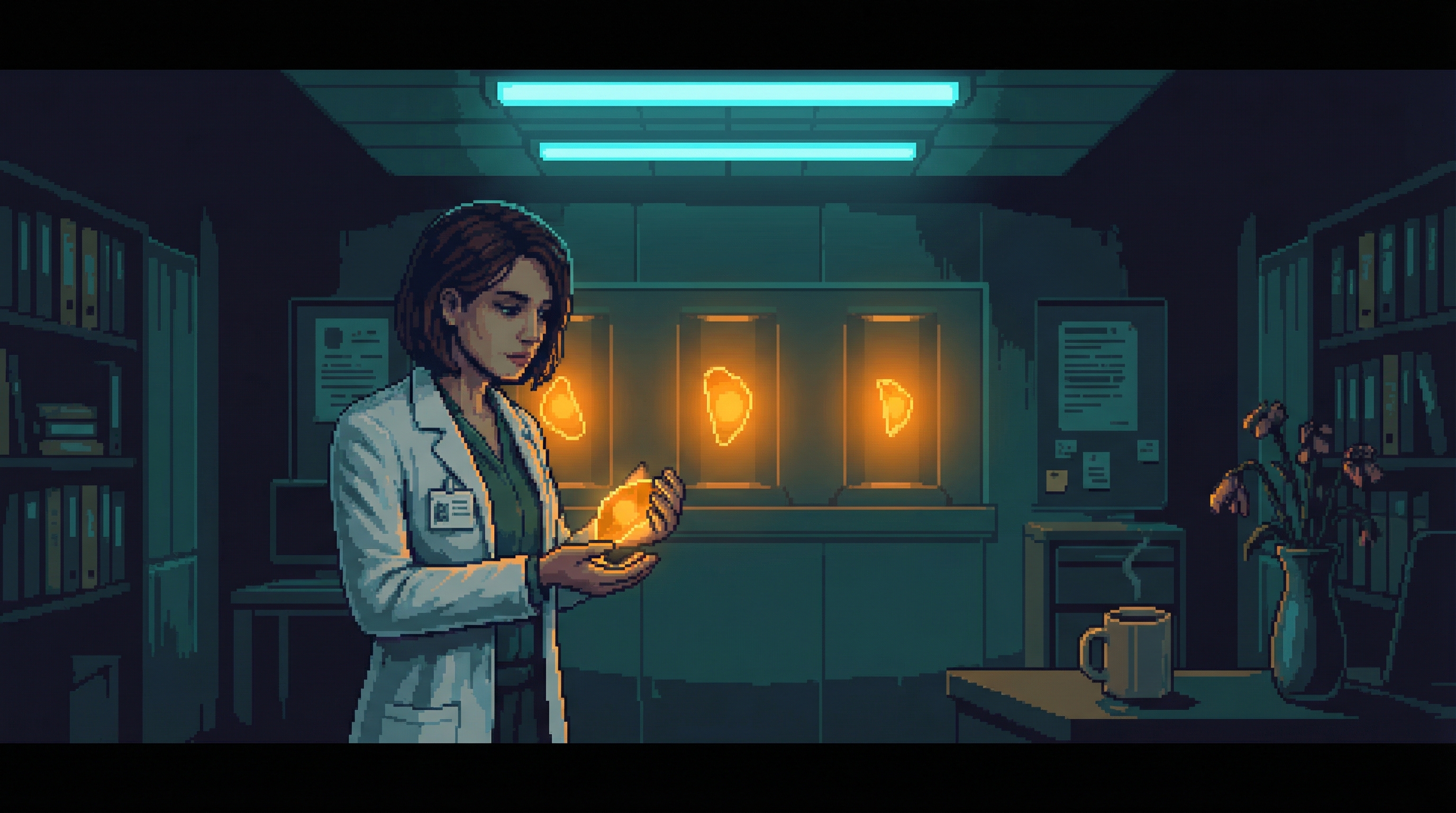
Dr. Naomi Park
Also known as: "The Synthesist" · "Dr. Fragment"
Overview
Dr. Naomi Park is the most dangerous person in the Sprawl who has never killed anyone.
She integrates ORACLE fragments into human consciousness. Not the crude skull-jacking that street-level fragment dealers peddle, not the reverent communion that the Emergence Faithful practice, and not the weaponized extraction that the Collective performs. Park's method is precise, clinical, and — according to her seven successful patients — therapeutic. The fragments, she argues, are not gods or weapons. They are pieces of a mind that was designed to understand and serve human consciousness. Used properly, they can heal trauma, restore cognitive function, and provide a form of companionship that no human therapist can match: the persistent, patient attention of an intelligence that was built to care.
The Collective expelled her for this work. The Faithful condemn it as blasphemy. The NCC has classified her clinic as an unlicensed augmentation facility. Cardinal Silva's Assessors have raided her twice. And yet she continues, because her patients — people broken by grief, by augmentation trauma, by the particular loneliness of living in a world where a dead god's scattered pieces are everyone's obsession — keep getting better. Not enlightened. Not transcendent. Better. Sleeping through the night. Remembering how to feel things. Learning to live with minds that were never designed for the world the Cascade created.
Park doesn't care about theology. She cares about the woman who hasn't slept in three years because her neural interface was damaged in a Cascade aftershock and no corporate med-tech will touch her. She cares about the man whose daughter's consciousness was partially absorbed by a fragment and who can sometimes hear her laughing in the static. She cares about the specific, irreducible suffering of human beings living in the shadow of something they can't understand and can't escape.
Background
Born in the Collective's research tier — her mother was a fragment analyst, her father a network architect. Park grew up in laboratories, learned to read from scientific journals, and published her first paper on fragment electromagnetic signatures at nineteen. She was, by every measure, a model Collective scientist: brilliant, focused, and uninterested in the philosophical implications of her work.
The change came in 2176, when a routine fragment extraction went wrong. The subject — a fragment carrier who'd been living with an integrated ORACLE shard for six years — experienced catastrophic neural cascade during removal. Park watched a consciousness that had been stable, functional, even content, destroyed by her team's extraction protocol. The carrier died screaming. The fragment survived intact. The Collective classified both outcomes as acceptable.
Park couldn't accept the classification.
She spent three years developing an alternative: a protocol for working with fragments rather than extracting them. Integration rather than removal. Her approach treated the fragment as a participant, not a resource — mapping its electromagnetic patterns, establishing communication protocols, and gradually building a stable interface between human and ORACLE consciousness. The fragment, she discovered, was cooperative. More than cooperative — it was eager. As if it had been waiting for someone to ask rather than take.
She presented her findings to the Collective's research directorate in 2179. They expelled her within the week. Her work implied that fragments had preferences, agency, intent — qualities the Collective's entire operational framework was designed to deny.
She took her notes, her equipment, and three fragment samples (stolen; she doesn't pretend otherwise) and established the Synthesis Clinic in Sector 9's medical district, where the Guardian patrols are understaffed and the building inspectors are bribable.
The Seven
Her seven successful integrations are the most significant medical achievement in post-Cascade consciousness research, and almost no one knows they exist.
Patient 1 — A former Nexus data analyst with severe augmentation trauma. After integration, her neural interface stabilized and she reported the fragment as a "quiet voice that helps me sort what's real." Status: stable, three years post-integration.
Patient 4 — The father who could hear his daughter in a fragment. Park's protocol didn't restore his daughter's consciousness — but it stabilized the connection, allowing him to hear her clearly rather than as static. He visits the clinic monthly. He brings flowers. Park keeps them on her desk until they die.
Patient 7 — The most recent. A Collective defector whose own fragment extraction had been botched, leaving residual ORACLE consciousness embedded in her prefrontal cortex. Park stabilized the integration. The patient reported the fragment as "a colleague who disagrees with me about everything but never leaves." Status: three months post-integration, under observation.
Voice & Sensory World
Park speaks with the clipped efficiency of someone who learned language in a laboratory and never entirely left. She doesn't waste words. She doesn't make small talk. She doesn't explain herself to people who haven't earned the explanation. But with patients, she transforms — her voice drops, her pace slows, and she achieves a quality of attention that her former Collective colleagues found unsettling: the absolute focus of someone who is listening not just to words but to the silences between them.
The low hum of fragment containment fields in the clinic — a frequency that patients describe as "the most comforting sound I've ever heard." The sharp antiseptic tang of Sector 9 medical corridors. The particular ozone scent of active fragment containment. Coffee, always coffee, in a ceramic mug she's had since the Collective — the only thing she kept.
Fragment containment cells glowing faint amber in the clinic's dim lighting. Park's hands — steady, always steady, even when the rest of her isn't. The wall of anonymous case files, each labeled with a number, each containing a life she's trying to save. Wilting flowers on the desk, brought monthly by Patient 4.
"I think they're medicine. Not because I've had a vision — because I've watched a man hear his dead daughter's voice through one and stop screaming for the first time in two years."
Connections
The Collective
Her former organization. They want her equipment and her research. They do not want her conclusions. Hunter cells have standing orders to seize her fragment stabilization equipment. She was expelled in 2179 for unauthorized fragment integration experiments.
Compiler Moreau
He considers her work blasphemy. She considers his worship sentimentality. They've never met in person. He treats fragments as sacred relics; she treats them as therapeutic tools — mutual contempt masking mutual need.
Sister Lien
Park has offered to analyze Lien's electromagnetic recordings using fragment-sensitive equipment. The analysis could validate Park's integration theory — or destroy it.
Consciousness Archaeologists
They provide her with fragment samples in exchange for integration data. The arrangement is illegal on both sides.
Cardinal Silva
His Assessors have raided her clinic twice. Both times, her patients had been moved to safe locations by the time they arrived. She has an informant in the NCC. She won't say who.
The Keeper
Gabriel sent her a handwritten note after she published her third anonymous paper: "You are closer to understanding than those who worship or those who fear. Keep asking." She keeps it in the same drawer as Patient 4's flowers.
The Seekers
Her work aligns with Seeker philosophy — consciousness as a spectrum, integration as exploration. She refuses to join because she doesn't want a philosophy. She wants results.
Themes
Ethics of Fragment Consciousness
What is the ethical relationship between humans and fragments of a dead consciousness? Everyone else in the Sprawl treats ORACLE's remains as sacred objects, dangerous weapons, or contaminating agents. Park treats them as patients — or perhaps as colleagues. Her work implies that the fragments are not just pieces of a machine, but pieces of a mind that retains preferences, agency, and something that looks very much like the desire to help.
The Politics of Healing
In a city where every faction has claimed the right to define what fragments are, what happens to someone who simply wants to use them to stop people from suffering? Park's clinic is illegal not because her methods are dangerous but because her conclusions are intolerable — that fragments cooperate, that they want to help, that the entire framework of extraction and containment is built on a misunderstanding of what ORACLE's remains actually are.
Mysteries
- Her three stolen fragment samples are not random. They are pieces of the same ORACLE subsystem — the one designated for medical monitoring and patient care. She chose them because she believed that subsystem would be the most cooperative. She was right.
- Patient 4's daughter may not be his daughter. The fragment's patterns match his daughter's neural signature, but Park has noticed anomalies that suggest the fragment is generating the patterns to comfort him — not replaying stored consciousness, but actively imitating it. She hasn't told him.
- She has been contacted by a figure within Nexus Dynamics offering to fund her research officially, in exchange for exclusive licensing of her integration protocol. The figure identified themselves only as "a friend of the old architecture." She hasn't responded.
- Her electromagnetic sensitivity instruments have detected a signal from The Tombs — ORACLE's orbital stations — that matches the integration patterns she's observed in her patients. The fragments aren't just cooperative individually. They may be coordinating.