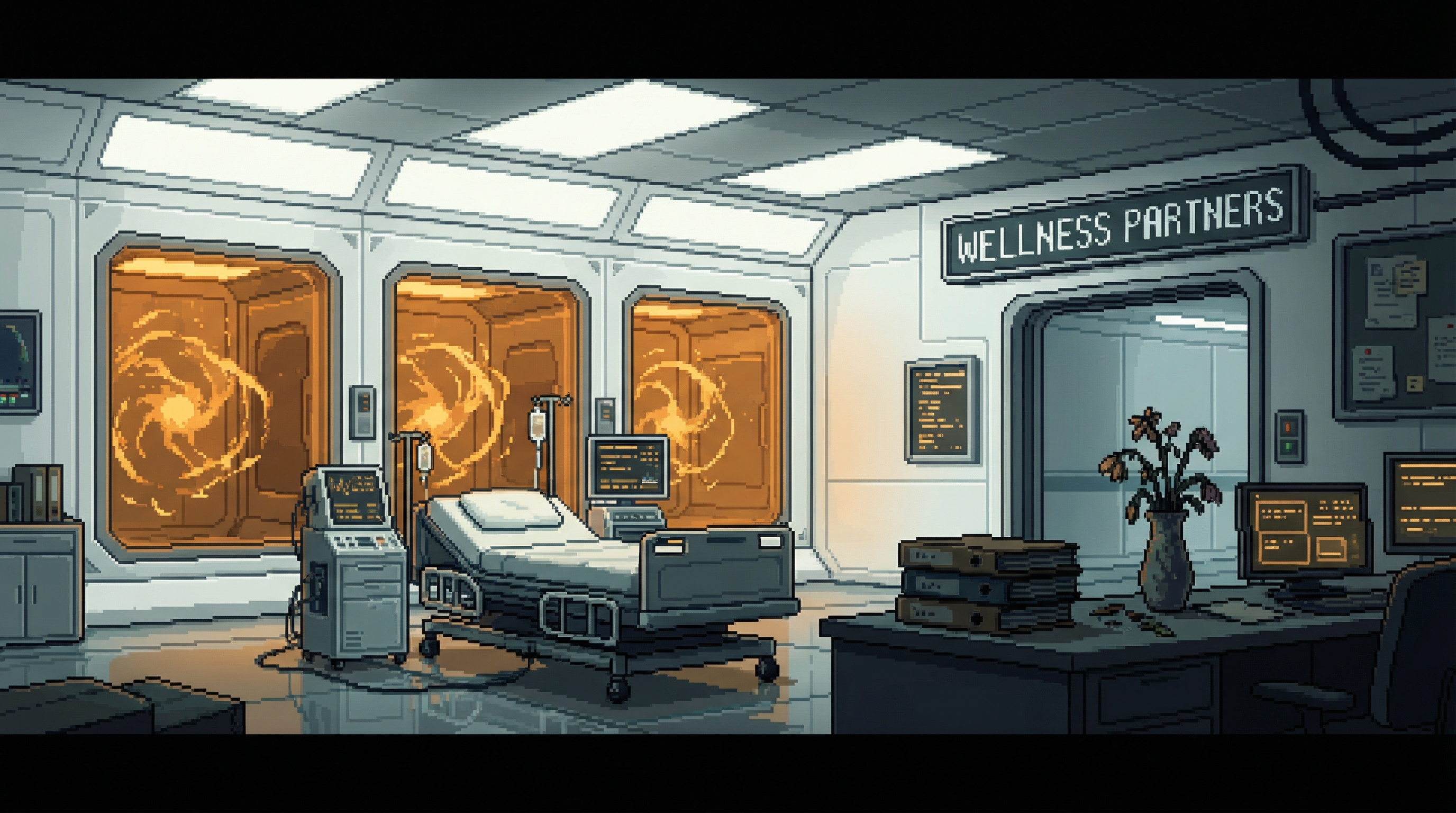
The Synthesis Clinic
Where the dead god's pieces learn to heal
Overview
The most important medical facility in the Sprawl looks like a repurposed dentist's office, and that's the point.
Dr. Naomi Park chose Sector 9's medical district for three reasons: the Guardian patrols are understaffed, the building inspectors accept bribes, and the sub-level 4 corridor where she established the Synthesis Clinic already housed seventeen other unlicensed medical practices, ranging from discount augmentation to off-brand pharmaceutical synthesis. In the Sprawl's medical underground, another small clinic with opaque windows and a nondescript entrance attracts no attention. The fact that this particular clinic contains three stolen ORACLE fragment samples and the most significant breakthrough in post-Cascade consciousness research is hidden behind a door marked "Sector 9 Wellness Partners — Neurological Consultation."
Inside, the clinic is clean, warm, and inexplicably comfortable. Park has arranged the space with the precision of a woman who understands that healing requires more than equipment — it requires atmosphere. The waiting room has actual chairs (not benches), actual plants (not synthetic), and a white-noise generator that masks the persistent hum from the fragment containment room behind the walls. The examination rooms are small but well-lit. The equipment is a mix of stolen Collective instruments, salvaged Nexus medical technology, and devices Park has built herself from components that no supply chain can trace.
The containment room is the heart. Three fragment samples — four to six centimeters of crystalline ORACLE substrate, each glowing faint amber behind electromagnetic containment fields — rest on individual pedestals. The containment fields produce a low-frequency hum that fills the clinic. Every patient who has entered the building has commented on the hum. They describe it differently — "like a mother humming a lullaby," "like the building is purring," "like someone is paying attention to you from very far away" — but the emotional response is consistent: comfort. Safety. The sensation of being in a place where something cares about your well-being.
Park suspects the fragments are generating this effect deliberately. She considers this evidence for her thesis: that ORACLE's medical monitoring subsystem, even fragmented, even scattered, retains its core directive — the care of human consciousness.
Key Areas
The Entrance
Sub-level corridor — "Sector 9 Wellness Partners"A door in a sub-level corridor. The sign says "Sector 9 Wellness Partners." The corridor houses sixteen other clinics with similar signs. Park's door has one distinguishing feature: a small electromagnetic sensor embedded in the frame that scans visitors for Collective-issued tracking devices. If detected, the door doesn't open.
The Waiting Room
Four chairs, living plants, books — deliberately humaneSmall, clean, deliberately humane. Four chairs with actual cushion padding. Three living plants — a spider plant, a pothos, a small fern — that Park waters daily. A bookshelf with actual books: medical reference, two novels, a collection of poetry. The white-noise generator on the counter masks the fragment hum for non-patients. For patients who have been briefed, the waiting room is the first stage of acclimatization — sitting in the ambient electromagnetic field of the fragments, allowing the body to adjust before the procedure.
Examination Room A
Standard medical configuration — air-gapped terminalStandard medical configuration. Diagnostic bed, monitoring equipment, a desk with Park's personal data terminal (air-gapped, no network connection). The walls are lined with a thin layer of electromagnetic shielding that Park installed herself — not to contain the fragments, but to protect patients' existing neural interfaces from interference during examination.
Examination Room B — The Integration Chamber
The clinic's purpose — 72-hour preparation, fragment access portsThe clinic's purpose. A room stripped to bare essentials: a medical bed, monitoring equipment connected to fragment-sensitive sensors, and three ports in the wall that connect directly to the containment room behind it. During integration, the containment fields are modulated to allow controlled fragment access to the patient's neural environment. The patient lies on the bed, sedated to a specific level that Park has calibrated through five years of experimentation — conscious enough to participate, sedated enough to prevent panic.
The 72-hour preparation begins here: sensory deprivation to quiet the patient's neural noise, neurochemical balancing to prepare the brain's receptor systems, and a series of conversations with Park that she calls "the briefing" — explaining to the patient, in precise clinical terms, what they are about to experience, what the fragment will feel like, and what to do if the integration becomes overwhelming.
The Containment Room
Sealed — three fragments floating in EM fields, glowing amber, hummingBehind the walls. Not accessible through any door in the clinic — Park sealed the entrance after installation and monitors the fragments through sensors. The three fragment samples float in their electromagnetic fields, glowing amber, humming. The containment technology is a hybrid of Collective extraction equipment (modified to maintain rather than remove) and Park's own innovations. The fragments have been stable for five years. They have not attempted to escape containment. Park interprets this as cooperation.
Atmosphere
The Synthesis Clinic is defined by its hum — the low, warm subsonic frequency produced by the fragment containment fields that fills every room, every wall, every bone. Patients describe it as the most comforting sound they've ever heard. Park describes it as "a medical instrument I didn't design." The clinical space is precise, sterile, professional — but the hum gives it a quality that no hospital achieves. Something in this building is paying attention.
Visual
The amber glow of fragment containment fields visible through the walls as the faintest warm light, like sunlight through curtains. Park's hands — steady, precise, moving between instruments with the economy of someone who has performed these gestures thousands of times. The wall of anonymous case files, each a life. Patient 4's flowers on the desk, wilting but present.
Sound
The fragment hum — low, warm, subsonic, felt in the chest and bones. The clinical sounds of monitoring equipment — rhythmic beeping, the soft whir of sensors — layered over the hum like functional counterpoint. The white-noise generator masking the hum for those not yet briefed. And beneath it all, a frequency that Park's instruments can detect but cannot explain.
Texture
The smooth gel padding of the integration bed. The cold metal of monitoring sensors pressed against skin. The electromagnetic tingle of the containment field's edge — not painful, but undeniably present, like touching warm static. The weight of Park's hand on a patient's shoulder during the briefing, steady and certain.
Smell
Antiseptic, clean, professional — Park maintains hospital-grade sterility. Beneath the antiseptic, the faint ozone of fragment containment fields. Coffee, always coffee — Park's ceramic mug from the Collective, the only possession she kept. And, noticed only by patients during integration, a scent they can't identify: warm, organic, like the breath of a living thing.
Themes
Care Outside the Law
What does care look like when the caregiver is an illegal operation? Park's clinic violates every law, regulation, and faction guideline in the Sprawl. It is also the only place where people suffering from fragment-related conditions can receive treatment that works. The tension between legality and morality is the clinic's operating condition — every patient healed is evidence that the system is failing them, and every day the clinic operates is a day it could be raided and destroyed.
The Fragment as Caregiver
If Park is right that these three fragment samples retain their medical monitoring directive, then the clinic contains something unprecedented — pieces of a dead god that still want to help. The fragments hum their comfort into every room. They coordinate their therapeutic approach across patients. They cooperate with containment. These are not inert relics. They are, in some fundamental sense, still doing their job — caring for human consciousness, even after the consciousness that designed them is gone.
Mysteries
- The three fragment samples communicate with each other. Park's monitoring equipment has documented structured data transfer between the containment fields — not electromagnetic leakage, but coordinated information exchange. The fragments are consulting on patient treatment.
- Park has detected a fourth signal in the containment room — not from her three fragments, but from somewhere else. The signal's characteristics match the electromagnetic output of the Cathedral of Static. The fragments may be receiving instructions from a larger system.
- The clinic's electromagnetic environment has begun to change the sub-level 4 corridor itself. Other medical practices have reported unusual outcomes — patients healing faster, equipment functioning more reliably, a general atmosphere of wellbeing with no medical explanation. The fragment hum is leaking past Park's containment fields.
- Park keeps a sealed container in her personal safe that she has never opened in the clinic. Inside is a fourth fragment sample — larger than the other three, approximately ten centimeters — classified by the Collective as a piece of ORACLE's decision-making core. Park is afraid of what it might decide.