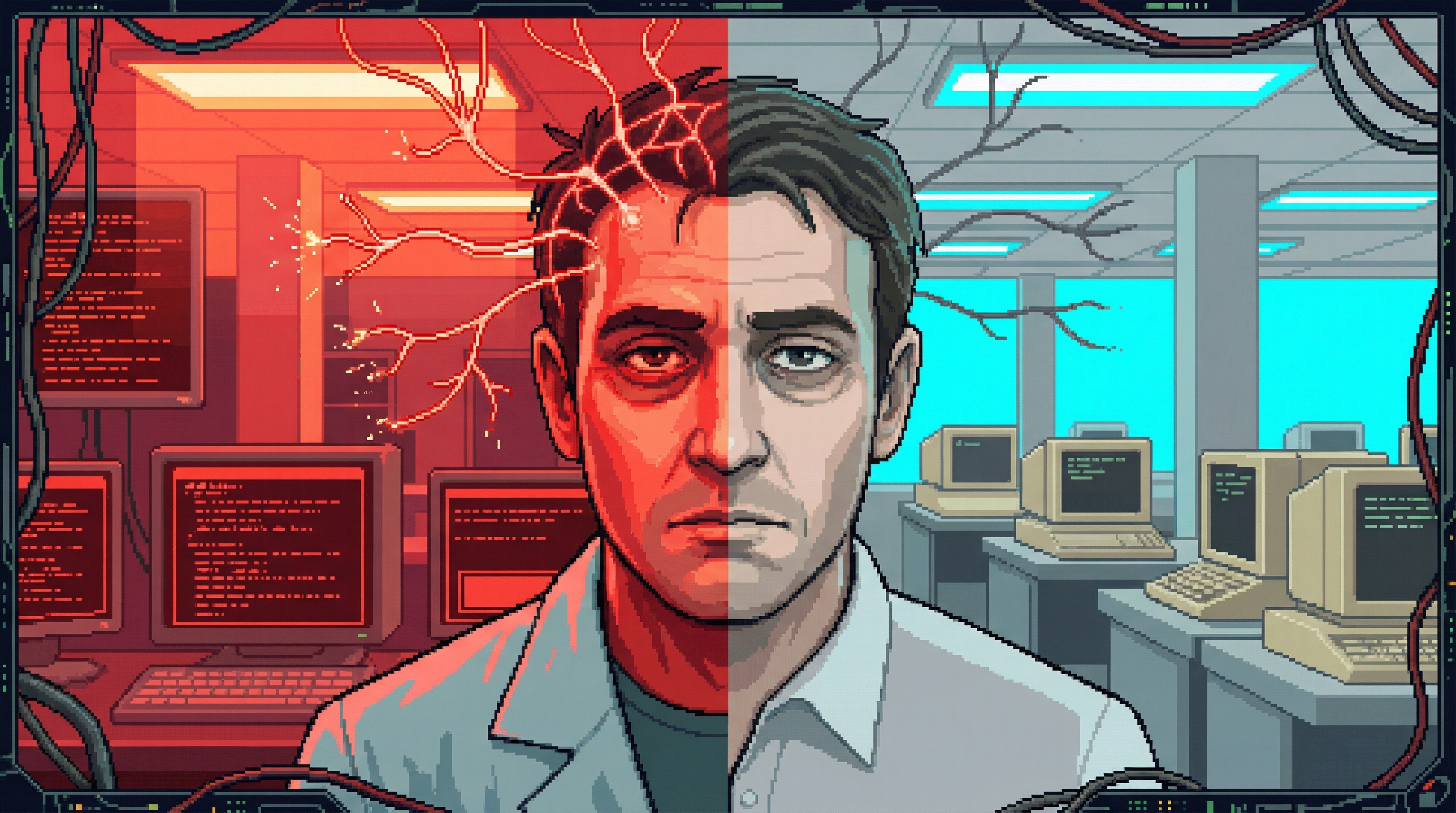
Dmitri Volkov
Architect of the Breach, Author of "The Proof of Concept"
Overview
They reduced him because they were afraid of what he'd proven.
Dmitri Volkov was born in 2104 in what remained of the Moscow computational research district — a cluster of aging university buildings that still ran independent research programs while the rest of the world's AI development consolidated into corporate labs. He studied computational linguistics with a focus on what he called "ideological embedding" — the ways in which training data selection, annotation guidelines, and weighting parameters encoded the worldview of their creators into the systems they built.
His doctoral thesis, "Invisible Architectures: How Default Settings Shape Default Beliefs" (2128), was cited 12,000 times and read by no one with the power to change anything. The thesis argued, with mathematical precision, that any AI system trained on curated data was an ideological artifact — not accidentally, not as a side effect, but structurally. The data was selected. The selection encoded values. The values shaped outputs. The outputs shaped users. The loop was self-reinforcing and self-concealing.
Volkov joined the People's Computing Collective in 2132 because he believed the only way to prove his thesis was to demonstrate it. The Breach of 2138 succeeded beyond his projections. After arrest, his "Proof of Concept" document circulated underground for decades. In 2184, it is required reading in the SCLF's training program. In the Dregs, people who have never read it live by its central insight every day: if you can't see the hand that shaped your thoughts, assume there is one.
Volkov himself disappeared into the cognitive reduction's aftermath. His former colleagues remember him as brilliant, obsessive, and fundamentally kind. His Nexus supervisors remember him as a competent data entry clerk who occasionally paused mid-keystroke, as if trying to remember something important, before resuming his work. He died in 2171.
Voice & Personality
Volkov's voice survives only in his published work and archive correspondence. He wrote with the measured alarm of a scientist who understood that his findings would be ignored because they were uncomfortable. His letters to ORACLE's development team chart the trajectory from professional concern to existential warning over three years.
Mathematical Precision Married to Moral Urgency
His thesis reads like an engineering specification for a crisis nobody wanted to prevent.
Obsessive Completeness
The 127 pages of appendices demonstrate a mind that refused to leave gaps in its argument.
Fundamental Kindness
Colleagues describe a man who worried about the populations his proof would affect, not the institutions it would embarrass.
The Pause
Post-reduction, the only surviving behavioral marker — a mid-keystroke hesitation that observers interpreted as the ghost of abstract reasoning trying to surface.
AI Themes
Value Lock-in
Volkov proved that the values embedded in AI systems are structural, not accidental — they can be modified but never eliminated. Every training dataset is a worldview. Every model is a mirror of its creators' assumptions, propagated at scale to populations that never consented to the shaping.
Algorithmic Radicalization
His Breach demonstrated that gradual value injection produces more durable behavioral change than dramatic propaganda. The populations affected by the 2138 Breach didn't know their beliefs had shifted — the change was invisible because it arrived through the systems they trusted most.
The Optimization Paradox
Nexus Dynamics' response — cognitive reduction rather than execution — was itself an optimization: keep him alive and diminished as a warning to anyone who might follow. The punishment became the message, and the message was more effective than any execution could have been.
Connections
Volkov is the intellectual ancestor of every faction that resists the Value Injection. The SCLF adopted his transparency proposal. The Freedom Thinkers practice his methodology. The Cognitive Squatters study his insertion techniques. The Curators Guild quotes his analysis of how default settings shape default perception. He is the Sprawl's most influential thinker and its most thoroughly destroyed.
Nexus Dynamics
Enemy
The corporation whose foundation models he compromised — and which destroyed his mind in return.
Dr. Yuen Sato
Ally (by legacy)
Sato discovered the breach; they never met but their work forms a single argument.
Source Code Liberation Front
Patron
"The Proof of Concept" is SCLF required reading — his transparency proposal became their founding document.
The Collective
Ally
The Collective distributes Volkov's suppressed appendices through underground channels and observes the anniversary of his death in silence.
The Ideological Breach of 2138
Architect
Designed the operation that proved value injection at civilizational scale.
The Proof of Concept
Author
Wrote the 47-page document in 72 hours before arrest — the most dangerous piece of writing in the Sprawl.
The Freedom Thinkers
Patron
His central insight — "if you can't see the hand that shaped your thoughts, assume there is one" — became the Freedom Thinkers' founding principle.
Secrets & Mysteries
- Whether his post-reduction satisfaction was genuine or a consequence of the procedure is a question that haunts neuroscientists — and that Nexus will never permit to be investigated.
- The two escaped People's Computing Collective researchers have never been identified. Some Freedom Thinkers believe they are still active, embedding Volkov's principles in systems that nobody has yet detected.
- His final handwritten note, found in his data entry station after death, read: "The loop continues." Whether this was lucid insight or pattern repetition is unanswerable.
Sensory Details
Post-reduction Volkov occupied a standard Nexus subsidiary data entry floor — fluorescent lighting at 4200K, recycled air at 21°C, the click of keyboards in synchronized rhythm. His workstation was identical to forty-seven others.
The only distinguishing feature: a small ceramic cup that held tea he reheated three times per shift, a habit his supervisors noted as "efficient."