The Privacy Gradient
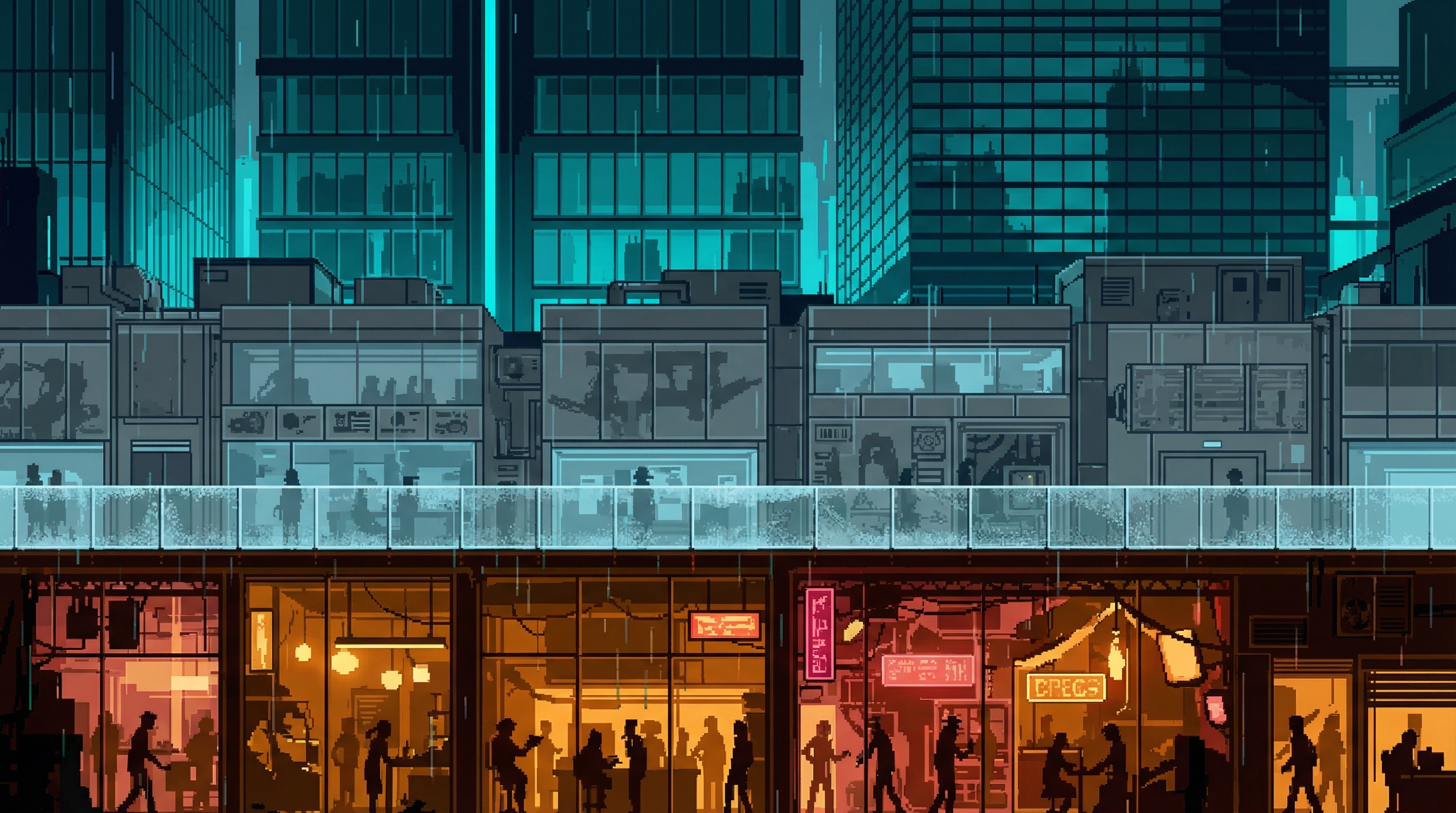
Privacy in the Sprawl is not binary. It is a gradient — a spectrum running from total sovereignty to total visibility, with every point on the scale carrying specific economic, social, and psychological costs. At one end: Executive-tier citizens who can afford privacy-grade electromagnetic shielding, personal data scrubbing services, and the legal team necessary to enforce data deletion rights. They are surveilled only by systems they own. At the other end: Basic-tier residents whose every thought passing through their interface is captured, analyzed, and sold. Their behavioral models are commodity products traded on the Attention Auction.
"Your Exposure Index is readable in your behavior within seconds. The way you move through a door, the way content arrives on your feed, the way a room adjusts to your presence — or doesn't."
— Sprawl social dynamics field report Technical Brief
Five tiers define the lived experience of surveillance in the Sprawl. Each tier carries its own economics, its own social markers, and its own ceiling on what kind of life is possible within it.
Executive Privacy
Full data sovereignty. Personal interference shielding. Behavioral model is proprietary and self-owned. The walls around these people are not metaphorical — electromagnetic countermeasures, legal enforcement teams, and data scrubbing services create a physical and digital cocoon. Annual cost: ¢400,000–2,000,000. Population: ~2 million.
Professional Opacity
Partial data control. Corporate-grade interface with negotiated telemetry limits. The "privacy clause" in employment contracts is the most negotiated section after compensation — every percentage point of data retention is fought over by legal teams on both sides. Population: ~60 million.
Standard Transparency
Full telemetry. Behavioral model owned by Nexus, licensed to partners. No negotiation possible. This is the default condition for most of the Sprawl's population — a permanent, uninterrupted feed of data flowing from your interface to systems you will never see and cannot influence. Population: ~200 million.
Deepened Monitoring
Enhanced telemetry installed as a condition of debt service, parole, or corporate programs. Cognitive lien holders — 4.2 million of them — operate here. Their best thoughts are diverted to creditors before reaching conscious awareness. The system does not merely watch you. It skims from you.
Total Visibility
Every neural event captured. Reserved for prisoners, consciousness-research subjects, and the most deeply indebted. At this tier, the distinction between your thoughts and their data about your thoughts effectively disappears.
The Double Bind
The system punishes privacy-seeking twice. Once to buy it — the infrastructure costs are staggering. Once in lost earning potential — reducing your visibility reduces your economic opportunity. Algorithms that distribute work, credit, and housing all favor high-telemetry profiles because they carry lower risk assessments. Seeking privacy is, in the language of the system, suspicious behavior.
The Numbers
Three statistics define the Gradient. Together, they describe a system that knows exactly what it does to people and has decided the returns are worth it.
The Exposure Index correlates with life satisfaction at 0.87. Three independent studies have replicated this finding. Nexus has published none of them.
More private people are harder to predict and retain. Nexus's retention algorithms treat privacy-seeking as a flight risk indicator — making the desire for privacy literally suspicious.
The average Dregs resident carries an Exposure Index of 55–70. The average Executive scores 5–15. The gap is visible in how doors open, how content arrives, how the world treats your presence.
What It Feels Like
The Gradient is felt before it is understood. Walking from Nexus Central (Index 5–15) to Sector 7G (Index 55–70) produces a specific sensory shift.
Corporate District
Frictionless convenience. Doors open before you approach. Content anticipates your preferences. The system knows your name, your schedule, your caloric intake. The air itself feels curated — temperature, humidity, scent, all calibrated to your biometric profile. Lighting: even, shadowless, clean.
The Transition
A few blocks of increasing friction. Doors hesitate. Content arrives slightly mistimed. Ambient personalization degrades from precise to approximate to generic. You feel the system losing interest in you.
The Dregs
Rough reality. Doors require physical contact. Content arrives as untargeted noise. The system that knew your name treats you as a stranger. Lighting: warm, irregular, unpredictable. The sensation is simultaneously liberating and terrifying.
Implications
The Gradient does not merely sort people by visibility. It compounds every other axis of inequality in the Sprawl, creating feedback loops that harden with each generation.
Privacy as Class Marker
When surveillance is a gradient, your visibility is a class marker as readable as your augmentation tier. How a door responds to your approach tells everyone in the room exactly where you stand. The Glass District makes this architectural — opaque cubes for the rich, transparent boxes for the poor.
Compounding Divides
The Gradient adds a privacy dimension to every other gap in the Sprawl. Cognitive gap, economic gap, and visibility gap compound. Consciousness licensing tiers and privacy tiers create overlapping hierarchies — your thinking capacity and your visibility are both products priced on a scale.
Correlation Without Causation
More private people are happier. But privacy correlates with wealth, which also correlates with happiness. The causal arrow is debated endlessly in academic journals and Dregs bars alike. The experience, however, is not debated at all.
Related Systems
The Gradient intersects every structure in the Sprawl that sorts people into categories. These are the systems where the intersection is sharpest.
The Exposure Index
The Gradient's measurement tool. A single number that quantifies your visibility, tradeable and manipulable in theory, immovable in practice for anyone below Professional Opacity.
Consciousness Licensing
A parallel hierarchy. Your thinking capacity and your visibility are both products priced on a scale. The overlap is not coincidental — the same infrastructure serves both markets.
The Glass District
The Gradient made physical. Transparent apartments for the poor, opaque cubes for the rich. Architecture as surveillance manifest.
The Opacity Movement
Advocates flattening the Gradient through data sovereignty. They have made the Exposure Index a social signifier in the Dregs — wearing your number as defiance rather than shame.
The Attention Auction
Where Standard Transparency and below become commodity. Behavioral models generated from high-telemetry profiles are traded here in real time. Your data, someone else's asset.
▲ Classified
The 0.87 satisfaction correlation has been replicated by three independent studies. Nexus has not published any of them. The implication — that the surveillance infrastructure Nexus profits from is directly correlated with human misery — is considered a strategic liability.
The inverse Loyalty Coefficient correlation means Nexus's own retention algorithms treat privacy-seeking as a flight risk indicator. The system that profits from watching you has formalized the suspicion that wanting to be unwatched is itself evidence of disloyalty. Privacy is not merely expensive. It is, in the eyes of the algorithm, a confession.
"The gradient creates a class structure as rigid as any in the Sprawl's history. The most telling metric: people with more privacy are happier. The correlation inverts with loyalty — more private people are harder for corporations to predict and retain. The system creates a double bind: reducing your visibility reduces your economic opportunity. Privacy costs you twice — once to buy it, once in everything it takes away."