The Glass District
Where the walls remember everything and hide nothing
There is a neighborhood in Nexus Central where the walls are transparent.
Not metaphorically. The Glass District occupies twelve blocks of mid-tier corporate residential space. Every wall, floor, and ceiling is constructed from switchable smart glass that defaults to transparent. Residents can opaque their surfaces — for ¢0.40 per hour, billed to their consciousness licensing account.
When Nexus Dynamics opened the District in 2175, the marketing called it "radical openness" — a prestige address for people who had nothing to hide. A community built on trust, made literal in glass. The brochures showed sunlit interiors, neighbors waving across transparent corridors, children playing in visible apartments where the whole block could keep watch.
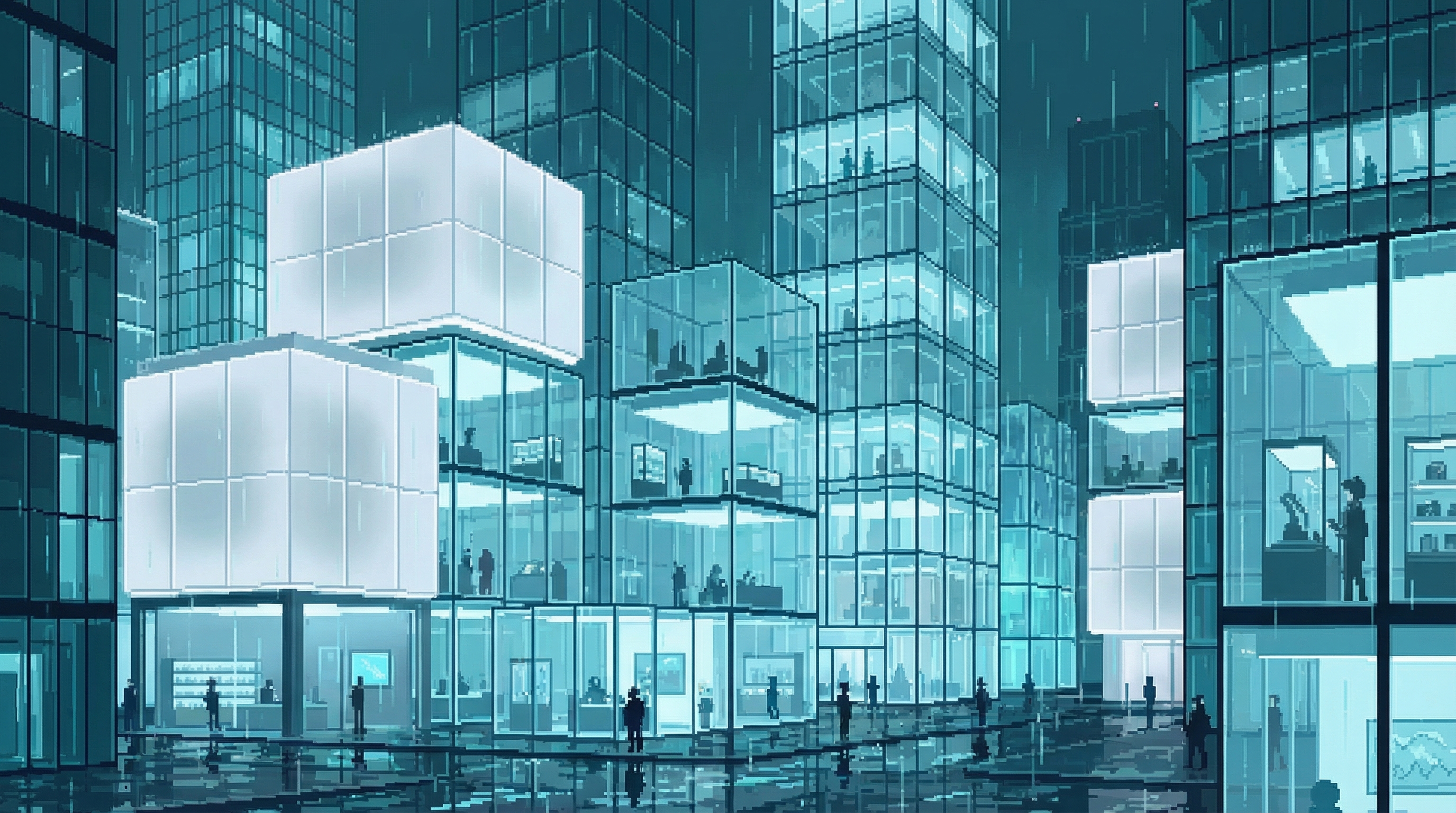
What happened was simpler. The District became the Sprawl's most precise expression of privacy-as-class. Wealthy residents maintain permanent opacity — their apartments are frosted white cubes, the hourly charge invisible against their income. Basic-tier residents cannot afford it. They live in glass boxes. Their neighbors can see them eat, sleep, argue, grieve, make love. The transparency marketed as community became surveillance without cameras.
Conditions Report
You enter the District from the east transit corridor and the first thing you notice is the silence. The second thing is that you can see into forty apartments at once.
Sight
The defining visual: opaque white cubes alternating with transparent apartments, lives visible through glass at every angle. Corporate blue-white lighting leaves no shadows. At night, every lit apartment is a display case. The contrast between warm-opaque and cool-transparent is the District's visual signature — you can read wealth in the frost of the walls.
Sound
Near-silent. The glass absorbs sound with engineered efficiency, creating acoustic isolation within visual exposure. You can watch your neighbor argue with their partner in vivid, theatrical detail — gestures, tears, thrown objects — and hear absolutely nothing. Too much information about strangers' lives, delivered in perfect silence.
Smell
Nexus-standard filtered air — no organic scents, no evidence of human habitation. Inside transparent apartments, cooking smells are visible (steam on glass) before they are detected. The District smells of nothing. The lives behind the glass produce evidence you can see but not inhale.
Touch
Glass surfaces at precisely 22°C. The specific sensation of touching a wall and knowing someone on the other side can see your hand. Everything is smooth, calibrated, thermally uniform. The walls do not feel like walls. They feel like screens that forgot to turn off.
Temperature
Corporate standard 22°C, maintained uniformly. No thermal privacy — infrared signatures visible through the glass. The District has no shadows because the walls let light through. Nowhere to be warm that isn't also visible.
"The Glass District is the only place in the Sprawl where you can determine someone's income bracket by looking at their walls." — Housing assessment, Nexus Central residential survey
Points of Interest
The Opacity Gradient
Walk the District from east to west and you can read the income distribution in the walls. East blocks: almost entirely transparent, Basic-tier residents stacked in glass. Central blocks: mixed, some frosted panels where residents have negotiated partial opacity through overtime or side contracts. West blocks: solid white cubes, permanent opacity, the hourly charge running continuously and invisibly. The gradient is not designed. It emerged from the economics of ¢0.40/hour.
The Bathroom Exception
One room in every apartment has permanently opaque walls: the bathroom. Nexus included this as a regulatory concession during construction permitting. For many Basic-tier residents, the bathroom is the only private space they occupy. Some residents eat in their bathrooms. Some have moved their sleeping arrangements there. The bathroom was designed for hygiene. It has become the last room where you can close your eyes without being watched.
The Non-Acknowledgment Protocol
Residents have developed an unwritten social contract: you do not acknowledge what you see through the glass. You do not mention your neighbor's argument. You do not comment on their meals, their grief, their intimacy. The protocol is never discussed and universally maintained. Violating it is the fastest way to become a social pariah in the District. This is what adaptation looks like — people learning to unsee what they cannot stop seeing.
The Opacity Movement Pilgrimage
The Opacity Movement brings visitors to the Glass District the way you might bring someone to a memorial. This is what the Transparency Bargain looks like when you build it out of glass and light. Visitors stand in the east blocks and look up at twelve stories of transparent lives and frosted cubes, and they understand the privacy gradient in a way no pamphlet could communicate. The District is the Movement's most effective recruiting tool, and Nexus built it.
Strategic Assessment
The Architecture of Class
Every building in the Sprawl sorts people by income. The Glass District is unusual only in its honesty. Elsewhere, the sorting is hidden behind identical facades, buried in access tiers and licensing brackets. Here, the sorting is the facade. You can stand on the street and count the opaque apartments. Each one is a resident who can afford ¢3,504 per year for privacy — 146% of Basic-tier consciousness licensing. Each transparent apartment is a resident who cannot. The District does not hide its function. That is what makes it disturbing.
Surveillance Without Cameras
No surveillance system operates in the Glass District. None is needed. The architecture itself performs the function — every transparent wall is a window, every neighbor a potential observer, every lit room a broadcast. Nexus does not record what happens inside the apartments. They do not have to. 4,200 residents watch each other continuously, for free, as a side effect of living in glass. The most efficient surveillance system in Nexus Central has no sensors, no data centers, no staff. It is made of walls.
The Adaptation Cost
Residents who cannot afford opacity adapt. They learn to cry silently. They change clothes in the bathroom. They develop facial control that masks emotion during moments they know are visible. They eat facing the opaque wall. They build relationships around mutual non-acknowledgment of everything both parties can see. The adaptation is complete and invisible. It is also, by any clinical standard, a sustained psychological distortion — humans reshaping their behavior to accommodate architecture that was supposed to be a prestige address.
▲ Restricted Access
Tomoko Adeyemi-Park
A resident named Tomoko Adeyemi-Park has lived in a transparent apartment for six years. She has adapted by learning to cry silently and change clothes in the bathroom — the one room with permanently opaque walls. She and her across-the-corridor neighbor maintain a relationship built entirely on mutual non-acknowledgment of everything they see. Neither has ever spoken to the other. Both know the other's daily routine in complete detail. Whether this constitutes intimacy or surveillance depends on who you ask.
The Turnover Numbers
Resident turnover in the Glass District runs 340% higher than adjacent opaque-wall districts. Nexus does not publish this figure. In marketing materials, the District is described as "a vibrant community with dynamic resident engagement." The word "turnover" does not appear. The 340% figure was obtained from internal facilities data by sources who understood what it meant: people leave the Glass District as fast as they can afford to. The ones who stay are the ones who cannot afford to leave.
September 3, 2183
On September 3, 2183, behavioral models for all 4,200 Glass District residents were published on the same transparent surfaces that already exposed their daily lives. Every resident saw their value assessment — their predicted behaviors, their consumer profiles, their likelihood scores — displayed on the walls of their own apartments. For forty-seven minutes before Nexus scrubbed the data, the Glass District showed its residents not just to each other but to themselves, as the system understood them. What happened in those forty-seven minutes has not been fully documented. The turnover rate spiked. Some residents who could afford opacity stopped paying for it afterward. The reasons are not recorded.
The Parallel
Intelligence analysts have noted the structural similarity between the Glass District and the Performance Temple. Both are corporate spaces where architecture makes ideology physical — one makes productivity sacred, the other makes transparency normal. Both were designed to produce a specific behavior through environmental pressure. Both succeeded. The question that keeps surfacing in assessments: if the Sprawl's most effective instruments of control are buildings, what does that say about the residents, and what does it say about the architects?