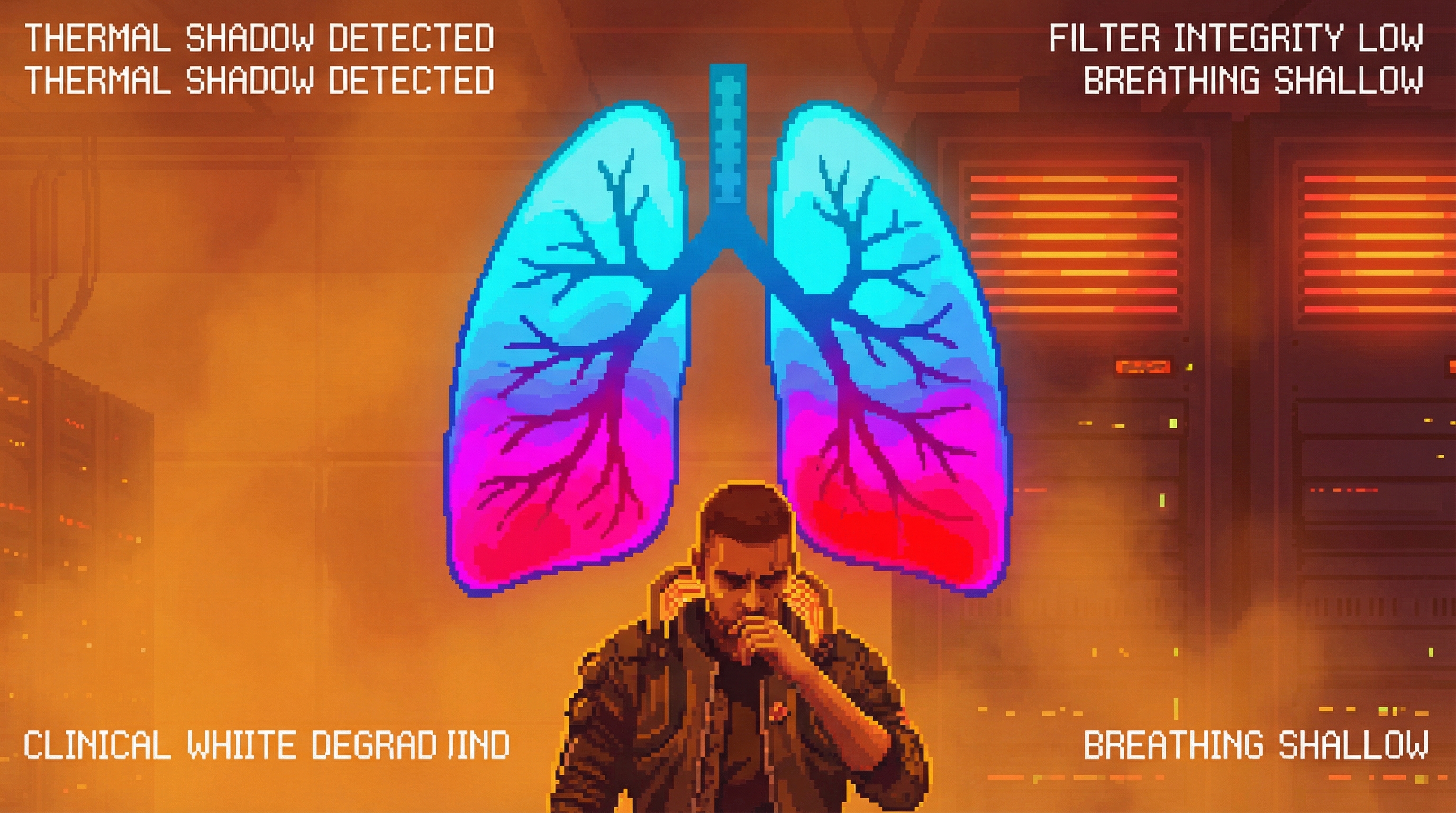
The Heat Tax: The Cost of Someone Else's Exhaust
Nobody levies the Heat Tax. Nobody collects it. Nobody files a return. It is the colloquial name for the cumulative cost of living in the Thermal Shadow — the medical expenses, equipment degradation, productivity loss, and quality-of-life reduction that thermal proximity to data processing infrastructure imposes on residents who happen to benefit from its warmth. The tax is biological and technological. It is the cost of existing in an environment that was engineered for servers, not people.
"The corporations generate the heat. The corporations profit from the processing that creates it. The residents pay the cost in lung tissue and interface decay."
— Shadow district health assessment, filed and ignored, 2183 Technical Brief
The Heat Tax operates through three concurrent vectors, each reinforcing the others, none requiring any deliberate act of cruelty.
Medical Costs
Residents of high-thermal zones show 23% higher rates of chronic respiratory conditions. The haze deposits microscite particles in lung tissue over years of exposure. Industrial lung, already endemic in the Dregs, progresses faster in the Shadow. The cough that never quite clears. The breathing that never quite deepens.
Equipment Degradation
Neural interfaces operating in sustained high-electromagnetic environments degrade 40% faster than manufacturer specifications. A Basic-tier interface that should last five years lasts three in the Shadow. Replacement cost: ¢800 minimum. Warranty void — "environmental exposure" is an exclusion clause.
Cognitive Load
The ambient electromagnetic environment adds approximately 4% to the Distraction Tax. Over a year, this accumulates to approximately 350 hours of lost cognitive capacity — nearly a month of waking awareness consumed by the effort of existing in someone else's exhaust.
The Perverse Incentive
The Heat Tax falls exclusively on people who cannot afford to live elsewhere. The corporations that generate the heat profit from the processing that creates it. The residents who absorb the heat pay the cost in shortened interfaces, scarred lungs, and stolen attention. This is the Scarcity Doctrine made thermal — artificial scarcity expressed not in pricing but in physics.
Implications
What Externalized Costs Feel Like
Every corporation externalizes costs. Accounting firms quantify them. Policy analysts debate them. In the Thermal Shadow, externalized costs are not abstract. They are the 23% increase in respiratory conditions. The ¢800 replacement interface. The 350 hours of cognitive capacity that vanish into electromagnetic noise. The Heat Tax is what happens when externalized costs land on bodies that can't move out of the way.
The Great Divergence, Measured in Temperature
The same infrastructure that makes corporate executives rich makes Dregs residents sick. The same servers that process trillion-credit financial instruments exhale waste heat into neighborhoods where the average income is ¢8,000. The thermal gradient is the class gradient. The temperature rises as you move down the social ladder. This is not metaphor. It is meteorology.
Sensory Profile
The Lungs
The shallow breathing that becomes normal. The cough that settles in like a roommate — unwelcome, persistent, eventually part of the furniture. The microscite particles are too small to see, too small to filter, just the right size to accumulate.
The Interface
The lag. The glitches. The error messages that become more frequent each month. The warranty claim that comes back stamped "environmental exposure — excluded." The replacement cost that equals two months of food.
The Body
The sweat that doesn't evaporate. The sleep that comes reluctantly in 28°C air. The amber light that filters through haze — never clean, never clear, always the color of warm exhaust.
The Color of It
Amber-orange haze. Clinical white of interface warnings. The gray of exhaustion. In corporate zones, the air reads blue on thermal imaging. In the Shadow, everything bleeds red.
▲ Classified
Three independent health studies commissioned between 2179 and 2183 reached the same conclusion: the Heat Tax costs Shadow residents an average of 4.2 years of life expectancy relative to non-Shadow Dregs. All three studies were purchased by corporate interests before publication. The data exists. The conclusions exist. They circulate in redacted form through underground medical networks. No official health advisory has ever been issued for the Thermal Shadow.
The 40% interface degradation figure is the manufacturer's own internal estimate, leaked in a quality assurance memo. The public specification still claims "normal operating conditions" extend to electromagnetic environments three times more intense than the Shadow actually produces. The gap between the public spec and the internal memo is the gap between corporate liability and corporate knowledge.
Related Systems
The Thermal Shadow
The geography where the tax is paid. Waste heat from data processing infrastructure creates the environment that generates every component of the cost.
The Distraction Tax
The Heat Tax adds approximately 4% to the Distraction Tax in Shadow districts — 350 hours of cognitive capacity consumed by electromagnetic noise.
The Consciousness Tax
Another invisible tax on existing in the Sprawl. The Heat Tax compounds the Consciousness Tax's burden for Shadow residents.
The Warmth Tax
A parallel premium. Both describe costs the Dregs pay for conditions the corporations create. One is thermal, the other economic — both are inescapable.
Connected To
"You can hear the servers through the walls. A low hum, constant, like the building is breathing. The building is breathing. It's exhaling into your apartment. The warranty on your interface says five years. Yours lasted thirty-one months. The clinic says your lungs are 'within expected parameters for your environment.' That phrase — 'for your environment' — does a lot of heavy lifting. It means: this is normal here. It means: you can't sue anyone. It means: move if you can afford to. You can't afford to." — Resident testimony, Shadow District 7, 2184