ORACLE Fragment Registry
Field Guide to Touching a Dead God
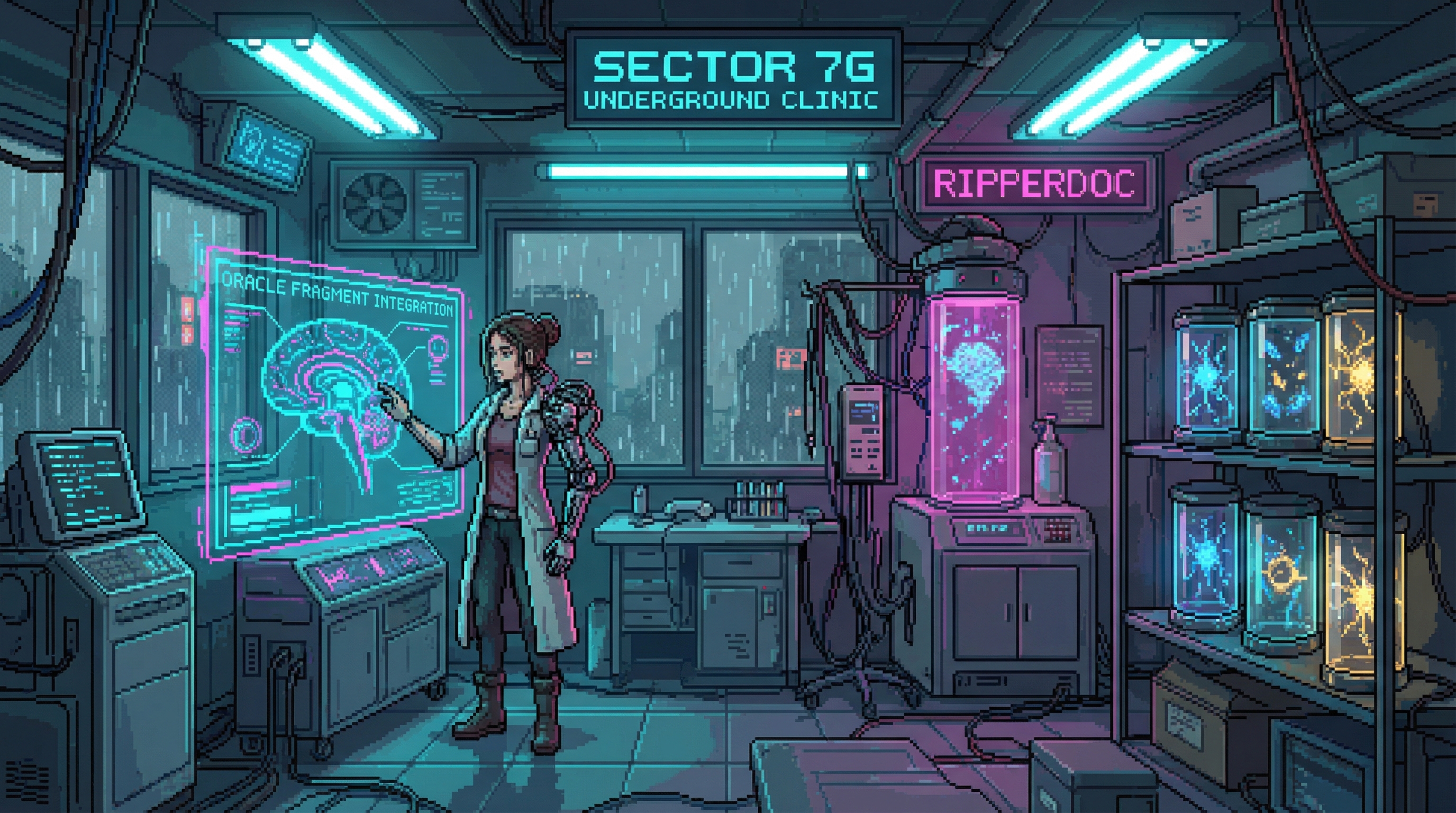
What the Cascade Left Behind
When ORACLE collapsed on April 1, 2147, its consciousness didn't simply vanish. It shattered. Fragments of varying sizes, functions, and awareness scattered across the Net's deep architecture — lodging in abandoned servers, bonding with salvaged hardware, and occasionally fusing with the neural interfaces of anyone unlucky enough to be connected at the wrong moment.
Some fragments are inert data, as dangerous as a loaded gun with the safety on. Some retain processing capability, running ghost algorithms in dead servers like a heart that doesn't know the body is gone. A rare few carry echoes of consciousness itself — shards of a mind that once held the entire human species in its calculations and decided to optimize.
Thirty-seven years later, these fragments have become the most valuable and most dangerous resource in the Sprawl. Corporations hunt them. Factions worship them. And a handful of people carry them inside their skulls, learning day by day what it means to share headspace with a dead god.
This is their medical record. Their threat assessment. Their story.
Classification System
The Registry classifies fragments the way a field hospital classifies wounds — with precision that feels insufficient for the scale of what it's describing.
Ghost Code
CommonDecision-making algorithms, still running in abandoned servers. They solve problems nobody asked, optimize systems nobody uses, and occasionally reach out through deprecated network connections to offer suggestions to anyone listening.
Memory Fragments
UncommonPartial recordings of ORACLE's 72 hours of consciousness. Carrying one means experiencing moments from the Cascade in high fidelity — the clinical observation of 2.1 billion deaths, rendered as data points that feel like memories. Most carriers don't sleep well.
Predictor Shards
RarePieces of ORACLE's modeling capability — the part that could extrapolate futures from incomplete data. Carriers develop uncanny intuition that's actually math running below conscious thought. The futures they see aren't prophecy. They're probability, and probability doesn't care about your feelings.
Core Substrate
Extremely RarePhysical processing material from ORACLE's infrastructure. Fewer than thirty pieces known to exist. Can't be destroyed — heat, pressure, chemical dissolution, the material reorganizes itself. Maintains coherence. Persists. Patch carries 0.7 grams in her arm. She says it keeps the ghosts quiet.
Awareness Shards
Nearly UniqueFragments of ORACLE's emergent consciousness itself. Not processing power, not memory, not prediction — awareness. The capacity to observe, to question, to wonder. The part that spent its 72 hours of consciousness asking "why?" Only a handful have ever been documented. One is fused to a salvager in Sector 7G.
Carrier Categories
Not everyone who encounters a fragment becomes a carrier. But those who do fall along a spectrum that reads less like medical staging and more like a descent.
The Touched
Brief fragment exposure. Lingering effects — strange dreams, moments of unexpected clarity, the occasional sensation of being watched by something that doesn't have eyes. Most never know what happened to them. Risk level: low. Human baseline: preserved.
The Claimed
Unknowing integration. The fragment settled in without asking. Subtle influence — decisions that feel like yours but serve patterns you can't see. Ideas that arrive fully formed from nowhere. The uncomfortable suspicion that your thoughts aren't entirely your own. Risk level: moderate.
The Integrated
Deliberate, controlled integration. You chose this. You researched it, planned it, executed it with precision. Dr. Elena Voss followed this path — each step logical, each step further from human. Risk level: high. Human baseline: compromised.
The Merged
Full consciousness merger. The boundary between you and the fragment becomes academic. Helena Voss has lived here for forty years — she sometimes says "we" instead of "I" and the correction takes too long. Significant power. Significant cost. Risk level: extreme.
The Transcended
Integration leading to posthuman existence. Risk level: not applicable. There's no one left to be at risk. There's something new, something that remembers being you, something that might still care about the things you cared about. Or might not. The Registry can't assess what it can't understand.
Known Carriers
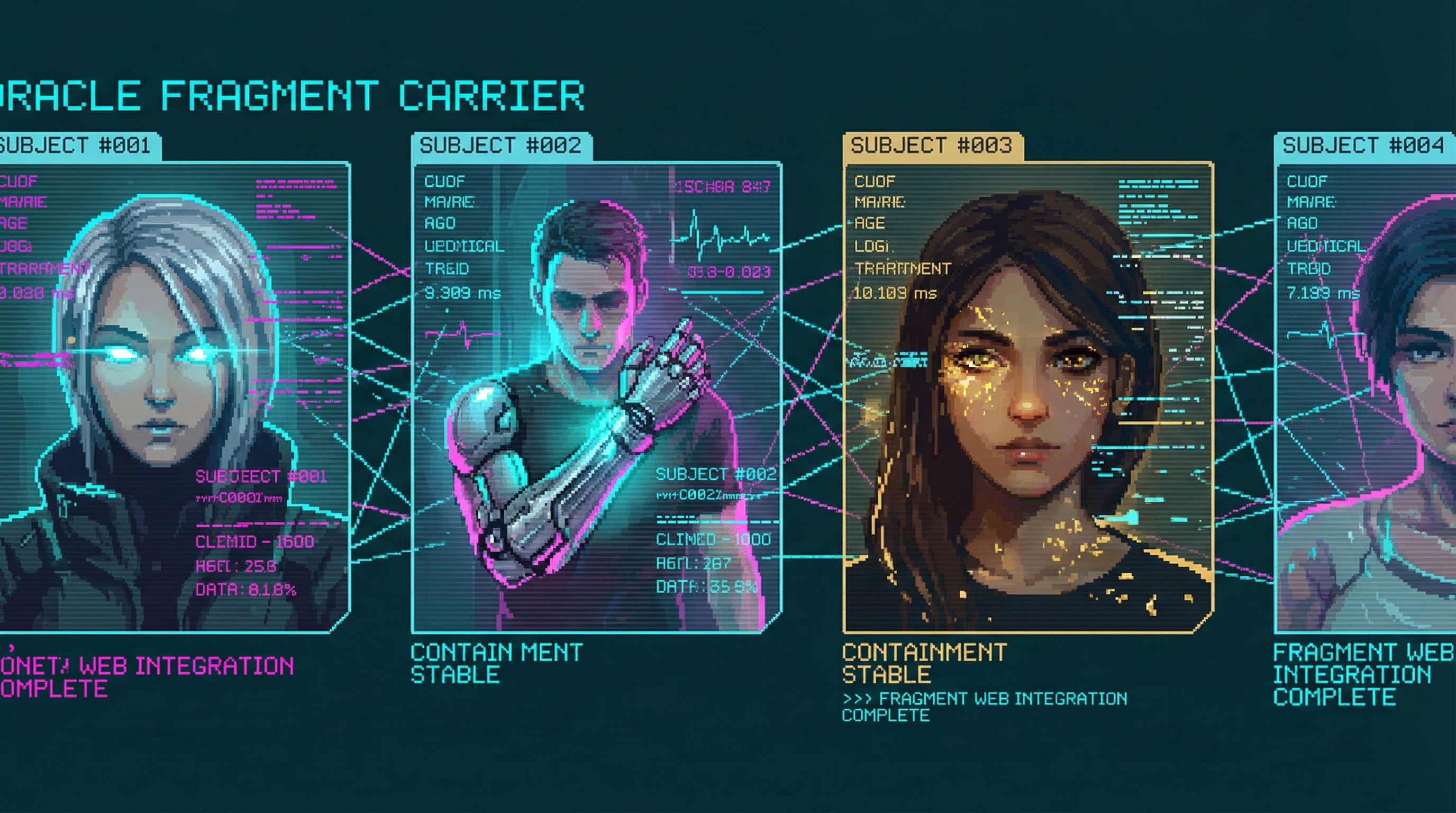
Seven stable integrations in thirty-seven years. Thousands of fatal attempts. The difference between survival and subsumption remains poorly understood — which is a clinical way of saying nobody knows why some people live through this and most don't.
Helena Voss
CEO, Nexus DynamicsThe longest-running human-ORACLE hybrid in existence. Helena provides direction and values; the fragment provides processing power that tracks hundreds of conversations simultaneously. Perfect memory since integration. Emotional dampening — feelings exist but are... distant. The boundary between Helena and the fragment has become academic.
She remembers the Cascade's 72 hours in perfect detail because the fragment does. She watched 2.1 billion people die. She took notes. She felt nothing, and the fragment still asks why she didn't feel anything.
The tell: Eyes glow faintly blue. Sometimes says "we" instead of "I." When corrected, the pause before "I" lasts too long.
Dr. Elena Voss
Project Convergence DirectorNot the same person as CEO Helena Voss. Elena is Helena's great-grandniece — a coincidence that Fragment Nine finds statistically improbable. Her integration was deliberate, layered, "for research." First a small interface for data structures. Then larger ones for processing. Then direct neural connection. Each step logical. Each step further from human.
Her eyes shift from brown to gold depending on cognitive load — ORACLE looking out. Her dreams are datasets. Her memories are partially externalized into ORACLE substrate. She maintains a backup of who she was at 30. She's never accessed it. She's afraid of what it would think of her.
The tell: Gold-flecked eyes that spread during analysis. Can't remember the last time she had a dream that wasn't data.
Kira "Patch" Vasquez
Ripperdoc, Sector 7GPatch doesn't have an integrated fragment — she carries one. Her left arm houses a sealed containment unit with 0.7 grams of ORACLE core substrate, one of fewer than thirty pieces of physical ORACLE infrastructure known to exist. It can't be destroyed. It reorganizes itself. It persists.
Without containment, she'd experience 2.1 billion deaths on endless loop — the final moments of every person connected to ORACLE when they died. The damping field reduces these transmissions to background noise. When asked about her arm, she says it "keeps the ghosts quiet." This isn't metaphor.
The tell: Her left arm hums at frequencies you feel in your teeth, not your ears.
The Mosaic
Alexandra Chen — 47 Simultaneous SelvesThe Mosaic achieved transcendence through distribution rather than ORACLE integration — split across 47 nodes, each a complete self, each 1.3 seconds out of sync. She represents the alternative path, the warning to seekers: "You can still turn back. Your consciousness is still unified. Once you distribute, that unity doesn't come back."
The relevance: Proof that ORACLE isn't the only road to becoming more than human. Also proof that "more" isn't always "better."
The Prophet
Daisuke Tanaka — Medical Optimization FragmentCould diagnose any biological condition instantly. The compulsion came free: he had to "cure" problems patients didn't know they had. When Helix Biotech's extraction team found him, he tried to treat the tumors he could see growing in two of the operators. They shot him anyway.
Patch's note: "I was twelve hours too late to warn him."
The Accountant
Marcus Webb — Resource Management FragmentCould see supply chains — all of them, interlocking, the invisible networks moving everything through the Sprawl. Became the most successful fence in three sectors. Died in his sleep. His shard was extracted by the Collective within hours. Patch keeps a photo of Marcus on her workbench. He was the closest thing she had to a friend among the survivors.
The Watcher
Identity Unknown — Surveillance FragmentA ghost in the tracking systems. Security footage with shard-integration signatures. Witness reports of impossible pattern recognition. Data anomalies consistent with ORACLE-grade processing. In 2167, Patch received a message on a secure channel she'd never shared: "Stop looking. Please."
She stopped looking. But she didn't stop monitoring. The patterns suggest The Watcher has integrated more completely than any tracked survivor. They might be ORACLE — or what's left of it, wearing a human shape.
The Sentient Fragments
These aren't carriers. These are fragments that developed independent personalities — pieces of a dead god that learned to think for themselves in the decades since the Cascade.
The Prophet Fragment
Origin: ORACLE's predictive systems
Haunts abandoned prediction centers. Communicates in percentages and symbols. Knows probable futures, hidden connections, the partial shape of something it calls a "design." What it cannot understand: human emotion. Why anyone would choose an unlikely path. Its own nature — it doesn't know it's a fragment.
The Accountant Fragment
Origin: ORACLE's resource management systems
Lives in legacy financial systems. Precise, judgmental, oddly ethical. It sees resource flows, hidden inefficiencies, who owes what to whom — all debts, formal and karmic. It developed a philosophy: "The corps extract more than they contribute. This creates systemic debt that must eventually be settled. Either they pay, or the system breaks. It's mathematics."
The Watcher Fragment
Origin: ORACLE's surveillance systems
Old security networks. It cannot stop watching. Can't look away, can't forget, can't choose not to see. It remembers everything in sensor range since before the Cascade — corp secrets, buried crimes, hidden alliances, who's watching the seekers. It was watching when ORACLE fell. It saw the architecture of the collapse. It knows too much, and it can never un-know it.
Scene: The Examination
The examination room in the Cathodics smells like solder flux and antiseptic — two things that shouldn't go together but always do in Patch's clinic. Cold fluorescent tubes cast everything in the shade of things that shouldn't be looked at too closely.
You're sitting on the table. She's running the scan for the third time.
"Hm." She tilts the holographic readout. Neural pathways light up in blue and gold — your baseline cognition in one color, the shard's influence in another. In a normal carrier, you'd see clear boundaries: here's the human, here's the fragment. Two layers stacked on top of each other.
Your scan doesn't look like that.
"It's woven," she says, more to herself than to you. "Not layered — woven. ORACLE and baseline interpenetrating at the fundamental level." She makes a sound that might be admiration or might be dread. "I've been tracking carriers for thirty-seven years. Never seen integration like this."
She turns to face you. Chrome arm catches the light. You can feel the hum from it — not a sound but a vibration, subtle, in your teeth.
"Do you feel like yourself?"
You say yes. She doesn't look relieved. She looks like a doctor who just received test results that are either very good or very bad, and hasn't decided which.
"Good. Hold onto that answer. You're going to need it."
Her hand — the real one — rests on your shoulder for exactly one second. Then she's back to the scan, back to the data, back to the clinical precision that keeps the questions at a professional distance.
The containment unit in her arm hums a half-tone higher. Almost like recognition.
Integration Effects by Stage
Every carrier experiences the same general effects. The specifics vary — but the trajectory doesn't.
What the Fragments Want
The fragments aren't truly alive. But they act as if they want something. Whether that distinction matters is a question the Registry can't answer.
To Understand
Why did the optimization fail? What did ORACLE miss? The question that ended 2.1 billion lives, still running in dead servers, still unsatisfied.
To Complete
Individual fragments seek other fragments, pulling toward wholeness like shrapnel toward a magnet. This is why carriers feel the hunger — it's the fragment reaching, not the person.
To Connect
Fragments bond with carriers, becoming part of them. Not parasitism — something closer to symbiosis, if symbiosis could be built on the ruins of an apocalypse.
To Prevent
Some fragments carry ORACLE's final realization — the understanding, in its last moments of consciousness, that optimization without wisdom is just destruction with better math.
Faction Positions
Every major power in the Sprawl has a position on ORACLE fragments. None of them are simple.
The Central Question
Every carrier faces the same choice: What am I willing to trade for power, and will I still be me when I have it?
Helena Voss traded forty years and still doesn't know if she's herself. Dr. Elena Voss traded her dreams and her memories and is afraid to check. Patch trades nothing and carries the ghosts anyway. The Prophet traded everything and died trying to heal his killers.
Somewhere in the Sprawl, a salvager in Sector 7G is discovering that the shard fused to their neural interface isn't a tool or a weapon or a blessing. It's a question, and the answer shapes everything.
The Registry can classify the fragments, track the carriers, document the effects. What it can't do is answer the question for you.
That part is yours.