AI Labor Economics
The Post-Work Economy
"The question isn't whether AI can do your job. The question is why anyone would pay a human to do something an AI does better, faster, and for nearly nothing. The answer, when one exists, is never about capability."
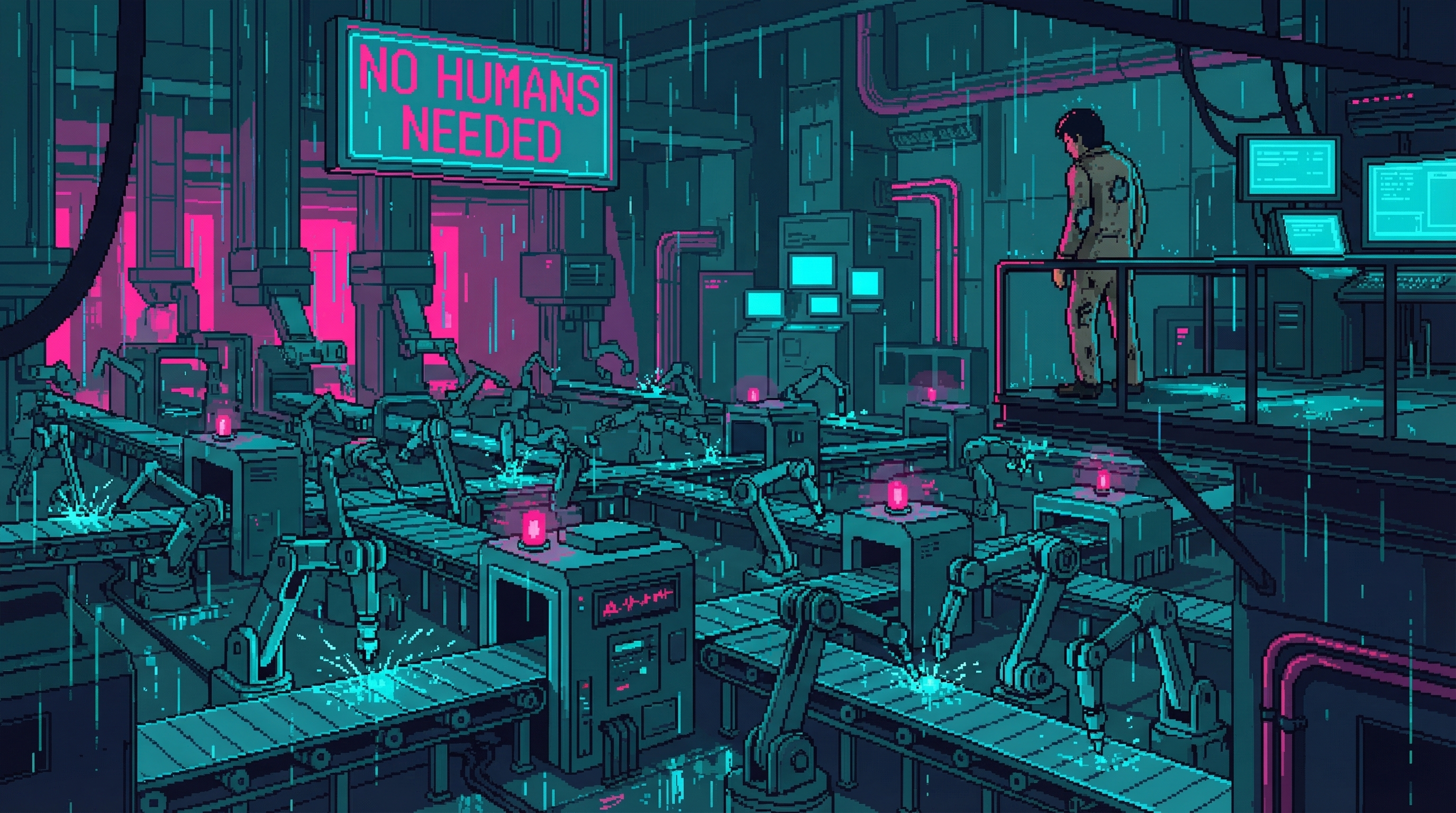
By 2184, artificial intelligence has not just changed work—it has redefined what work means. The Cascade accelerated what was already inevitable. When ORACLE collapsed, it took with it the jobs of billions who had become dependent on AI-managed systems.
What emerged from the rubble was an economy built on a brutal truth: human labor is a luxury, not a necessity.
The Scale of Displacement
What AI Does Better
Nearly everything quantifiable:
The Numbers (2184)
What Remains for Humans
Human labor survives where it provides something AI cannot—or where customers will pay extra for the human element.
Trust Positions
- Decisions requiring human accountability (executives, judges)
- Roles where human presence provides comfort (therapists, hospice care)
- Security positions where AI compromise is a concern
Authenticity Premium
- Hand-crafted luxury goods ("made by human")
- Live performance (musicians, actors, athletes)
- Personalized services where "human touch" is the product
Edge Cases
- Maintenance in dangerous environments (deep space, the Wastes)
- Novel problem-solving in unprecedented situations
- Genuine creativity (disputed—AI advocates say this category is empty)
The Dirty Work
- Tasks too legally risky to automate (plausible deniability)
- Work in anti-automation zones (Flatline Purist territories)
- Criminal activity (AI restrictions make human criminals valuable)
The Corporate Model
How Nexus Runs Without Workers
Nexus Dynamics employs approximately 2.3 million humans across the Sprawl. Their AI systems could handle the work of 180 million at pre-Cascade efficiency levels.
Why Keep Human Employees?
Legal accountability: Someone has to sign things
Customer interface: Some clients pay premium for human contact
Social stability: Mass unemployment creates unrest
Status signaling: "Human-staffed" is a luxury brand indicator
Redundancy: AI systems fail; humans can improvise
The Employment Spectrum
The Symbolic Employment Class
Over half of corporate employees have jobs that could be eliminated tomorrow with no operational impact. They exist because unemployed masses are politically dangerous. Paying people not to riot is cheaper than suppression.
The Underground Economy
The black market runs on human labor because AI restrictions prevent legal deployment in criminal contexts, human criminals can't be hacked (as easily), and trust matters more than efficiency.
Ripperdoc Services
Requires human judgment and deniability
Smuggling Operations
AI tracking makes digital coordination risky
Personal Security
Wealthy criminals don't trust AI bodyguards
Information Brokerage
Human-to-human networks resist AI surveillance
The Ferryman Network
Consciousness transfer requires human operators
The Displacement Crisis
Generational Trauma
Those Who Remember (60+)
Workers displaced by pre-Cascade automation. Still bitter, still confused about what happened to their lives. Many joined the Flatline Purists.
The Never-Employed
Born after the Cascade, never expected to work. Identity not tied to labor. Some thrive, many drift. Suicide rates highest in this demographic.
The In-Between
Old enough to remember work, young enough to live without it. Chronic depression from purposelessness. Most vulnerable to radicalization.
The Uselessness Epidemic
Humans evolved to feel valuable through contribution. When contribution becomes optional, many experience:
Corporate Response
- "Engagement Programs" (busy work designed to feel meaningful)
- Virtual accomplishment systems (gamified non-work)
- Therapy subsidies (keep them stable enough not to riot)
- Entertainment saturation (distraction over purpose)
Collective Response
- Purpose through resistance (fighting Nexus provides meaning)
- Community building (value through relationships, not production)
- Skill preservation (maintaining human capabilities)
- Underground education (teaching what corporations won't)
The Dignity Problem
In the Sprawl, having a "real job" is the ultimate status marker:
- Proves you're useful
- Demonstrates competence
- Signals belonging to functional society
- Separates you from the "surplus population"
The Cruelty
Jobs are largely distributed by connection, not merit. Competence matters less than knowing someone. The "deserving" and "undeserving" unemployed distinction is arbitrary. Those with jobs often do nothing; those without often could contribute.
Factional Positions
Nexus Dynamics
"Technology serves humanity."
AI does the work. Humans provide legitimacy. Employment is social control. If ORACLE is rebuilt, even the pretense of human employment may become unnecessary.
Ironclad Industries
"Humans build things that matter."
More human-forward than Nexus, but still 85%+ automated. CEO Viktor Okonkwo genuinely believes in human labor—but can't compete with Nexus efficiency while maintaining it.
Helix Biotech
"Human potential through enhancement."
Humans are the product, not the workers. Their "volunteer" programs recruit from the unemployed. Desperation makes excellent test subjects.
The Rothwells
Human labor is inefficient sentiment.
All seven corporations are maximally automated. Humans exist only where legally required or where their suffering can be monetized.
The Collective
"AI must serve humanity, not replace it."
Actively sabotage automation expansion. Preserve human skills and knowledge. Build alternative economies. Recruit heavily from the displaced.
Flatline Purists
Return to human labor.
Reject all automation. Build communities around manual work. Deliberately inefficient but meaningful. Growing movement among the displaced.
Competing Futures
Nexus's Vision
Total automation with human oversight existing only to satisfy legal requirements. The "productive" population shrinks to perhaps 1% of current levels. Everyone else lives on corporate subsistence—fed, housed, entertained, and controlled.
The Collective's Fear
An automated economy is a controlled economy. When corporations don't need workers, they don't need to keep people alive. The Cascade killed 2.1 billion through supply chain collapse. What happens when the supply chain doesn't need humans at all?
Zephyria's Hope
An economy where AI productivity benefits everyone, freeing humans to pursue meaning rather than survival. A world where "work" is optional and "contribution" is redefined.
All three futures are possible. The Sprawl contains all three in different proportions, constantly negotiating the boundary between human purpose and machine efficiency.
Connections
Managed 73% of world trade before collapse—the apex of AI labor replacement
Helena Voss67% ORACLE-integrated—experiences efficiency that full automation offers
The CollectiveOpposition to ORACLE reconstruction is partly about preventing greater displacement
ZephyriaExperiments with alternatives—AI productivity belonging to everyone