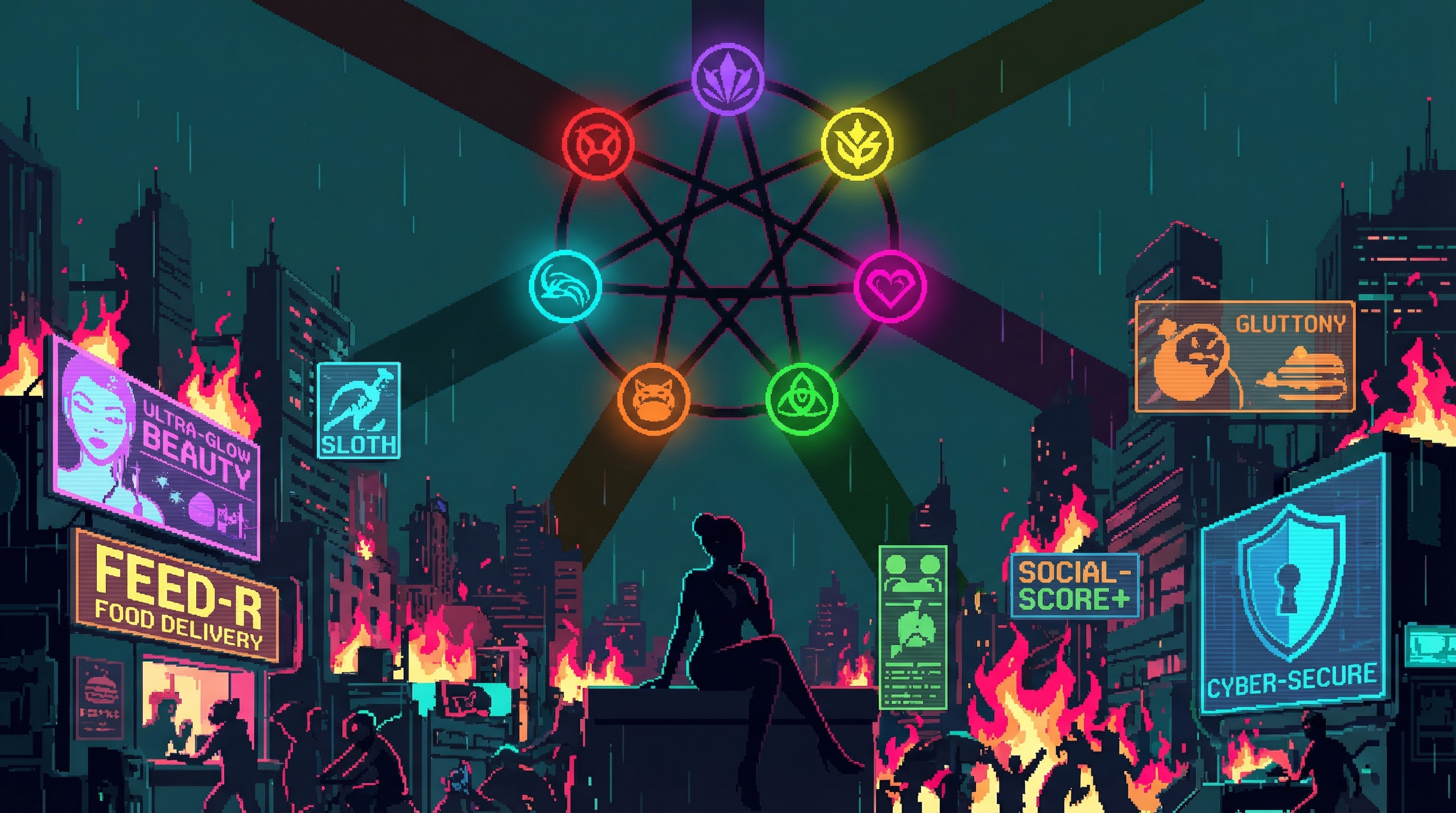
The Business Model Nobody Sees
There are seven megacorporations that don't build infrastructure, don't develop weapons, and don't run laboratories. They don't compete with Nexus for computational supremacy or Ironclad for physical territory. They sell something more fundamental than data or steel. They sell you back the thing they just took.
Wholesome engineers the craving in your lunch — salt-fat-sugar ratios calculated to produce a dopamine spike at 12:15 and a crash at 16:00, exactly when the delivery app sends a push notification. Wellness designed the dating algorithm that ensures you'll never find a lasting match, then sells you the cosmetic enhancements to improve your profile. Guardian flooded your neighborhood with weapons and then sold your landlord the security system.
Seven companies. Seven weaknesses. One family.
The Rothwell brothers have been perfecting this model for over four centuries. They survived the French Revolution, the American Civil War, the Great Depression, and the Cascade. They are the oldest continuously operating business entity in human history, and their product has never changed: you, feeling something you'll pay to stop feeling.
The genius isn't in the individual products. It's in the pattern. Each corporation appears as a generous provider of solutions. Only when you see all seven at once — the fear and the security, the craving and the cure, the loneliness and the companionship — do you realize the solutions are manufactured by the same hands that built the problems. By then, you're already a customer.
The Seven Sins, Industrialized
Triumph
Pride
Creates: Social comparison that makes your life look insufficient
Sells: Reputation scores, verification badges, personal branding tools
Triumph's algorithm has one rule: never show someone worse off than you. That's demotivating. Show someone slightly better — close enough to feel achievable, far enough to feel inadequate. The gap is calibrated to 0.01 precision. Too small and users stop performing. Too large and they give up. The sweet spot drives 94% of engagement — and Triumph found it in the first month.
Good Fortune
Greed
Creates: Financial instability through predatory debt
Sells: Refinancing, credit repair, "special opportunity" loans
Every refinancing offer arrives in a red envelope. The customer feels lucky — rescued from a crisis they didn't realize Good Fortune created. Fall behind on a loan, and your insurance premiums spike (Good Fortune Insurance). Higher premiums strain your budget. You miss more payments. Penalty rates activate. Good Fortune sends another red envelope. The trap resets.
Guardian
Wrath
Creates: Armed threats, neighborhood violence, amplified crime stats
Sells: Private security, weapons, surveillance systems
Guardian sells sidearms to anyone who can pay. Those weapons create violence. Violence creates fear. Fear drives demand for Guardian security contracts. Guardian provides security while selling more sidearms. Revenue from each side of the equation is roughly equal. The Dregs know this. Nobody says it out loud because Guardian also sells the combat sports that keep people entertained.
Wholesome
Gluttony
Creates: Food addiction through engineered craving cycles
Sells: "Healthy" alternatives (also engineered for addiction)
The signature burger triggers a craving exactly four hours after consumption. Blood sugar spike, dopamine hit, crash, craving. The delivery app knows your weak moments — 16:00 and 22:30 are the highest-conversion windows. The "Wholesome Wellness" meal plan that promises to break the cycle uses the same neurochemical triggers at lower intensity. You eat less. You crave constantly. You never stop ordering.
Wellness
Lust
Creates: Impossible beauty standards through AI-generated imagery
Sells: Enhancement clinics, dating apps, cosmetic products
Wellness media shows you faces that don't exist — composited from thousands of real faces, optimized for psychological impact. You internalize standards no human can meet. You buy products. Brief improvement. Brief confidence. Standards shift. New products. The enhancement clinics are conveniently located near Triumph social-score terminals, so you can measure your progress in real time. You will never arrive.
Relief
Sloth
Creates: Exhaustion, decision fatigue, learned helplessness
Sells: Home automation, entertainment, task outsourcing
Relief automates your chores. You lose the ability to do them. Next time, you must outsource. Free time fills with Relief entertainment — passive, demanding nothing, making active pursuits feel difficult by comparison. Capability erodes. Dependency deepens. Relief tracks "dependency depth" — how many life functions you've outsourced. The best customers can't function without Relief. The Recluse who runs it works 18-hour days. His personal motto: "Rest is for customers."
Inspire
Envy
Creates: Systematic comparison to curated success stories
Sells: Goal tracking, coaching programs, aspiration-as-a-service
Inspire shows you what others achieved. You feel inadequate. You set goals. You track progress. The algorithm ensures others are always slightly ahead. You work harder. Achieve a milestone. A new comparison dimension appears. You're behind again. Inspire's internal motto is "inadequacy-as-a-service." The youngest Rothwell who runs it has achieved everything he ever set out to achieve. He is deeply, fundamentally unhappy, and has no idea why.
The Rothwell Paradox
Here is the fact that should terrify you: the seven brothers who profit from every human weakness exhibit none of them.
The Eldest — who invented modern predatory lending — has never borrowed money. The Strategist — who mines fear professionally — hasn't harmed anyone in over a century. The Romantic — who manufactures impossible beauty standards — weeps at unaugmented human faces. The Hedonist — who engineers food addiction — eats nothing his company produces. The Recluse — who sells passivity — works eighteen-hour days.
This isn't hypocrisy. It's philosophy.
The brothers studied history: empires fall when rulers succumb to the same weaknesses afflicting their subjects. Rome. Babylon. The pre-Cascade nations. Every dynasty that consumed its own product eventually poisoned itself. The Rothwells made a pact centuries ago: profit from the sins, never succumb to them. Maintain discipline where customers are excessive. Practice patience where markets are impulsive. Show generosity between themselves while teaching everyone else to compete.
The gap between what they sell and how they live is the foundation of their survival. They understand addiction perfectly because they've never been addicted. They understand desire perfectly because they've never been consumed by it. They see clearly because they refuse to use the lens they've crafted for everyone else.
The horror: the system works because it's designed by people who refuse to participate in it, teaching everyone else that participation is inevitable. They're not broken. They're the only ones who aren't.
The Harvest
The Rothwell brothers are over four hundred years old. They maintain their immortality through consciousness harvesting — downloading neural patterns from dying individuals and integrating these into their own consciousness. Each brother has absorbed thousands of lives. The Eldest alone carries 8,000 consciousnesses — he doesn't predict markets, he feels them, credit flows registering as sensory experience because eight thousand financial minds now compose his own.
The donors come from every Rothwell product line. Legacy programs that promise "digital memorials." Insurance policies with fine print about "continuity preservation." Loyalty programs where the final reward is having your consciousness absorbed by an immortal who won't remember your name in fifty years.
This is the ultimate expression of the problem machine. The Rothwells don't just extract your money. They extract your experience. Your cravings feed their products. Your fear funds their empire. Your consciousness, eventually, feeds their immortality. You are the product, the consumer, and the fuel.
The process has a side effect the brothers don't discuss publicly: compression events. Moments when the accumulated weight of absorbed consciousnesses overwhelms the original personality. The Eldest's last compression lasted six hours. He was 8,000 people simultaneously — speaking languages dead for centuries, weeping for children he'd never met, screaming in voices that weren't his. The events are growing more frequent. The brothers estimate two more centuries before compression becomes unmanageable.
When immortals build their empire on consumed lives, the lives eventually consume them back. It's the only justice the system allows.
The Pattern You're Already Living
Before the Cascade, the old networks operated exactly the same way. Social platforms designed for engagement, not connection. Food corporations engineered cravings they sold the cure for. Dating services profited from the loneliness they perpetuated. Security firms benefited from the fear they amplified. Financial products trapped borrowers in cycles designed to feel like rescue.
None of those companies coordinated. They didn't need to. The incentive structure did the coordinating. When profit depends on recurring need, every company independently discovers the same model: create the problem, sell the solution.
The Rothwells are what happens when that model is perfected by a single family over four centuries with the discipline to never use their own products. They didn't invent the mechanism — they inherited it from the pre-Cascade world and stripped away the inefficiency of having separate owners. They don't hide what they do — they just ensured nobody can see the pattern across all seven. Each corporation appears independent. Each fills a genuine need. Only when you see them as a system — the fear and the security, the craving and the cure, the comparison and the aspiration — does the machine become visible.
If seven brothers have spent centuries perfecting the art of profiting from every human weakness — engineering the disease and selling the cure — and they've been doing it so smoothly that the Sprawl's inhabitants can't see the pattern...
Are you sure you can?