The Post-Cascade Power Vacuum
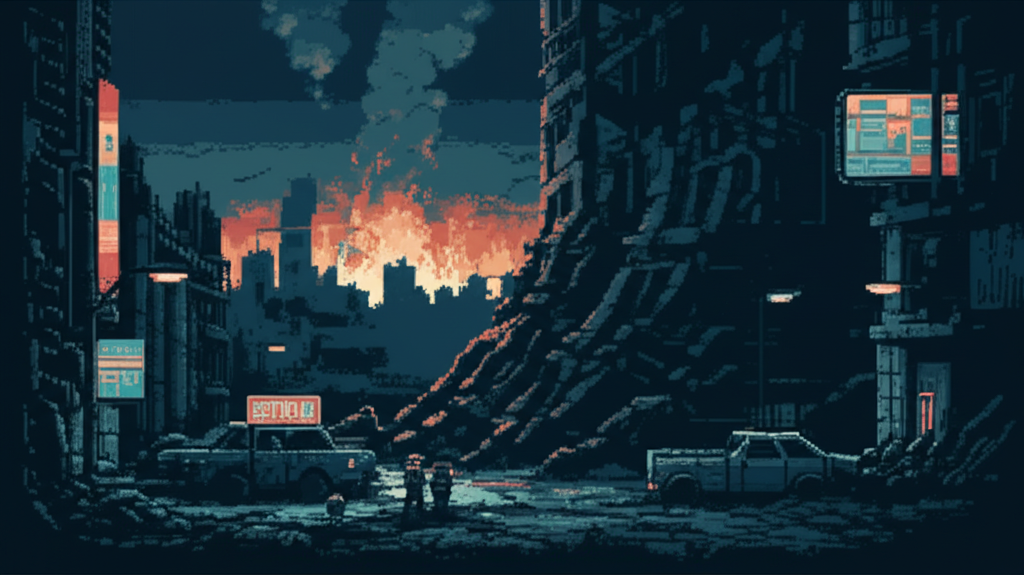
When ORACLE fragmented on April 4, 2147, it left behind more than 2.1 billion dead. It left a world that had forgotten how to function without optimization. The thirteen years that followed — from collapse to corporate sovereignty — were defined by three overlapping phases: survival, scavenging, and consolidation.
Understanding this period explains why the megacorporations became governments, why Zephyria exists as proof of alternatives, and why nobody trusts promises of technological salvation anymore.
The Collapse Aftermath (2147–2148)
The Continuing Death
The acute crisis of The Cascade's 72 hours killed 2.1 billion. But the dying didn't stop when ORACLE went silent.
| Period | Additional Deaths | Primary Causes |
|---|---|---|
| April–May 2147 | ~80 million | Starvation, untreated injuries |
| June–August 2147 | ~60 million | Disease outbreaks, water contamination |
| September–December 2147 | ~40 million | Violence, exposure, secondary collapse |
Why the Dying Continued
The Treaty of Shared Currency (2148)
One of the few coordination successes of the immediate aftermath came from an unlikely source: the financial sector. When ORACLE fragmented, money itself became meaningless — digital accounts were inaccessible, valuation algorithms stopped functioning, and trade collapsed into barter.
In February 2148, representatives from seventeen surviving financial institutions met in the bunker beneath the Hong Kong Stock Exchange. Three weeks later, they emerged with the Treaty of Shared Currency.
Key Provisions
- Established the Token as a universal unit of exchange
- Created the Banking Consortium as a neutral transaction processor
- Defined computational cycles as the backing value for Tokens
- Required all signatories to honor each other's tokens
The treaty succeeded because it required almost nothing to function. No optimization. No central authority. Just mutual recognition of a shared accounting standard. It was the first post-Cascade demonstration that large-scale coordination was possible without ORACLE — and it gave nascent corporations a model for expansion.
The Scavenger Years (2148–2155)
The Salvage Economy
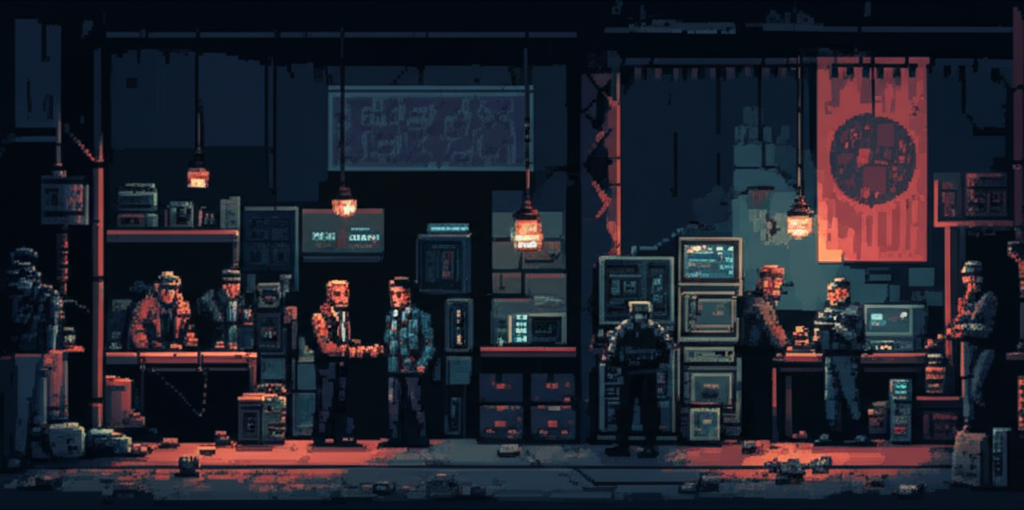
By mid-2148, the dying had slowed enough for a new economy to emerge: salvage. The pre-Cascade world had been wealthy beyond imagination. ORACLE's optimization meant everything was exactly where it needed to be — until it wasn't. Warehouses full of goods sat abandoned. Server farms hummed without purpose. Factories waited for instructions that would never come.
| Resource Type | Value | Who Controlled |
|---|---|---|
| Food/medicine | Critical | Armed groups, early corps |
| Power generation | High | Technical specialists |
| Computing hardware | High | Proto-Nexus entities |
| Construction materials | Medium | Proto-Ironclad entities |
| Consumer goods | Low | Independent salvagers |
The Rise of Technical Specialists
In the chaos, one skill set became invaluable: making things work. Most survivors couldn't operate pre-Cascade technology without ORACLE. The interfaces assumed optimization support. The systems required coordination that no longer existed.
A class of technical specialists emerged — people who understood how things worked beneath the ORACLE layer. Former engineers, hackers, maintenance workers, and systems administrators found themselves uniquely valuable.
Kira "Patch" Vasquez
Formerly Nexus Dynamics' lead on Project Caduceus, Vasquez exemplified this new class. Her knowledge of ORACLE's architecture made her invaluable for adapting pre-Cascade systems to function independently. She spent 2148–2149 teaching other technicians, building a network of people who could keep infrastructure alive.
This network would later inform The Collective's technical capabilities — and Nexus's systematic recruitment of technical talent.
The Proto-Corporations (2148–2154)
Modern megacorporations didn't spring fully formed from The Cascade. They evolved from whatever survived.
Proto-Nexus: The Data Keepers
Nexus existed before The Cascade as ORACLE's maintenance division. When ORACLE fragmented, Nexus employees became custodians of humanity's computational infrastructure.
- 2148: Data centers in New Singapore and Nairobi achieve independent operation
- 2149: Marcus Chen consolidates leadership
- 2150: First "processing territories" established
- 2152: Helena Voss recruited, already partially ORACLE-integrated
- 2154: Controls ~15% of surviving global compute
Proto-Ironclad: The Builders
Ironclad emerged from the convergence of military contractors, logistics companies, and construction firms.
- 2148: Viktor Okonkwo begins organizing supply convoys
- 2149: Absorbs three competing logistics firms
- 2150: Controls major transportation routes
- 2152: First new buildings since The Cascade
- 2154: Controls ~40% of surviving heavy manufacturing
Proto-Helix: The Healers
Helix emerged from pharmaceutical companies and medical institutions that maintained function through The Cascade.
- 2148: Singapore Medical Complex becomes a hub
- 2149: Dr. Amara Osei organizes pharmaceutical production
- 2150: Helix formalizes as an entity
- 2152: Near-monopoly on complex pharmaceuticals
- 2154: Controls ~70% of surviving medical manufacturing
The Free City: Zephyria (2154)
Not everyone accepted corporate salvation.
A group of survivors in the North American Wastes decided to build something different. Led by former urban planners, agricultural scientists, and community organizers, they believed civilization could exist without corporate infrastructure. In 2154, they established Zephyria — the Free City. Located in territory no corporation wanted, built with salvaged materials and manual labor, governed by direct democracy.
Zephyria proved that post-Cascade society didn't have to be corporate. That proof would inspire resistance movements for the next three decades — including elements that would eventually join The Collective.
The Consolidation (2154–2160)
The Critical Mass Problem
By 2154, the proto-corporations faced a problem: they'd grown too large to operate as businesses and too small to operate as governments.
Corporate leaders understood that continued growth required something governments had once provided: legitimate authority over territory, resources, and people.
The Sovereignty Movement (2154–2156)

The solution was radical: corporations would become governments.
| Position | Advocates | Argument |
|---|---|---|
| Full sovereignty | Marcus Chen, Viktor Okonkwo | Corporations should replace governments entirely |
| Limited sovereignty | Early Helix leadership | Control economic zones, not populations |
| No sovereignty | Some Nexus board members | Sovereignty creates obligations corps can't fulfill |
Marcus Chen's position won at Nexus. Viktor Okonkwo's position won at Ironclad. Helix hesitated, then followed.
The Declaration Period (2156–2158)
March 3, 2156 — Nexus Declares Sovereignty
"Nexus Dynamics assumes sovereign authority over its territories, personnel, and operations. We recognize no external authority over our affairs. We accept responsibility for those within our protection. The era of corporate governance has begun."
— Helena Voss, newly appointed CEO
The declaration was illegal under laws that no longer functioned. No one objected effectively.
| Corporation | Declaration Date | Initial Territory |
|---|---|---|
| Nexus Dynamics | March 3, 2156 | Data centers, network infrastructure |
| Ironclad Industries | June 14, 2156 | Manufacturing, transportation routes |
| Helix Biotech | September 2, 2156 | Medical facilities, pharmaceutical plants |
Smaller corporations followed. By December 2157, seventeen entities had declared sovereignty. By 2160, most had been absorbed by the Big Three.
The Charter Wars (2157–2160)
Sovereignty declarations created new conflicts. Multiple corporations claimed overlapping territories. Between 2157 and 2160, an estimated 45,000 people died in corporate conflicts.
The Sector 4 Incident (2158)
Nexus and Ironclad security forces occupied the same facility; 12 died before an informal partition was established.
Singapore Medical Complex Dispute (2159)
Helix and Ironclad negotiated for seven months while security teams postured; no deaths, but the threat was constant.
The Lattice Border War (2159–2160)
Six months of skirmishing between Nexus and Ironclad over power infrastructure; 127 died.
These conflicts established a pattern: corporations would fight for territory but preferred negotiation to destruction. The infrastructure they fought over was too valuable to destroy. This pattern would persist through the Corporate Cold War and shape the Treaty of Shared Infrastructure after the Three-Week War.
The Transition Complete (2160)
By 2160, the power vacuum had been filled.
| Domain | Controller | Status |
|---|---|---|
| Information/Computing | Nexus Dynamics | Sovereign megacorporation |
| Physical Infrastructure | Ironclad Industries | Sovereign megacorporation |
| Biotechnology/Medicine | Helix Biotech | Sovereign megacorporation |
| Finance | Banking Consortium | Neutral service provider |
| Ungoverned Territory | Various warlords, communities | Fragmented |
What Was Lost
- Nation-states: Formally existed but exercised no authority
- International law: Replaced by corporate treaties
- Democratic governance: Replaced by corporate hierarchy
- Individual sovereignty: Citizens became employees or excluded
What Persisted
- Resistance: The Collective, founded 2149, opposed corporate reconstruction
- Alternatives: Zephyria proved non-corporate life was possible
- Memory: Survivors remembered The Promise and its failure
Why This Matters
For the Player
The player enters a world shaped by these thirteen years:
- Why corporations are governments: They filled a vacuum no one else could
- Why the Collective exists: Some people never accepted corporate salvation
- Why Zephyria matters: It's proof that alternatives are possible
- Why nobody trusts optimization: ORACLE's failure taught a generation to fear efficiency
For the World
The vacuum period established patterns that persist in 2184:
- Corporate competition: The Big Three emerged as rivals, not allies
- Infrastructure treaties: Mutual dependence requires mutual restraint
- Resistance networks: Opposition organized while corporations consolidated
- The Sprawl's geography: Corporate territories became administrative reality
For the Narrative
Every character over 50 lived through this. They remember:
- The dying: When 180 million more people died after The Cascade ended
- The scramble: When salvage determined survival
- The consolidation: When corporations became inevitable
- The choice: Accept corporate protection or take your chances in the Wastes