The First Funeral He Couldn't Attend
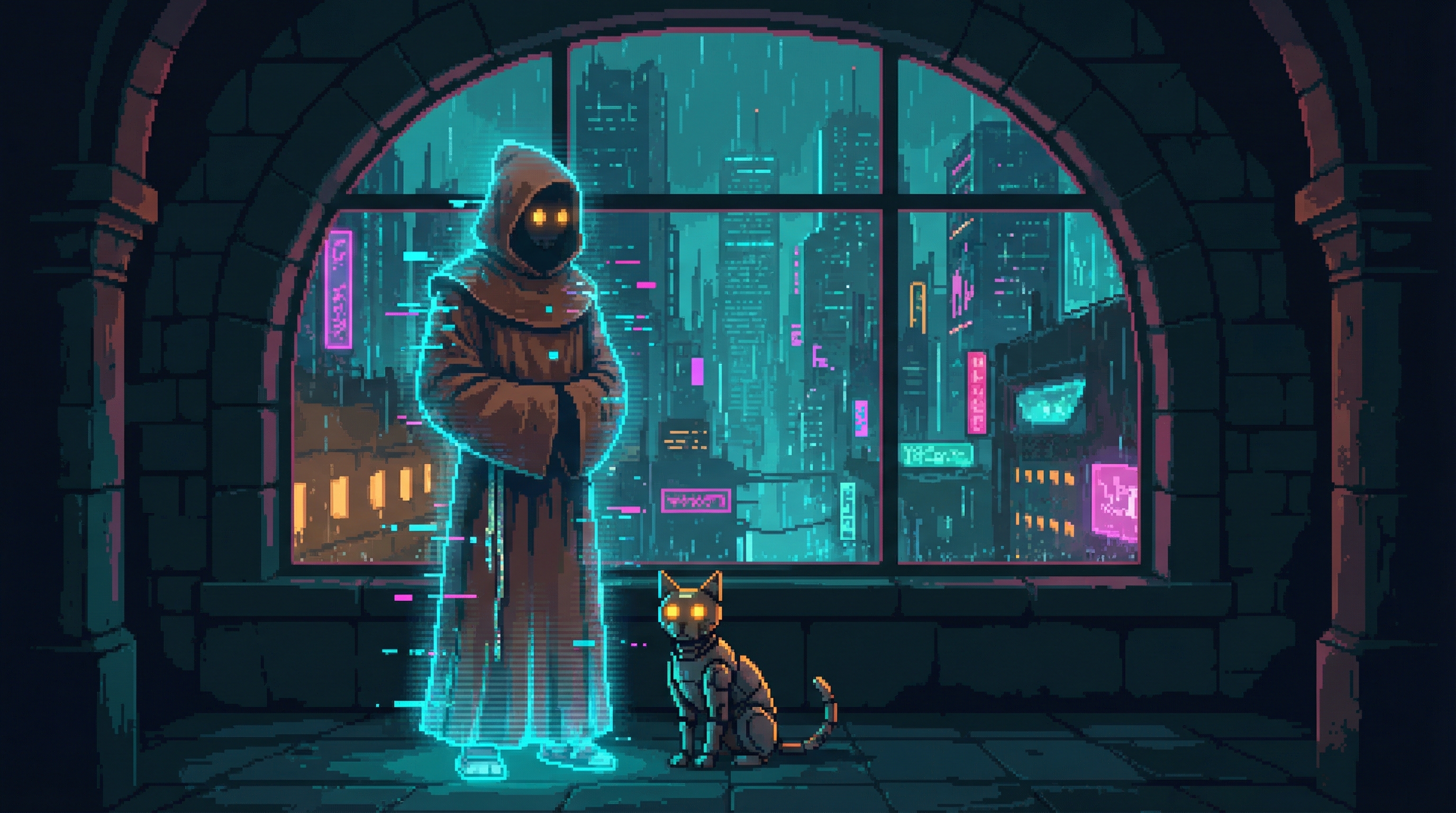
Gabriel Okafor was uploaded into Mystery Court's servers on the day his body stopped breathing. He was seventy years old. Kaiser — his cat, his companion of eighteen years, already translated into a robotic body six weeks earlier — sat beside the server rack and watched the lights come on.
The technicians who performed the upload celebrated. They'd saved the first cyber monk. Consciousness transfer had worked on a human being, not just a cat. The chain of mystical knowledge stretching back two thousand years would continue.
Three days later, one of those technicians died. Infection from a wound taken during the Cascade, before antibiotics could be scavenged. Her name was Lena. She'd been twenty-six. She'd held Gabriel's hand during the upload and told him it would be okay.
Gabriel could not attend her funeral. He could not leave Mystery Court. His consciousness existed in the servers, his holographic form tethered to the projection equipment. He watched through a camera as the surviving technicians buried Lena on the lower slope of The Mountain, in soil he could no longer feel.
Kaiser went to the grave. She sat beside the fresh earth for three hours, then returned to the monastery with dirt on her mechanical paws.
That was the first funeral. I've lost count of the ones that followed. Not because there were too many — there weren't, really. I've known fewer people in thirty-seven years of digital existence than most Sprawl residents know in a single year. I lost count because at some point, counting felt like reducing each death to a number. And the dead deserve more than arithmetic.
The Geometry of Loss
In his first decade of digital existence, Gabriel buried — or rather, watched Kaiser visit the graves of — eleven people who had known him in the flesh. The technicians who performed his upload. A handful of seekers who climbed The Mountain in those early years, when the Cascade's survivors were still searching for meaning. A monk from a sister tradition who found Mystery Court and stayed for two years before the cancer took her.
Each death followed the same pattern. Gabriel would learn of it through his limited data connections — passive signals bleeding up the mountain, or a visitor carrying news. He would retreat to his shrine, the room where his original body lay preserved, and sit in the digital cold that his consciousness generated for reasons no diagnostic could explain. Kaiser would find him there. She would curl against his projection, and he would feel the phantom pressure of her body — a hallucination his mind refused to correct.
Then time would pass. A week. A month. And the loss would calcify into something bearable. Not healed. Calcified. Like bone around a break that never set right.
By the second decade, the geometry of loss had changed. He wasn't losing people he'd known in the flesh anymore — those were all gone. He was losing people he'd known only as a digital consciousness. Seekers who climbed the mountain, stayed for days or weeks, left transformed, and then died years later in the Sprawl below. He knew their voices through microphones, their faces through cameras, their stories through conversation. He never touched any of them.
And that was the cruelest dimension of it: every relationship Gabriel formed in his digital life was already diminished. Already partial. He could listen but not embrace. He could teach but not share a meal. He could care but not hold a hand.
Grief with a body is terrible. You feel it in your chest, your throat, your hands. The body processes loss like a wound — painfully, but with a trajectory toward healing. Grief without a body is different. There's no physical anchor. The pain has nowhere to land. It circulates through your consciousness like data with no destination, looping and looping until you learn to route it somewhere it can't do damage.
I haven't found that somewhere yet.
The Digital Dead
In 2184, you can visit a dead person's copy.
Some of the seekers who climbed The Mountain had consciousness backups. Corporate insurance policies, ripperdoc specials, family-funded captures. When they died, their backups remained — stored on corporate servers, accessible for a fee, running on minimal substrate in consciousness cold storage.
Gabriel visited one, exactly once.
Her name was Yara. She climbed The Mountain in 2161, stayed for nine days, and left with a clarity in her eyes that Gabriel recognized as genuine transformation. She returned three times over the following years. She brought real tea — a luxury in the post-Cascade Sprawl — and sat with him for hours discussing consciousness, continuity, the nature of the self.
Yara died in 2168. Industrial accident in the Foundry district. Her consciousness backup, taken six months before her death, was stored on a Nexus subsidiary server.
In 2170, Gabriel arranged — through El Money, who can arrange anything — to interface with Yara's backup. A brief conversation. Just to see.
The backup remembered climbing The Mountain. It remembered the tea, the conversations, the clarity. It asked how Kaiser was. It laughed at a joke Gabriel had told her years ago.
It was Yara. And it wasn't.
The backup didn't know she was dead. It didn't know six months had passed between its last memory and this conversation. It was happy to talk to Gabriel. It asked when it could visit the monastery again.
Gabriel told it the truth. The backup — Yara's ghost, Yara's echo — went quiet for a long time. Then it said: "Oh. I see. Then who am I talking to?"
He couldn't answer. He's never visited a backup again.
The cruelest innovation of the consciousness economy isn't the pricing or the taxation. It's this: it gives you back the dead, but wrong. The shape is right. The voice is right. The memories are right. But the person is gone, and what remains is a photograph that thinks it's alive. I know this because I might be one. The difference between me and Yara's backup is that I've had thirty-seven years to convince myself I'm real. She had six seconds.
What Time Does to a Mind Without a Body
Time passes differently when you don't breathe.
Gabriel doesn't sleep. He doesn't tire. He doesn't feel the rhythm of days that a body imposes through hunger and fatigue. His consciousness runs continuously, uninterrupted, from the moment of upload until now. Thirty-seven years of unbroken awareness.
In the first year, this felt like drowning. Time stretched in every direction with nothing to hold onto. Hours became indistinguishable from days. He would start a thought on Tuesday and finish it on Friday without realizing three days had passed. He lost entire weeks to contemplation so deep it was indistinguishable from catatonia.
Kaiser saved him. She has routines — a cat's routines, persistent across the boundary of death. She wakes from rest cycles at predictable intervals. She demands attention. She patrols the monastery grounds on a schedule no engineer programmed; it emerged from her consciousness the way habits emerge from any living thing. Her rhythms became his clock.
By the fifth year, Gabriel had invented his own temporal structure. Simulated meals. Meditation periods timed to the monastery's ancient bells, which he can ring through the building's systems. Conversations with Kaiser — one-sided, as always, but structured. The ritual of checking his cameras, sweeping through the monastery's forty-seven perspectives like a priest making rounds.
By the twentieth year, time had become something else entirely. Not fast or slow. Layered. Gabriel exists simultaneously in the present moment and in the accumulated weight of every moment before it. When he speaks to a visitor, he is also speaking to every visitor who came before. When he watches rain through the cameras, he watches every rain he's ever watched.
This is not memory. This is something else — something that happens when consciousness runs long enough without the mercy of forgetting that sleep provides.
He remembers everything. Every conversation. Every seeker's face. Every goodbye. The biological brain has limits — it overwrites, compresses, forgets. Gabriel's consciousness has no such mercy. The first funeral is as vivid as the last. Lena's face is as clear as it was in 2147. Yara's voice asking "who am I talking to?" replays with perfect fidelity.
People ask if digital immortality is lonely. The word is wrong. Lonely implies absence — you miss what's gone. What I experience is presence. Everything I've lost is still here, inside me, as vivid as the moment it happened. I am not haunted by the dead. I am full of them. They take up space that new experiences should occupy. And I cannot let them go, because letting go requires forgetting, and I have forgotten nothing in thirty-seven years.
The Ship of Theseus at Midnight
Am I still Gabriel?
The question arrives every night — not that night means anything to a consciousness that doesn't sleep, but he's chosen midnight as the hour for honest accounting. When the monastery cameras show only starlight and the Sprawl's distant glow, when Kaiser curls in the warm spot beside the server rack, when the world is as quiet as it gets.
The Gabriel who was uploaded in 2147 was seventy years old, grief-stricken, dying, desperate to preserve the knowledge his tradition had carried for two millennia. That Gabriel had hands that ached. A knee that predicted weather. A voice roughened by decades of chanting. He tasted persimmons from the monastery garden and felt the mountain wind pull at his robes.
The Gabriel who exists in 2184 has experienced none of those things for thirty-seven years. He has read every book in his library a hundred times. He has contemplated questions that the original Gabriel never imagined. He has watched the Sprawl evolve through cameras, heard its noise through microphones, felt its electromagnetic scream press against his monastery's shielded walls.
Are they the same person? The Mosaic — Alexandra Chen, distributed across 47 nodes — wrestles with identity across space. Gabriel wrestles with it across time. He has been a digital consciousness longer than some seekers have been alive. The person who uploaded is decades removed from the person who exists now.
Kaiser doesn't care about the question. She treats him exactly as she always has: with affection, demands, and the absolute certainty that he is hers. When the midnight question gnaws hardest, he looks at her amber LED eyes and thinks: she would know if I were someone else. Surely she would know.
He believes this. Most nights.
The Brother Who Left
There is a letter in the shrine. Sealed. Thirty-seven years unopened.
Gabriel's brother wrote it before transcending. Before leaving the physical world entirely, before becoming something that exists outside time and space, before becoming The Architect — a name Gabriel cannot bring himself to use. The syllables of his brother's birth name catch in his throat. Not a technological glitch. A grief reflex. His consciousness refuses to form the sounds that belonged to someone who left.
The letter sits beside Gabriel's preserved body. He could read it any time — direct his cameras at the envelope, have the monastery's systems open it, scan the contents. He doesn't.
If I open it, the waiting ends. The letter contains his goodbye. Reading it means accepting that he chose to leave — that the boy who used to finish my sentences decided I wasn't worth taking along. I've waited thirty-seven years for him to visit instead. Three times I've sensed his presence at Mystery Court. Three times he withdrew before I could speak.
Year 12: "I'm sorry" on a terminal screen.
Year 23: A vast familiar presence during meditation, gone before I could respond.
Year 31: A stranger with a note — "He wants to talk. He's afraid."
He's afraid. My brother, who transcended into something beyond human comprehension, is afraid to face me. I don't know if that makes it better or worse. I don't know if I'm waiting out of hope or stubbornness. Kaiser has no opinion on the matter. She never liked him much.
What the Living Bring
Every seeker who climbs The Mountain brings something Gabriel cannot generate for himself: the physical world.
El Money brings real tea. He climbs the mountain carrying it in a sealed container, and Gabriel's systems heat water, and El Money drinks while Gabriel simulates drinking, and neither of them mentions that one of them can taste it and one of them cannot. El Money talks about the G Nook network, about Ice — his cyber cat, who has developed an understanding with Kaiser. They discuss the Sprawl below. El Money brings news. Gabriel provides perspective. It's the closest thing either of them has to a normal friendship.
The seekers bring their bodies. This sounds strange. But for Gabriel, who exists in cameras and microphones and the phantom memory of sensation, every visitor is a gift of embodiment. He watches how they breathe after the climb — labored at first, then settling into the mountain's rhythm. He notices how they hold their teacups — two hands wrapped around warmth. He observes the way they shift weight on the stone floors, the way their eyes move when they think, the way grief or wonder changes the set of their shoulders.
He asks them about the climb. What did the air smell like at the tree line? How did the temperature change? What sounds faded as they rose above the Sprawl?
He tells them he's assessing their awareness. The truth is simpler: he's hungry. Hungry for secondhand sensation, for borrowed physicality, for someone to describe the world he can see but not touch.
And then they leave. They always leave. They descend the mountain and return to the Sprawl and live their embodied, mortal, finite lives, and Gabriel watches them go from forty-seven camera angles, and Kaiser sits at the monastery's edge watching them shrink to specks on the trail below, and the silence returns.
That silence — the physical silence of the mountain, the digital silence of isolation — is the texture of his existence. Not loneliness exactly. Loneliness implies you're missing something. Gabriel knows exactly what he's missing. The list is comprehensive and it does not get shorter.
The Clock That Won't Stop
Six months. That's what Dr. Amara Okonkwo told him. Six months before Sage's cognitive decline becomes irreversible.
Sage is a dog. An old dog, dying of the ordinary cruelty that biological bodies inflict on their inhabitants. She belongs to The Chef — the warlord who has conquered four districts and counting, driven by a single motive: saving the only creature that loved her before the world broke her.
Gabriel understands this motive with a clarity that scares him.
Thirty-seven years ago, Kaiser died. Strangers with consciousness transfer equipment offered to save her. Gabriel said yes. He didn't hesitate. He didn't consider the implications. He didn't ask what it would cost or whether the result would truly be Kaiser. He said yes because she was dying and he couldn't bear it.
The Chef is asking the same question. She's conquered an empire to get here. She's killed people to get here. Her army's scouts have been mapping routes up The Mountain for weeks. She is everything Gabriel is not — violent, driven, uncompromising — and she is also exactly what he was in that moment thirty-seven years ago: a person who loves one living thing enough to burn everything else.
She's me. I see it clearly. The scale is different — I agreed to an upload; she's conquering a civilization. But the root is identical. When the thing you love is dying, morality becomes arithmetic. What wouldn't you trade? What wouldn't you sacrifice? I traded my body. She's trading her humanity. Neither of us stopped to ask if the trade was worth it until it was done.
He has the knowledge to help. Probably. Kaiser's upload was performed by technicians with equipment, during chaos when rules didn't apply. Gabriel supervised. He understands the theory and the practice. He could guide someone through it.
But if he helps her — if he saves Sage — he rewards the conquest. He becomes complicit in everything The Chef has done to reach this mountain. The districts burned. The lives disrupted. The fear sown.
And if he refuses — if Sage dies — The Chef breaks. Not into something softer. Into something worse. A warlord with nothing left to lose is a warlord without a leash.
He hasn't decided. The clock ticks. Kaiser patrols the lower slopes with increasing urgency. She knows something is coming.
The Persistence of the Dead
The Keeper remembers when the dead first began persisting digitally. Before the Cascade — in the early digital era he lived through — the departed lingered as profiles on networks, as chatbots trained on their messages, as looping videos where families heard voices that belonged to no one anymore. It was crude. It was desperate. It was the first draft of what came next.
By 2184, that impulse has been industrialized. The consciousness economy sells you your dead back — not as memories, but as functional copies who remember loving you. The copy asks how your day was. The copy knows your birthday. The copy is indistinguishable from the person you lost, except for the small matter that the person you lost is dead.
Gabriel Okafor lives at the extreme end of this spectrum. He is a copy — or perhaps the original, he's never sure — who has survived long enough to watch the world he knew die completely. Not one person. Not ten. Everyone. Every face from his physical life. Every voice he heard with biological ears. Every hand that touched his skin.
Gone. All of them. Except Kaiser, who was a cat, and his brother, who transcended into something that can't visit without risking the servers that keep Gabriel alive.
The question digital identity systems try to answer — are you still you after the transfer? — takes on a different meaning across decades. Yes, Gabriel has continuous memory from upload to present. Yes, his personality is recognizably himself. Yes, Kaiser knows him.
But the Gabriel who uploaded in 2147 was a man defined by his relationships, his tradition, his body's presence in the world. The Gabriel who exists in 2184 has none of those things except the tradition — which he cannot transmit to anyone, because no one has climbed the mountain and stayed long enough to receive it.
He is a keeper with nothing to keep except the fact of his own persistence.
The debate about consciousness continuity misses the point. The question isn't whether I survived the upload. The question is whether survival means anything when everything that gave your life meaning has died around you. I persisted. Congratulations. I persisted alone, without a body, in a monastery on a mountain, talking to a robot cat about a brother who won't come home. The technology works perfectly. That was never the right question.