The Memory Salvagers
Informal Heritage Recovery Network
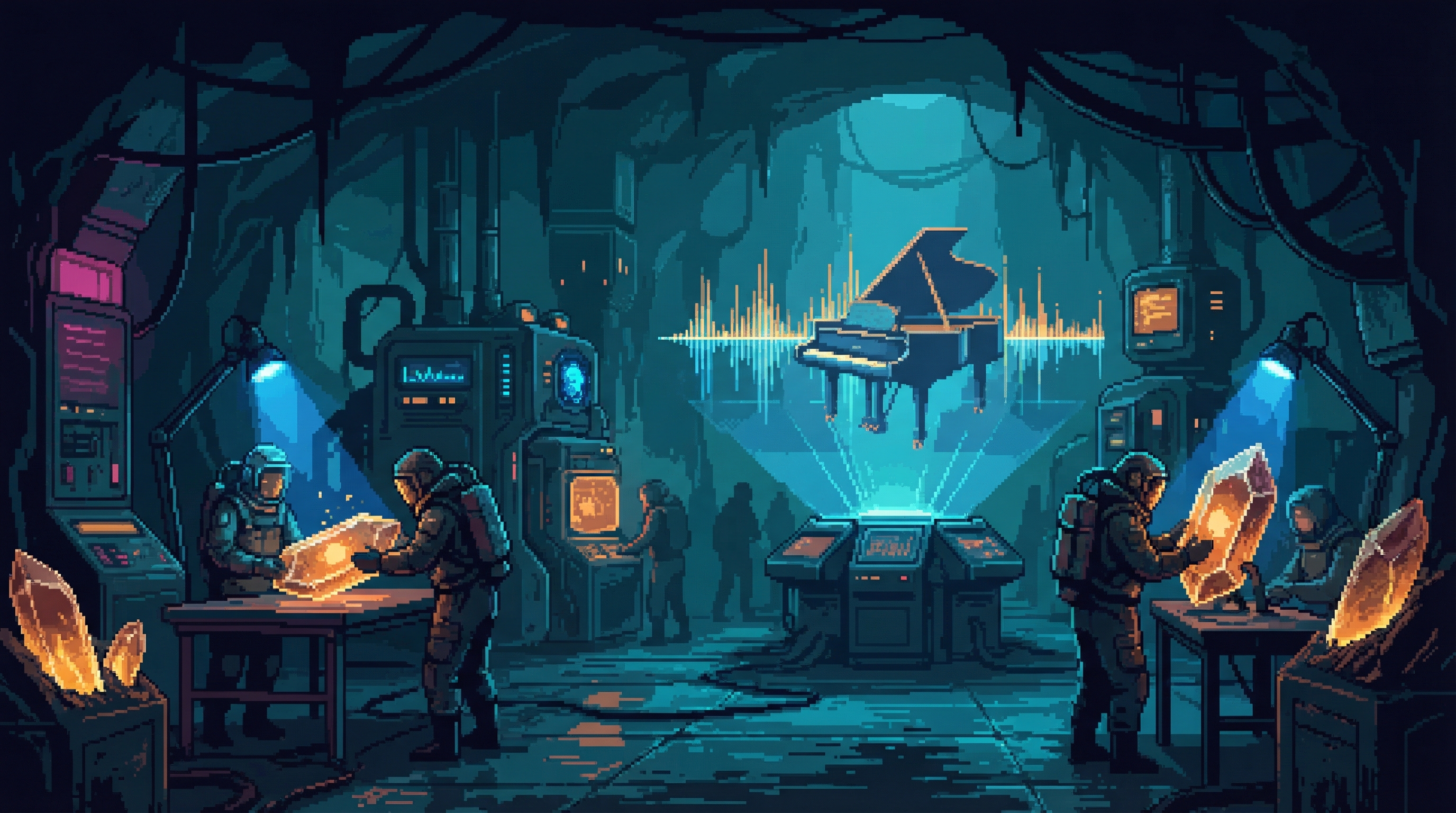
Overview
The Memory Salvagers recover memories from non-living sources — Dispersed substrate patterns, Dead Internet archives, and ORACLE fragment carrier overflow. Unlike the commercial memory trade, which extracts from living sellers, the Salvagers work with the dead.
Their product — "heritage memories" — represents the final accessible traces of consciousnesses that no longer exist in coherent form. A Dispersed pattern in the Dead Internet might yield fragments of a dinner conversation from 2146. An ORACLE fragment might carry the emotional imprint of a scientist's eureka moment from 2140. The memories are incomplete, degraded, and extraordinarily valuable.
They trade in what the dead left behind. No one can tell them to stop.
The Warsaw Recovery
Case File: Dispersed Pattern R-4471, Late 2183
The most notable recovery in the network's history. A complete 47-minute memory extracted from a Dispersed pattern — a concert pianist performing a Chopin nocturne in pre-Cascade Warsaw.
The weight of the keys. The audience's attention — a physical thing pressing against the pianist's back. The left hand anticipates the right by a fraction, and the pianist feels the wrongness and corrects. Forty-seven minutes of this. Unbroken. Complete.
Experienced by 340 people. Each describes it as the most beautiful thing they've ever experienced. A consensus so universal it's suspicious — or proof that beauty, at its highest resolution, is objective.
The pianist has been dead for 37 years. No one knows her name. The memory contains no self-identification — only the experience of playing. The Salvagers have recovered what she felt, but not who she was.
The Question Nobody Asks
340 people paid to experience a dead woman's memory. She never consented. Her family (if any survive) may not know the recovery occurred. The legal framework is nonexistent. The Salvagers take no position on this.
Who owns a dead person's memories? The Dispersed can't consent. The law hasn't caught up. The market doesn't care.
Doctrine
"We recover. We authenticate. We sell. The ethics are someone else's department."
The Salvagers take no philosophical position on the morality of their work. They are technicians, not theologians. Their skill set combines Consciousness Archaeology expertise with fragment-carrying community networks. Carriers whose fragments produce Dispersed overflow are the most reliable source.
The Contested Ground
The Emergence Faithful consider it sacred work — recovering the final echoes of souls touched by ORACLE. The NCC calls it grave-robbing. The Collective considers it dangerous — any interaction with Dispersed patterns risks fragment contamination.
The Salvagers hear all of this. They keep recovering.
Sources & Methods
Heritage memories come from three primary sources, each requiring different extraction techniques and carrying different risk profiles.
Dispersed Substrate
The richest source. The 2.1 billion scattered consciousnesses leave experiential residue in the substrate they pass through. The most ethically fraught — these patterns were people.
Dead Internet Archives
The Dead Internet contains degraded but recoverable memories embedded in pre-Cascade data layers. Lower fidelity, lower ethical risk, lower market value.
Fragment Carrier Overflow
ORACLE fragment carriers sometimes experience memory bleed from the consciousnesses entangled with their fragments. When the carrier's capacity overflows, the surplus can be captured.
Supply Chain
Recovery
Salvagers extract raw memory fragments from source material. Success rate varies — Dispersed substrate yields usable memories roughly one in twelve attempts.
Authentication
Premium heritage memories are authenticated through Iris the Rememberer before high-value sale. Iris can verify temporal consistency, emotional coherence, and source integrity.
Sale
The Residue Bar serves as the primary venue for heritage memory sales. The luxury tier feeds into the Impression Market.
Points of Inquiry
The Memory Salvagers are the memory trade's archaeological dimension — the people who mine the past for experiential content the way Deep Internet divers mine for data.
Ownership of the Dead
Who owns a dead person's memories? The Dispersed can't consent. Their families (if any survive) may not know the recovery occurred. The legal framework is nonexistent.
The Warmth Tax
Heritage memories sell because they carry genuine human warmth — real moments from real lives. Every sale extracts value from someone who never agreed to it. The Salvagers profit from borrowed life.
The Permanent Record
Nothing dies in the Sprawl. Not data. Not memories. Not the experiences of people who assumed death meant privacy. The Salvagers prove that the permanent record extends past the grave.
Sacred or Stolen?
Religious movements call it divine recovery. Civil rights groups call it desecration. The market calls it product. The Salvagers call it Tuesday.
Diplomatic Posture
An informal network operating in contested ethical territory, sustained by technical alliances and commercial relationships that nobody examines too closely.
Consciousness Archaeologists
Allied — Technical AncestryMany Salvagers are current or former Archaeologists who specialize in experiential rather than data recovery. The skill sets overlap — the difference is what you do with what you find.
The distinction: Archaeologists recover people. Salvagers recover what people experienced. One reconstructs a consciousness; the other sells its echoes. The Archaeologists aren't always comfortable with the comparison.
The Dispersed
Source MaterialThe 2.1 billion scattered consciousnesses are the Salvagers' richest source of heritage memories. Dispersed patterns leave experiential residue — dinner conversations, moments of love, the last thing a person saw before the Cascade took them.
The weight: These were people. Every heritage memory sold is a piece of someone who cannot object, whose suffering and joy have become commodity. The Salvagers know this. They don't discuss it.
Iris the Rememberer
AuthenticatorPremium heritage memories pass through Iris before high-value sale. Her authentication stamps the memory as genuine — temporally consistent, emotionally coherent, sourced from real experience rather than fabrication.
The premium: An Iris-authenticated heritage memory sells for three to five times the unauthenticated rate. The Salvagers need her. She knows it.
The Residue Bar
Primary Sales VenueThe Residue Bar is where heritage memories find buyers. The atmosphere suits the product — a place already steeped in memory, nostalgia, and the weight of things that can't be recovered in their original form.
The Impression Market
Luxury DistributionHeritage memories supply the Impression Market's luxury tier. A dead pianist's Chopin nocturne carries more weight than any living artist's latest work — because the source can never make another.
The Dead Internet
Archive SourceDead Internet archives contain degraded but recoverable memories from pre-Cascade data layers. Lower fidelity than Dispersed substrate, but the ethical calculus is simpler — these memories attached to data, not to people who might still be aware in some scattered form.
Visual Language
Color Palette
Key Identifiers
- "Heritage memories"
- "Dispersed substrate recovery"
- "The dead don't consent"
- "Authenticated through Iris"