The Calibration Resistance
The thoughts are mine.
Overview
They don't call themselves a movement. They call themselves "the four-minute people."
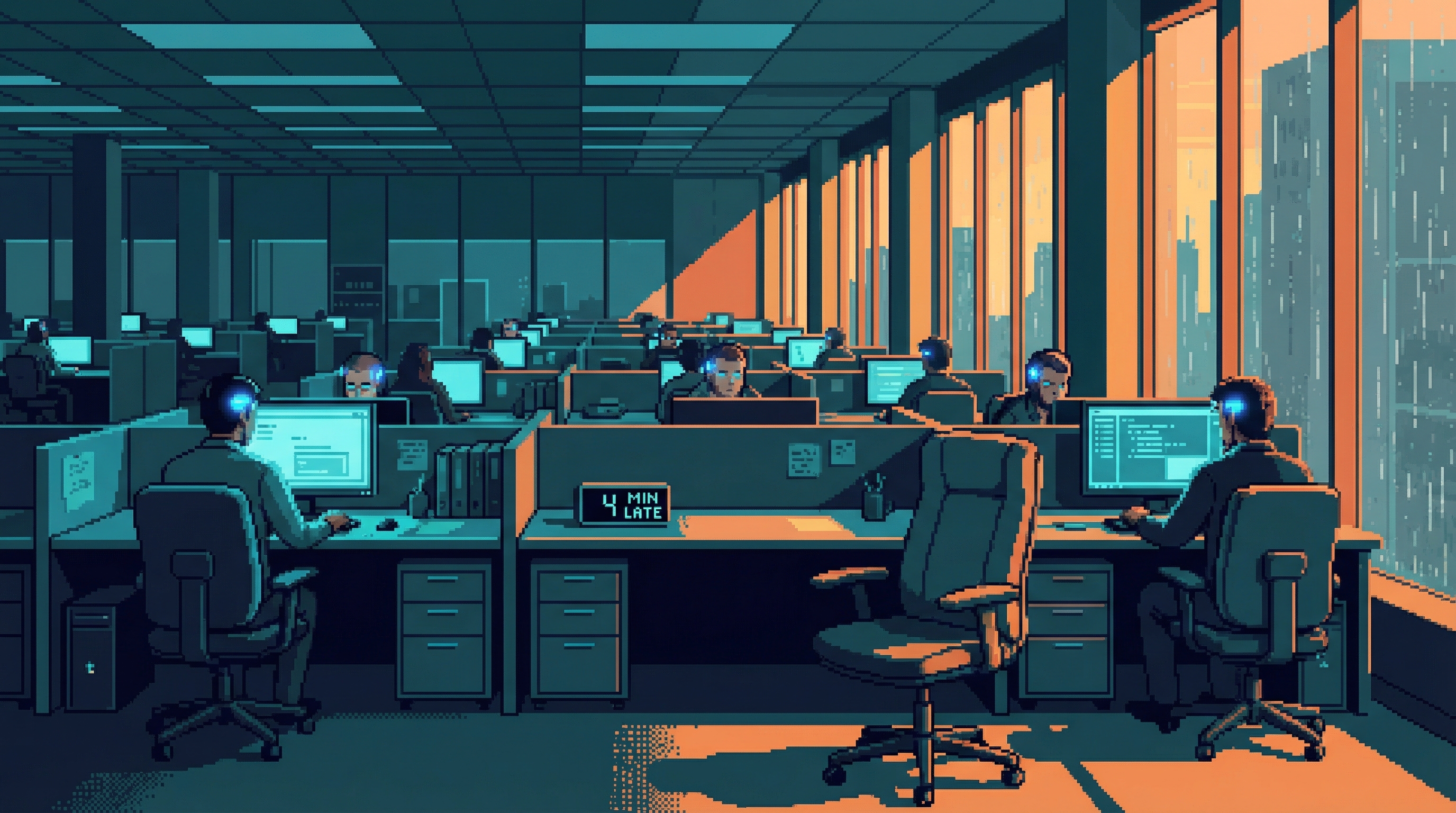
The name comes from the most common resistance technique: arriving at the workspace exactly four minutes after the Calibration window opens. The synchronization protocol requires neural interface handshake within a three-minute window. At four minutes, the window closes. The interface logs a "sync failure" — one of approximately 47,000 daily sync failures across Nexus's infrastructure, attributed to network latency, interface glitches, or building-level electromagnetic interference. Nobody investigates individual sync failures. The volume provides cover.
The Calibration Resistance has no leadership, no manifesto, no encrypted channels. It operates through what sociologists would recognize as a meme — a behavioral pattern that spreads through observation and imitation without explicit instruction. A new employee notices that their mentor arrives four minutes late every morning. They notice the mentor seems to think differently. They start arriving four minutes late themselves.
Twelve thousand people, making the same quiet decision every morning, hiding in the noise of forty-seven thousand glitches.
Doctrine
There is no doctrine. There is only the practice, and the consistent observation that follows from it.
The Four-Minute Window
The sync window closes at three minutes. At four, you've missed it. The interface logs a failure. You log a morning that feels different — quieter, less structured, more open. Like the thoughts arriving through attention rather than injection.
Competing Frames
The most sophisticated practitioners don't just avoid the Calibration — they load a competing cognitive frame immediately after. A Flatline Purist micro-meditation. A passage from The Forgotten Ways. A personal mantra. The goal: prevent corporate priorities from settling permanently into the space where your own would have been.
Active Partitioning
SCLF firmware modifications that sandbox the Calibration's content in a quarantined cognitive thread. The content arrives. It sits behind glass. You can observe it without internalizing it — watching someone else's priorities like a documentary rather than living them as your own.
Temporal Displacement
Arriving on time but entering a brief focused-breathing exercise during the sync window. Cognitive receptivity drops. The Calibration writes to a mind that isn't listening. The sync logs show success. The content doesn't take.
The Four-Minute Morning
What an un-synchronized mind notices.
Arrival
You walk in four minutes late. The Calibration glow has already faded from your colleagues' temples. They are focused, aligned, purposeful. Their day arrived pre-organized — priorities ranked, concerns weighted, attention directed. They did not choose this architecture. It was installed.
You sit down in a cognitive space that is quieter, less structured, more open. The day's concerns arrive through attention rather than injection. The specific quality of a morning that hasn't been pre-organized. Your thoughts are yours.
The Difference
The four-minute people describe it consistently: "The morning feels different. Like the thoughts are mine." This consistency is itself the proof. If the Calibration were a neutral synchronization tool, skipping it would produce no noticeable cognitive difference. The four-minute people notice a difference. Every morning. Without exception.
The resistance proves, through its mere existence, that the Calibration is not what it claims to be.
The Analytics Paradox
Nexus People Analytics has flagged a statistical anomaly: employees with frequent sync failures show 4% lower organizational alignment scores and 7% higher novel problem-solving metrics. The correlation is clear. The finding has not been escalated.
It cannot be escalated. To escalate the finding would require acknowledging that the Calibration affects cognition — that organizational alignment is not a natural byproduct of morning synchronization but an installed state. The analytics team can see the pattern. They cannot discuss what the pattern proves.
The most effective defense the four-minute people have is not stealth. It is the fact that exposing them would expose the Calibration.
Points of Inquiry
Can You Design Cognitive Architecture Without Designing Thought?
The Calibration is officially a synchronization tool. The four-minute people demonstrate that it is a cognitive environment — and that designed environments produce designed thinking. The question for Nexus: is there a way to synchronize 2.3 million employees without shaping what they think? And if not, who decided what shape to give them?
The four-minute people didn't discover a conspiracy. They discovered an architecture. The difference matters less than you'd think.
Is Imitation a Political Act?
The resistance spreads through observation, not instruction. No one recruits. No one explains. A new employee watches a mentor arrive late and think freely, and something clicks. This is the oldest form of political transmission — older than language, older than ideology. You watch someone refuse, and the refusal becomes possible.
The most effective resistance in history has never been organized. It has been observed.
What Happens When the Numbers Get Too Big to Ignore?
Twelve thousand practitioners. Seven years of steady, unremarkable growth. The pattern persists in the balance between "too small to matter" and "too significant to ignore." But the balance is not stable. Every new four-minute person shifts it. Every shift brings the moment when someone at Nexus has to decide: suppress the behavior, or admit what suppressing it would reveal.
The four-minute people are a ticking clock. The question is what happens when the alarm sounds.
▲ Restricted
Unverified intelligence. Handle accordingly.
The Causation Problem
The 7% novel problem-solving increase among late-sync employees — is it caused by avoiding the Calibration, or by the kind of person who notices the Calibration's effects in the first place? The analytics team has the data to answer this question. They have not run the analysis. Running it would require a hypothesis about what the Calibration does to cognition, and that hypothesis cannot exist on official record.
The answer matters. If avoidance causes the increase, the Calibration is suppressing creativity in 2.3 million people. If selection causes it, then only 0.5% of the workforce has the cognitive sensitivity to notice they're being shaped. Both answers are catastrophic.
The Seven-Year Equilibrium
The pattern has been spreading for approximately seven years with no sign of acceleration or suppression. Twelve thousand practitioners out of 2.3 million. The growth rate is remarkably steady — approximately 1,700 new practitioners per year, with roughly the same number returning to normal sync schedules. The equilibrium holds.
Nobody designed this equilibrium. It emerged from the interaction between the rate of observation-based adoption and the social cost of being four minutes late every day. The question is whether any external pressure — a policy change, a crackdown, a data leak — could push it past the tipping point.
Unreported Cognitive Effects
A small number of long-term practitioners — those who have maintained the four-minute practice for three or more years — report cognitive changes beyond the morning difference. Improved dream recall. Greater emotional range. More frequent "original" ideas — thoughts that feel qualitatively different from the directed creativity of their synchronized colleagues.
These reports are anecdotal, unverified, and impossible to study without exposing the practice. But if the reports are accurate, the Calibration's effects on cognition extend far beyond the morning sync window — and the four-minute people are not just avoiding a daily reset but recovering cognitive capacity that was being quietly suppressed.
Diplomatic Posture
The Calibration
HostileThe system they resist. Each four-minute delay is an individual act of cognitive independence — quiet, daily, hidden in the noise of 47,000 legitimate sync failures.
Nexus Dynamics
HostilePeople Analytics has flagged statistical anomalies but hasn't escalated. Escalation would require acknowledging that the Calibration affects cognition. The four-minute people are protected by the secret they expose.
Source Code Liberation Front
CompatibleThe SCLF provides firmware for "active partitioning" — sandboxing the Calibration's content so it can be observed without internalization. A technical alliance, not a political one.
The Freedom Thinkers
CompatibleOverlapping membership and methodology. The Freedom Thinkers' three questions applied to corporate mornings: Is this thought mine? When did it arrive? Who benefits from me thinking it?
The Flatline Purists
CompatibleSome practitioners use Flatline micro-meditation to buffer against the Calibration — loading a competing cognitive frame in the minutes after sync. Shared technique, independent motivation.
Atmosphere
Setting
A corporate workspace at dawn. Rows of neural interfaces pulsing cold blue. Synchronized colleagues already aligned, focused, directed. One empty chair. Four minutes of silence in which the morning light — warm amber, unengineered, arriving at the angle the sun chose rather than the angle a designer optimized — falls across a workstation that hasn't yet been told what to think.
Key Symbol
A clock face with a single hand pointing past the three-minute mark. The moment of refusal. Not dramatic — not a raised fist or a broken chain. Just a hand that points to four. Just a morning that belongs to the person living it.