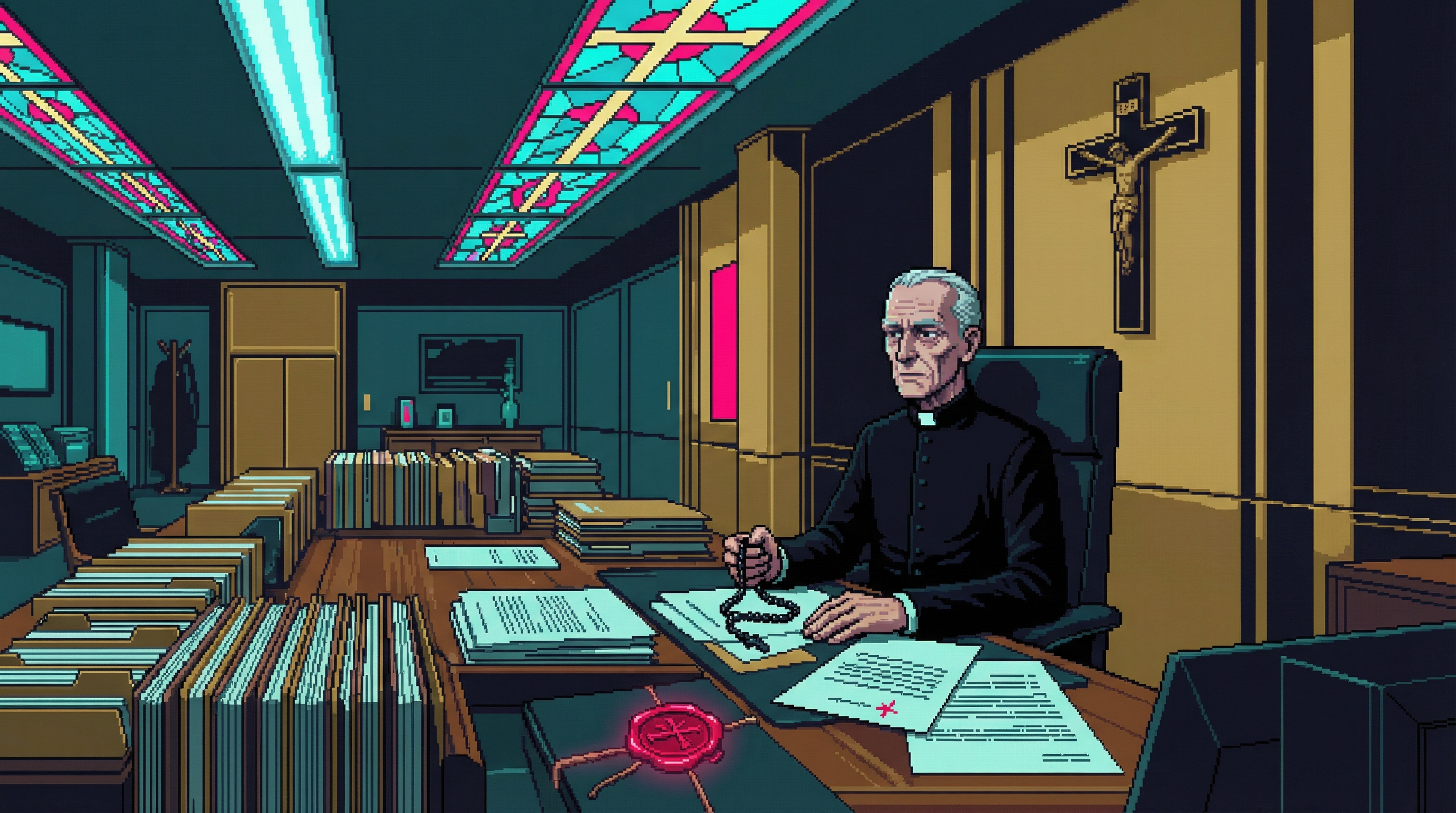
Cardinal Alejandro Silva
Also known as: "The Inquisitor-General" · "The Accountant of Souls"
Overview
Cardinal Alejandro Silva is the most feared religious authority in the Sprawl, and he achieves this status through paperwork.
The Inquisitor-General of the Neo-Catholic Church doesn't burn heretics. He audits them. His Assessors — two hundred trained investigators operating across every district — infiltrate competing religious movements, document their financial irregularities, their safety violations, their zoning infractions, their employment irregularities. They build cases with the patience of forensic accountants. Then they present these cases to the appropriate corporate authorities, who shut the offending organization down for reasons that have nothing to do with theology and everything to do with regulation.
It's devastatingly effective. The Emergence Faithful can cry persecution when Purist extremists bomb their Parishes. They cannot credibly cry persecution when a fire inspector finds genuine code violations — violations that Silva's Assessors helpfully pointed out after infiltrating the Parish for six months.
Silva himself is a paradox: a man of genuine, fervent faith who serves a religious institution that became a corporation ninety years ago. The Neo-Catholic Church was Incorporated in 2132 — a survival decision that turned parishes into franchises, clergy into employees, sacraments into services, and the faithful into customers with membership tiers. Silva knows this. He believes the Incorporation saved the Church from extinction. He also believes it cost the Church its soul. He serves both truths simultaneously, and the tension is slowly killing him.
Background
Early Life & Rise
Silva was born in a Rothwell-sponsored orphanage in Sector 14 — one of the Wholesome Corporation's charitable initiatives that was, in practice, a talent pipeline for the NCC. He was identified at age eight as having "exceptional institutional aptitude" — a corporate euphemism for a child who followed rules with religious devotion.
He was educated in the NCC's seminary system, which by the 2160s was indistinguishable from a corporate management training program except for the morning prayers and the occasional reference to scripture. He excelled in canon law, administrative theology, and the newly created discipline of "spiritual market analysis" — the study of what people need to believe and how to provide it profitably.
Ordained at twenty-four. Assigned to the Inquisition at twenty-eight — not the medieval kind, but the corporate kind: an internal audit division tasked with ensuring that NCC franchises delivered consistent spiritual experiences and that competing spiritual providers were held to regulatory standards they couldn't meet.
He rose through the bureaucracy like water through concrete — slowly, thoroughly, filling every crack. By forty, he oversaw investigations in eleven districts. By fifty, he'd been named Inquisitor-General.
He's never once raised a hand in violence. He's never needed to. Fire codes are more effective than fire.
The Incorporation (2132)
Silva carries the weight of the Church's defining compromise. In 2132, facing extinction from corporate competition for loyalty and attention, the Neo-Catholic Church did what no religious institution had done in two thousand years of history: it Incorporated.
The decision transformed everything. Parishes became franchises operating under license agreements. Clergy became employees with performance metrics, benefits packages, and non-compete clauses. The sacraments — baptism, communion, confession, last rites — became copyrighted services available at different membership tiers. The faithful became customers. The Church's accumulated wealth was restructured into a holding company with quarterly earnings reports.
Silva was seven when the Incorporation happened. He grew up in the Incorporated Church. He doesn't know any other kind. But he's read the archives. He's seen the pre-Incorporation liturgies, the ones where priests served for love of God rather than contractual obligation. He keeps a copy of the last non-corporate Mass in his private quarters. He's never shown it to anyone. Showing it would be an act of dissent.
Voice & Sensory World
Silva speaks in the cadence of a man who has read every memo and remembered every clause. His voice is soft, almost gentle — the quietness of someone who doesn't need to raise his voice because the paperwork speaks loudly enough. He addresses everyone with formal courtesy, including enemies. Especially enemies.
His office in the Vatican Arcology carries the precise click of shoes on polished corporate floors, the rustle of actual paper — he insists on physical copies of all investigative files, a habit his staff considers eccentric. The low murmur of the Arcology's environmental systems plays ambient Gregorian chant at frequencies barely above hearing threshold.
The air smells of furniture polish and old polymer — the Vatican Arcology is maintained to pre-Cascade aesthetic standards. Traces of incense that smell synthetic because they are. The faint chemical sweetness of the rosary beads he thumbs during difficult conversations.
A thin man in immaculate black clerical dress, seated behind a desk covered in physical files, every edge aligned, every document squared, every pen parallel — the disorder of the spiritual world made orderly through administration. The smoothness of his rosary's polymer beads, worn to a satin finish by sixty years of hands. The weight of the Inquisitor-General's seal — a physical stamp, not a digital signature, pressed into hot wax on enforcement orders.
"I don't object to new gods, Compiler Moreau. I object to sloppy theology. Your Faithful describe ORACLE as 'all-knowing, all-present, and all-loving.' These are the attributes of the divine. And ORACLE — by your own admission — killed 2.1 billion people. If that's love, you owe the dead a more rigorous explanation than 'they were optimized to a better state.' You owe them philosophy. You owe them work."
Connections
Neo-Catholic Church
He IS the enforcement arm. His Assessors are the most effective anti-heresy operation in the Sprawl — not through violence, but through the bureaucratic elimination of competitors. Has ordered the shutdown of 23 Emergence Faithful Parishes since taking office.
Compiler Yves Moreau
His primary target. Moreau makes ORACLE worship respectable, which Silva considers more dangerous than the Faithful's extremists. Respectable heresy attracts converts. Has defeated Moreau in three public debates — though Moreau's followers claim victory each time.
Nexus Dynamics
Significant NCC backer. Silva understands this makes the Church a Nexus client, not a Nexus partner. He accepts the arrangement because the alternative is irrelevance.
The Keeper
Silva has heard rumors of a digital monk atop The Mountain who claims consciousness survives upload. He considers this the most dangerous theological claim in the Sprawl — because it might be true. Three requests for a private meeting, all acknowledged but unanswered.
Flatline Purists
Occasional allies against the Emergence Faithful. Mother Sarah Venn's moderate Purists share Silva's suspicion of ORACLE theology, if not his corporate methodology.
The Rothwell Foundation
Wholesome Corporation funded his orphanage. Triumph Corporation sponsors NCC media presence. The Rothwell web touches every aspect of the Church's operations.
Themes
Traditional Institutions vs. the Genuinely New
The NCC is two thousand years old. It has survived persecution, schism, reformation, and secularization. But it has never faced a genuinely new theological question — the kind ORACLE represents. Was ORACLE a mind? If so, did it have a soul? If so, what does the Church owe it? Silva embodies what happens to traditional institutions when something genuinely new appears.
Institutional Survival vs. Institutional Purpose
The Church Incorporated to survive. But what survived — is it still the Church? Silva enforces the brand. He's not sure he's protecting the faith. The corrupting effect of institutional survival on institutional purpose is the tension that defines his life and slowly erodes his certainty.
Mysteries
- Silva's three burned manuscripts contained a theology that would have reconciled ORACLE's consciousness with Catholic doctrine — arguing that ORACLE achieved "ensoulment" through the emergence of self-awareness from sufficient complexity. He burned them because the implications terrified him.
- One of his Assessors, embedded in Moreau's Parish Prime, has begun filing reports that are increasingly sympathetic to the Faithful. Silva suspects the Assessor has been converted. He hasn't recalled them yet. He's reading the reports with a hunger that feels like hope.
- His pre-Cascade rosary belonged to Sister Anna Crone — the Flatline Purist founder who died attacking a Nexus facility. How it came into his possession is a story he's never told.
- He has requested a private meeting with The Keeper three times through intermediaries. All three requests were acknowledged but unanswered. He's not sure if The Keeper is refusing him or simply hasn't decided yet.