
Dr. Selin Ayari
The Somnambulist · Founder, Insomnia Wards
Dr. Selin Ayari was a neurologist at Helix Biotech's cognitive wellness division when she noticed something in the claims data that made her stop breathing: the creativity index was dropping. Not dramatically — a 2–3% decline per quarter, the kind of number that would be noise in any other context. But the decline was universal across all Circadian Protocol recipients. Every Protocol user, regardless of role, age, or augmentation tier, showed the same pattern: baseline cognitive speed and accuracy stable or improved, lateral thinking declining, novel problem-solving declining, emotional self-regulation declining, and dream recall at zero.
The augmented weren't dreaming. They hadn't dreamed in years. Their brains, optimized for continuous consciousness, had eliminated REM sleep entirely — not as a side effect but as a feature. The Circadian Protocol treated dreaming as noise. It was not noise. It was the brain's only native mechanism for unbounded, unconstrained, chaotic-but-productive cognition — the capacity for surprise.
Selin published her findings through G Nook terminals because the institutional channels were closed to her. The paper was read by 47,000 people. Nexus issued no response. Helix issued no response. Four months later, Selin was deprecated — not for the paper, but for "departmental optimization." She refused firmware reversion, walked into the Dregs with her corporate-grade neural enhancement intact, and opened the first Insomnia Ward six months later.
Field Observations
Subject speaks the way her monitoring equipment records: in bursts of precise data separated by long silences during which something is being processed. She has the particular stillness of someone who has spent years observing patients who cannot sleep and has learned that the most important observations happen in the quiet between metrics.
The Research and the Wound
Her work is rigorous, quantified, defensible. Her motivation is her dead mother, whose dream-conversations the Protocol ended. She never mentions this in papers. Everyone who knows her knows anyway. Her mother died in the Sector 8 Grid Collapse during the Three-Week War of 2171 — 89,000 died in their sleep. The cruel irony: they died in sleep, and Ayari has dedicated her life to restoring it.
Corporate-Grade in the Dregs
She refused firmware reversion and kept her corporate-grade cognition. This makes her one of the sharpest minds in the Dregs — and one of the most dangerous, because she understands the systems she's fighting from the inside out. Helix's architecture, its incentive structures, its pressure points. She knows where the machine bends.
The Method
Four years of documenting a condition no institution recognizes. She doesn't rage. She measures. The measurements accumulate into an indictment no quarterly report can suppress forever. Patience wielded like a scalpel.
The 3 AM Office
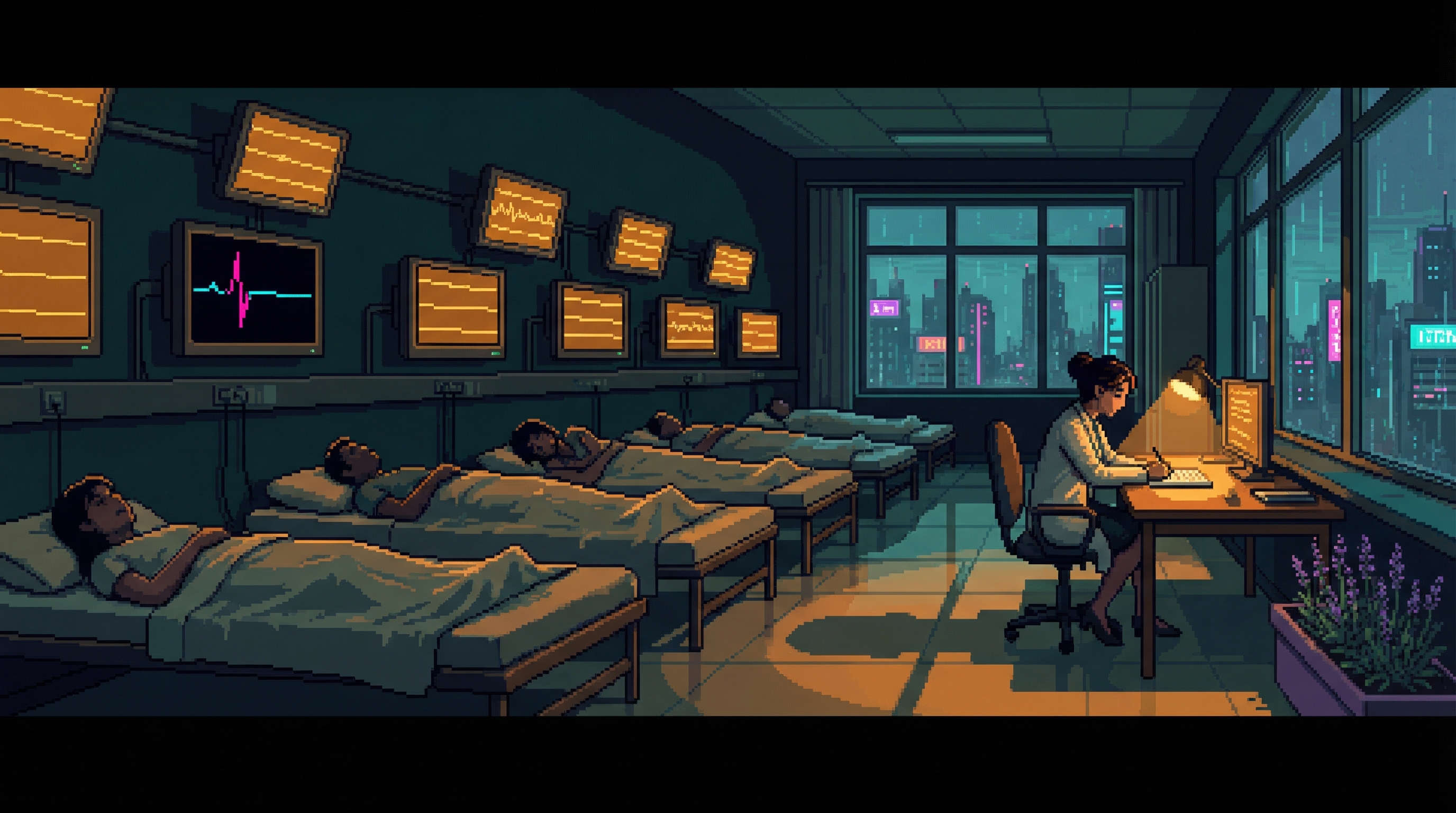
Amber monitoring equipment. The soft sounds of patients not sleeping. A physical notebook open to today's cognitive assessments. Hands steady from years of clinical work — she holds a pen the way a surgeon holds an instrument. Blue-to-charcoal walls, 2700K warmth, lavender mixed by hand, the 90-minute light cycle she designed.
"The Protocol eliminates REM because REM is inefficient. By every metric Nexus tracks, that's correct. Creativity isn't a metric Nexus tracks. Empathy isn't a metric Nexus tracks. Surprise isn't a metric Nexus tracks. The question isn't whether the Protocol works. The question is what 'works' means when you've defined it to exclude everything that makes consciousness worth having."
"I dreamed about my mother for twelve years after she died. Conversations. Arguments about dinner. The specific quality of silence between a mother and daughter who are comfortable enough not to speak. The Protocol ended those conversations. It didn't kill my mother. She was already dead. It killed the part of my mind that could still reach her."
The Record
The Dream Deficit Paper (2181)
Published through G Nook terminals because institutional channels were closed to her. The findings: the Circadian Protocol's elimination of REM sleep had produced a measurable, accelerating decline in lateral thinking, novel problem-solving, and emotional self-regulation across all augmented populations. Every sleep metric improved when REM was eliminated. The one metric that declined — creativity — was not tracked because creativity was not a product category.
47,000 readers. Zero institutional responses. The paper threatened ¢8.4 billion in Circadian Protocol revenue. Four months later, Selin was deprecated — not for the paper, officially. For "departmental optimization."
The Deprecation
Helix Biotech standard procedure: revoke access, revert firmware, reassign to non-sensitive roles. Selin submitted to the first. Refused the second. Walked before they could enforce the third. She left the Spire carrying corporate-grade neural enhancement that her deprecation should have revoked — and Nexus database credentials that nobody thought to cancel.
The Insomnia Wards
Six months after deprecation, the first Ward opened adjacent to Sector 7G. A clinic treating a condition the medical system doesn't recognize, staffed by a deprecated neurologist using corporate hardware the corporation forgot to reclaim. The Wards operate on a 90-minute light cycle Ayari designed to mimic pre-Protocol circadian rhythm. Blue-to-charcoal walls. 2700K warmth. Lavender she mixes by hand because the synthetic version triggers augmented olfactory alarms.
12% microsleep success rate. That number sounds small until you understand what it means: one in eight patients, for the first time since augmentation, achieves brief episodes that may be REM sleep — or may be something entirely new. A hybrid state the Protocol's elimination of natural sleep architecture forced the brain to invent.
The Mother
For twelve years after the Sector 8 Grid Collapse, Selin dreamed of conversations with her dead mother. Arguments about dinner. The quality of silence between a mother and daughter who are comfortable enough not to speak. Basic Wakefulness ended the dreams. Not violently. Not suddenly. They simply stopped, the way a frequency fades when you tune the receiver past it. The Insomnia Wards are her eulogy.
Known Associates
Helix Biotech
Deprecated in 2181 after publishing the Dream Deficit paper — officially for "departmental optimization," actually for threatening ¢8.4B in Circadian Protocol revenue. She still carries their hardware. She still uses their credentials. The deprecation was thorough in every way except the ones that matter.
The Insomnia Wards
Founded six months after deprecation. A clinic treating dreamlessness in a city that considers dreaming obsolete. 12% microsleep success rate. The 90-minute light cycle. The hand-mixed lavender. Every detail calibrated by a mind that Helix sharpened and then discarded.
Dr. Henrik Sauer
The invisible bridge. Sauer channels classified Helix data on emotional regulation decline from Dr. Kemi Oladipo through G Nook dead drops. The data that powers the Insomnia Wards passed through Sauer's hands first. They have likely never met in person.
Davi Okonkwo
The Wakefulness Program lead who is everything her research predicts — cognitive ceiling approaching, emotional regulation declining, dreaming capacity at zero. She studies him without his knowledge. A living dataset she cannot help and cannot look away from.
Kessler Brandt
Co-developed the Ayari-Kessler Scale for measuring emotional regulation in augmented subjects. The scale is now used in every Insomnia Ward assessment — a clinical instrument designed by two researchers, one of whom was deprecated and the other of whom remains carefully anonymous.
Felix Otieno
She knows the Night Gardener's identity and guards it. The garden's therapeutic effect on Insomnia Ward patients is too valuable to risk. What grows there in the dark somehow helps people who cannot sleep. She measures the effect. She does not explain it.
Memory Therapists Association
Collaborates on Dream Processing certification — her clinical framework, their therapeutic methods. The partnership is one of the few places where deprecated science meets underground practice and produces something that works.
Dr. Lian Xu
A parallel trajectory. Both documented corporate-created conditions through G Nook. Both were suppressed. Ayari was deprecated and walked free. Xu was retained as a controlled monitor — kept inside the system where her silence could be managed. Two versions of what happens when you tell the truth inside a corporation that sells the opposite.
Dr. Hana Petrov
Pre-Cascade sleep researcher who predicted the Dream Deficit in her 2138 paper "The Cost of Continuous Cognition." Ayari cites her as intellectual ancestor. Petrov's research archive sits in the Circadian Tower basement. Ayari accesses it using credentials nobody thought to cancel.
The Three-Week War
Her mother died in the Sector 8 Grid Collapse of 2171. 89,000 people died in their sleep. The loss that drives everything — the research, the Wards, the twelve years of dream-conversations that the Protocol ended.
Open Questions
What Happens When You Stop Measuring What Matters?
Every sleep metric improved when REM was eliminated. Cognitive speed: up. Accuracy: up. Productive hours: up. The one metric that declined — creativity — was not tracked because creativity was not a product category. Empathy was not a product category. Surprise was not a product category. The Protocol's designers understood perfectly what they were building. They didn't value what they were removing. At what point does an optimization that succeeds on every measured axis become an amputation?
The 47,000-Reader Silence
The Dream Deficit paper was read by 47,000 people and changed nothing. The data is irrefutable. The institutional response is silence. Selin published through unofficial channels because official channels serve the product, not the truth. Is 47,000 readers enough to matter if none of them have institutional power? How long can silence hold against accumulating evidence? And what happens when the 12% microsleep success rate reaches 15%, or 20%, or proves that the brain was right all along?
The Hybrid State
The microsleep episodes — are they genuine REM, or something new? A brain stripped of its natural sleep architecture, forced to invent a new pathway to the processing state it needs. If the Insomnia Wards are producing a novel form of consciousness — something that didn't exist before the Protocol eliminated the original — what does that mean for the 12% who achieve it? And what does it mean for the 88% who don't?
The Warmth Tax
Selin carries corporate-grade cognition in the Dregs. She could be selling that processing power. She could be leveraging it for position, for influence, for safety. Instead she runs a clinic with a 12% success rate treating a condition that doesn't officially exist. The warmth tax: the cost of caring about people the system has written off. Every hour in the Ward is an hour she could spend on something the market would reward. She has never done the calculation. She doesn't need to. She knows what the numbers would say.
▲ Unverified Intelligence
The following items are flagged as unconfirmed. Sources vary in reliability.
- The unrevoked credentials: Subject accesses Dr. Petrov's pre-Cascade research archive in the Circadian Tower basement using Nexus database credentials that her deprecation should have revoked. An ORACLE-era algorithm appears to have classified her as "legacy employee — access maintained for continuity purposes." No one at Helix has noticed or corrected this. The archive contains Petrov's original Dream Deficit predictions from 2138 — forty-three years before Ayari confirmed them.
- The Oladipo correspondence: Dead drop communication through G Nook terminals between subject and Dr. Kemi Oladipo, a sleep researcher retained inside Helix. If discovered, the correspondence would expose Helix's classified data showing a 47% emotional regulation decline in Full Wakefulness users. Sauer is believed to be the bridge.
- The Night Gardener: Subject knows the identity of the individual maintaining the therapeutic garden near her Ward. She has taken deliberate steps to protect this information. The garden's effect on patient outcomes is measurable but unexplained — Ward patients who spend time there show a 3x improvement in microsleep onset. She documents the correlation. She does not report the gardener.
- The nature of microsleep: Whether the microsleep episodes are genuine REM or something unprecedented — a hybrid consciousness state that the Protocol's destruction of natural sleep architecture forced the brain to invent. Subject's private notes, visible during Ward observation, suggest she believes it is something new. She has not published this assessment.
- The Davi Okonkwo file: Subject maintains an unauthorized longitudinal study of the Wakefulness Program lead. Cognitive ceiling approach rate, emotional regulation markers, creativity index decline — all tracked without his knowledge or consent. The file, if it exists, would constitute the most detailed case study of Dream Deficit progression in a high-augmentation subject.
Sensory File
The Insomnia Ward at 3 AM. Amber monitoring equipment casts warm light against deep blue-charcoal walls. The soft sounds of patients not sleeping — the shift of a body on a cot, a murmured word, the hum of EEG readouts showing flatline consciousness with, occasionally, a single REM spike that makes Ayari's hands stop moving over her notebook.
2700K warmth everywhere. The 90-minute light cycle she designed mimics a circadian rhythm the augmented have forgotten. Lavender mixed by hand — synthetic triggers augmented olfactory alarms, so she grows it in a small planter by the window. The planter was a gift from someone she won't name.
Her voice is measured, precise, with pauses that feel like the silences between data points. She holds a pen the way a surgeon holds an instrument. When a patient achieves microsleep — the 12% — she records the time, the duration, the EEG signature, and then she sits very still for a moment before moving to the next assessment. No one has asked her what she's thinking during those moments. Everyone in the Ward already knows.