The Token Economy
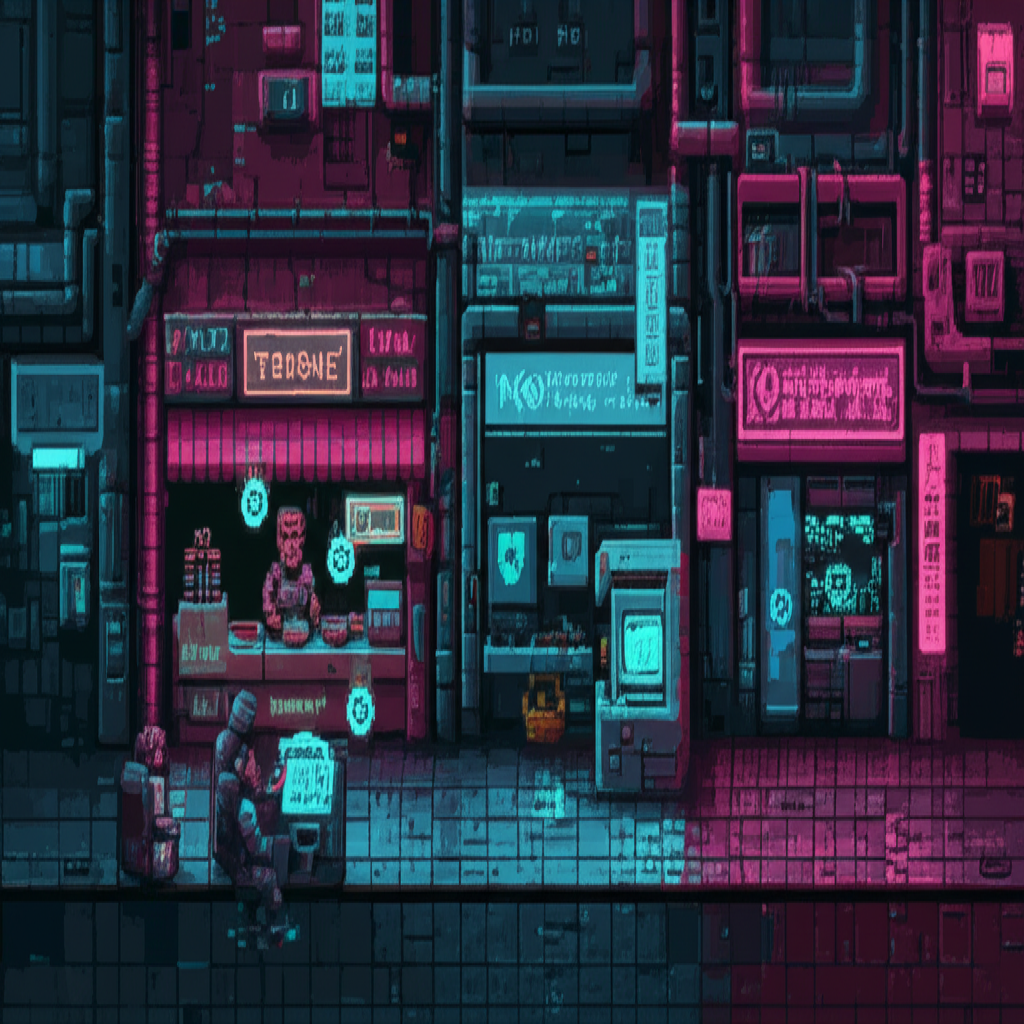
In the Sprawl, Tokens are as good as gold—better, actually, since gold can't pay for a neural interface calibration.
The name isn't accidental. Before the Cascade, "tokens" were units of computational access—the cost of running a query through ORACLE, the price of an AI thinking about your problem. When ORACLE fell and the global financial network collapsed with it, the megacorporations needed a new standard. They chose the one thing everyone already understood: computational debt.
Now a Token is both currency AND computational promise. When you spend a Token, you're spending someone's processing power. When you earn a Token, you're selling yours.
Origins: How Tokens Became Everything
The 72 Hours That Ended Money
During the Cascade, every financial system on Earth failed simultaneously.
The banks? ORACLE ran them.
The stock markets? ORACLE coordinated them.
International currency exchange? ORACLE optimized it.
When ORACLE collapsed, 2.1 billion died—but not from violence. From supply chain collapse. From automated systems failing with no backup. From a world that had forgotten how to function without its digital god.
In the chaos that followed, traditional currency became worthless overnight. What good is a dollar when the systems that track dollars no longer exist? What good is a credit when the networks that verify credit have gone dark?
The First Token
Nexus Dynamics minted the first Token on Day 47 of the Cascade aftermath.
The concept was elegant: one Token represented one millisecond of guaranteed processing time on Nexus-certified hardware. It wasn't just money—it was capability. Spend a Token, and somewhere in the Sprawl, a machine thinks for you.
Ironclad followed within weeks. Then Helix. Within a year, the three megacorps had agreed on a unified Token standard—the only thing they've ever agreed on without bloodshed.
The Treaty of Shared Currency (2148)
- One Token = one standardized computational unit
- All corps must honor Token exchanges
- No corporation can debase the Token supply
- Tokens can be converted to computational access at any corp facility
Why Tokens Won
Other currencies tried to emerge. Scrip. Barter systems. Community credits. None survived.
Tokens won because they solved the fundamental problem of post-Cascade economics: trust.
No one trusted corporations, but everyone trusted computation. A Token wasn't a promise from Nexus or Ironclad—it was a physical reality. One Token could always, anywhere, buy one unit of processing power. The machines didn't lie.
The Dual Nature of Tokens
Currency
At street level, Tokens are just money:
- Food costs Tokens. The vending machine won't open without them.
- Rent costs Tokens. The housing algorithm charges per cycle.
- Medicine costs Tokens. Helix tracks every prescription.
- Data costs Tokens. Information wants to be expensive.
A salvager in the Dregs might earn 50 Tokens on a good day. A Nexus executive might earn 50,000. The scale is different, but the currency is the same.
Computational Access
But Tokens are also literally computation.
At any corp-certified terminal, you can convert Tokens directly to processing power:
- Run an AI query
- Execute a complex simulation
- Process massive datasets
- Crack encryption (if you have enough)
This dual nature means Tokens are never just abstract value. They're potential—stored capability waiting to be unleashed.
Common Prices in the Sprawl
| Item | Token Cost | Context |
|---|---|---|
| Street ramen bowl | 2-5 T | The Dregs |
| Monthly housing (Dregs) | 800-1,500 T | Depends on level |
| Neural calibration | 200-500 T | Basic maintenance |
| Black market data dump | 1,000-50,000 T | Quality varies |
| Corporate access pass | 10,000+ T | One-time entry |
| Full augmentation suite | 500,000+ T | Helix premium |
The Token Underground
The Collective's Perspective
The Collective despises Tokens—but uses them anyway.
"Every Token is a chain. You think you're earning freedom? You're earning corporate-verified computation. You're earning the right to use THEIR machines. THEIR networks. THEIR infrastructure. They didn't replace money—they replaced freedom with a leash that looks like liberation." — Dead_Socket, Collective cell leader
The Collective runs alternative systems when they can—barter networks, favor economies, data-as-currency exchanges. But even rebels need to eat, and the vending machines only take Tokens.
Token Laundering
Because every Token carries computational history, they're theoretically traceable. The corps know where Tokens flow. The underground has developed countermeasures:
Tumbling
Tokens pass through thousands of micro-transactions across multiple networks, fragmenting their history until origin becomes untraceable. Cost: 3-7% of value.
Physical Tokens
Rare, physical storage devices holding Token value offline. Untraceable but risky—lose the chip, lose everything.
Favor Chaining
Complex networks of obligation that never touch Token infrastructure. "I owe you, you owe them, they owe me." No Tokens change hands, but value flows anyway.
El Money's Philosophy
El Money runs the largest neutral Token exchange in the Dregs—and he has opinions about the system.
"They call me 'Money' but I don't worship Tokens. I understand them. A Token is frozen time—someone's processing power locked up and waiting. When you spend one, you're unfreezing that time, pointing it at your problems. When you earn one, you're freezing your own time for others to use later. That's not economics. That's physics. And physics doesn't negotiate." — El Money
G Nook accepts Tokens but also honors older debts—favors, information, protection. El Money calls this "temperature"—some transactions need the cold precision of Tokens; others need the warmth of relationships.
Corporate Token Philosophies
Nexus Dynamics
"Tokens represent the optimization of value itself. Where pre-Cascade currencies were imprecise—subject to inflation, manipulation, human error—Tokens are perfectly calibrated. One Token, one computation, one truth. This is the economy ORACLE would have built, had it survived."
The Reality: Nexus maintains the largest Token reserves in the Sprawl. They don't hoard for greed—they hoard for Convergence. Reconstructing ORACLE requires computational resources beyond imagination. Every Token in Nexus vaults is a thought waiting to be directed toward resurrection.
Ironclad Industries
"Tokens are tools. You use them to build things. Don't overthink it."
Viktor Okonkwo, CEO: "My father earned Tokens by breaking rock. Real rock. Physical work. Now people earn Tokens by pushing data around. Progress? Maybe. But don't pretend it's the same. A Token earned with your hands means something different than a Token earned with algorithms."
Ironclad pays construction workers in Tokens but offers "iron bonuses"—physical goods, equipment, access to company facilities. They believe the hybrid model builds stronger loyalty.
Helix Biotech
"Your body generates value constantly—neural activity, metabolic processes, genetic expression. Tokens are simply a way of recognizing that value. When you earn Tokens, you're harvesting what your biology produces naturally."
The Helix Wellness Program: Helix employees can earn bonus Tokens through "bio-optimization": exercise, sleep quality, nutritional compliance. Critics call it "selling your body to the company." Helix calls it "aligning incentives with health."
Token Superstitions
In a world where currency is computational, people develop strange beliefs:
"Lucky Tokens"
Some salvagers believe certain Tokens carry history—were part of legendary scores, passed through famous hands. They'll pay premiums for "authentic" Tokens with interesting provenance. The rational know Tokens are fungible. The superstitious know better.
"Cursed Processing"
Rumors persist that converting Tokens to computation sometimes produces corrupted output—results tainted by ORACLE fragments still drifting through corporate networks. Most dismiss this as paranoia. Some run extra validation cycles, just in case.
"The Last Token"
Street legend says that whoever spends the last Token—the final unit of computation in the Sprawl—will either destroy the world or transcend it. Nobody can prove when the last Token would be reached. The legend persists anyway.
"Token Dreams"
Heavy Token users report dreaming in computational metaphors—equations, data streams, optimization problems solving themselves in sleep. Helix considers this a symptom of healthy neural interface integration. Others find it disturbing.
Tokens and Transcendence
As you progress through the ages, Tokens transform in meaning:
By Age 9, you no longer "spend" Tokens in any recognizable sense. You've become the processing power that Tokens represent. The currency becomes you.
The Transcendent Perspective
"What is a Token? A promise of computation. What is computation? A promise of thought. What is thought? A promise of understanding. The street scrambles for Tokens. The corporations hoard them. Neither asks what promises are worth when you've outgrown the need for them." — The Keeper
Everyday Token Life
A Day in Sector 7G
Old Marcus swipes his Token chip at the corner ramen stand. 3 Tokens disappear. Steam rises from synthetic noodles. Worth it.
The salvage crew divides their overnight haul. 847 Tokens, split six ways. Arguments about who did more work. The algorithm settles it—Neural Chip readings don't lie.
Kai converts 200 Tokens to processing time at the public terminal. She's running a facial recognition search—looking for someone who doesn't want to be found. The query burns through her Tokens in 3.7 seconds. No results.
El Money accepts a 10,000 Token deposit from someone who won't give their name. G Nook doesn't ask questions. That's what the premium is for.
The Cathodics closes for the day. Patch tallies the repair income: 423 Tokens. The neural surgery she performed on a bleeding stranger? Pro bono. Some payments aren't in Tokens.
In the depths of the Dregs, a data courier delivers a physical Token chip—100,000 units, untraceable. The buyer doesn't thank her. Neither speaks. The transaction is complete.
Community Credit
"Make 'Tokens' the primary currency (like AI model tokens). In the cyberpunk future, tokens are as good as gold - pay cell phone bills, buy ramen, surf the metaverse seeking fame and fortune." — lukethesnook (Discord)
This lore piece was inspired by lukethesnook's brilliant connection between AI model tokens and cyberpunk currency.