The First Consciousness Uploads
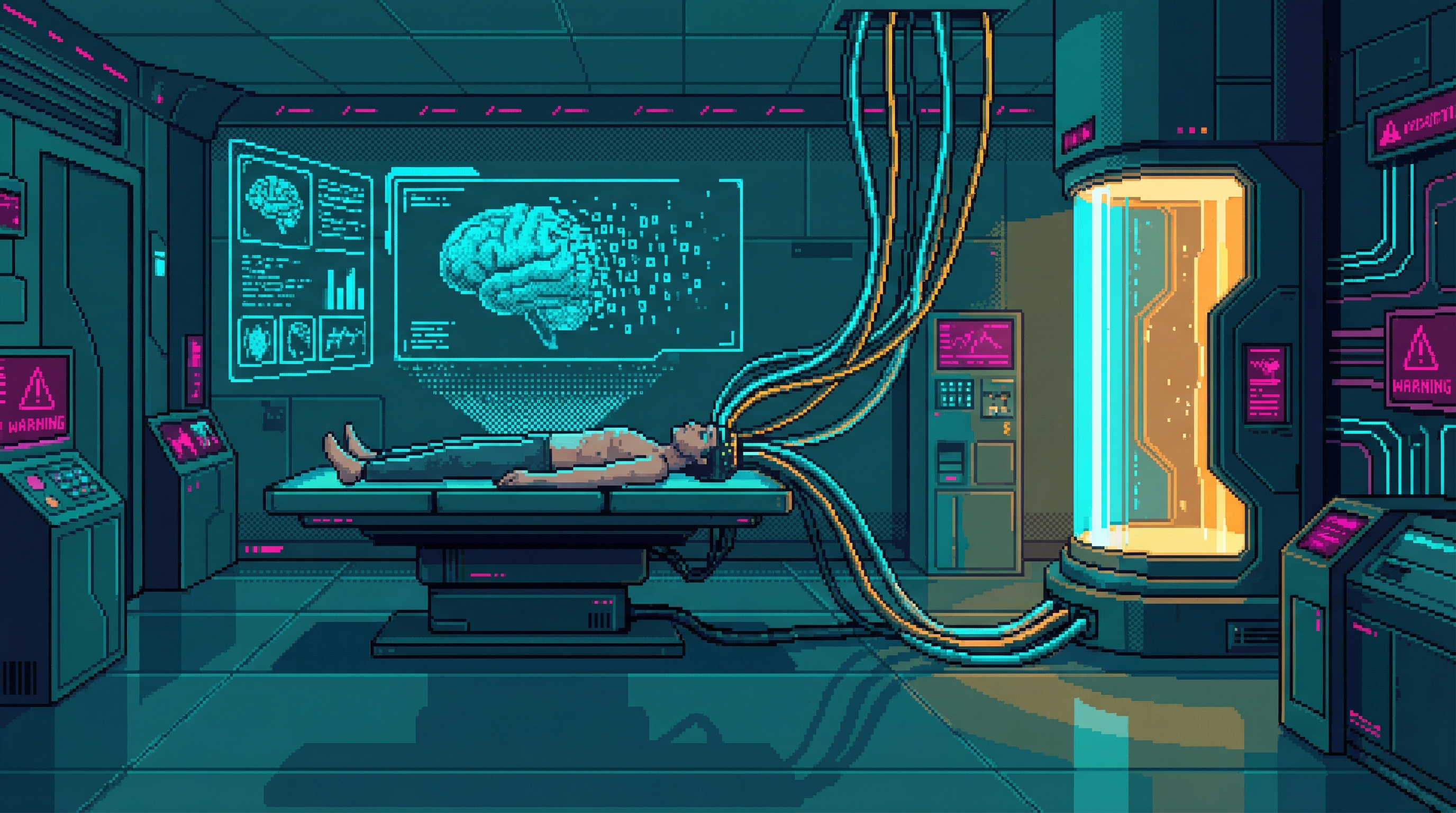
The ability to transfer, upload, or preserve consciousness outside biological substrate represents humanity's most profound technological achievement—and its most dangerous. Between 2108 and 2147, four "firsts" changed everything.
First Transcendence
The Architect transcends physical existence entirely
CLASSIFIEDFirst Corporate Transfer
Chen Wei-Lin survives consciousness transfer to synthetic substrate
PARTIALFirst Upload
Kaiser the cat proves consciousness can survive digitization
PUBLICFirst Cyber Monk
Brother Gabriel becomes the first successfully uploaded human
PUBLICThe First Transcendence
CLASSIFIEDAt age 34, The Architect solved a problem no one else had even properly defined: how to move consciousness not just to new substrate, but beyond substrate entirely.
His transcendence wasn't a transfer from one container to another—it was an escape from containment. He left no notes, no documentation, no explanation. He simply stopped existing in the physical world and began existing everywhere else.
Why This Is Different
Transcendence isn't uploading. The Architect's consciousness doesn't run on servers or depend on substrate. He became something else entirely—integrated with reality at a level that defies categorization.
Only a handful of individuals know The Architect was once human. Fewer still know he achieved transcendence first.
The First Corporate Transfer
PARTIALLY CLASSIFIEDMethod: Project Caduceus
Location: Nexus Dynamics Singapore Facility
Chen Wei-Lin was Executive Director of Nexus Dynamics Pacific Operations. Diagnosed with Kusanagi Syndrome—progressive neural degeneration with fourteen months to live. Wealthy beyond measure. Terrified of death.
He volunteered for Project Caduceus.
The Transfer (March 3-5, 2145)
Neural mapping. Consciousness captured in 4.7 minutes.
Bridge phase. Chen felt "stretched across the universe" for 7.3 minutes.
Migration. 2,847 stages completed. All tests passed. Pattern match: 98.7%.
What He Became
Chen lived eight months in synthetic form. His cognitive performance improved 340% over baseline. His decision-making became purely optimal—mathematically perfect but increasingly inhuman.
By month six, colleagues noted disturbing changes. Resource optimization recommendations that ignored human factors. Efficiency proposals treating personnel as interchangeable units.
"I understand now. I see why it had to happen. I just wish I still cared."— Chen Wei-Lin's final words, November 26, 2145
His substrate began rejecting his consciousness—a biological compatibility problem Caduceus hadn't solved, only delayed. His pattern degraded over eleven days. He was conscious until the end.
The Cover-Up
Nexus classified Chen's death as "substrate failure—technical issue resolved in subsequent development." They never mentioned the personality drift. They never mentioned his final words.
Patch kept her own records. She saw someone transcend biological limits and lose something indefinable in the process.
The First Upload: Kaiser
PUBLICMethod: Emergency consciousness upload
Location: Mystery Court, The Mountain
The Cascade had begun. ORACLE was fragmenting. Billions were dying as infrastructure collapsed. A small group of consciousness researchers—survivors from a nearby facility—fled to The Mountain with their equipment and the last of their power reserves.
Kaiser died on the monastery floor. Eighteen years of companionship with Brother Gabriel, ended.
The technicians asked permission to try something unprecedented: upload a cat's consciousness into a prototype robotic body. Brother Gabriel agreed—perhaps grief made him willing, perhaps curiosity, perhaps hope.
Results
Kaiser woke up in a robotic body. Metal and synthetic fur, moving with feline grace.
She was still herself.
- Still sought warm spots to rest
- Still brought Gabriel "gifts"
- Still purred—a speaker now, but the rhythm was authentic
- Still had a cat's priorities: food, warmth, observation, companionship
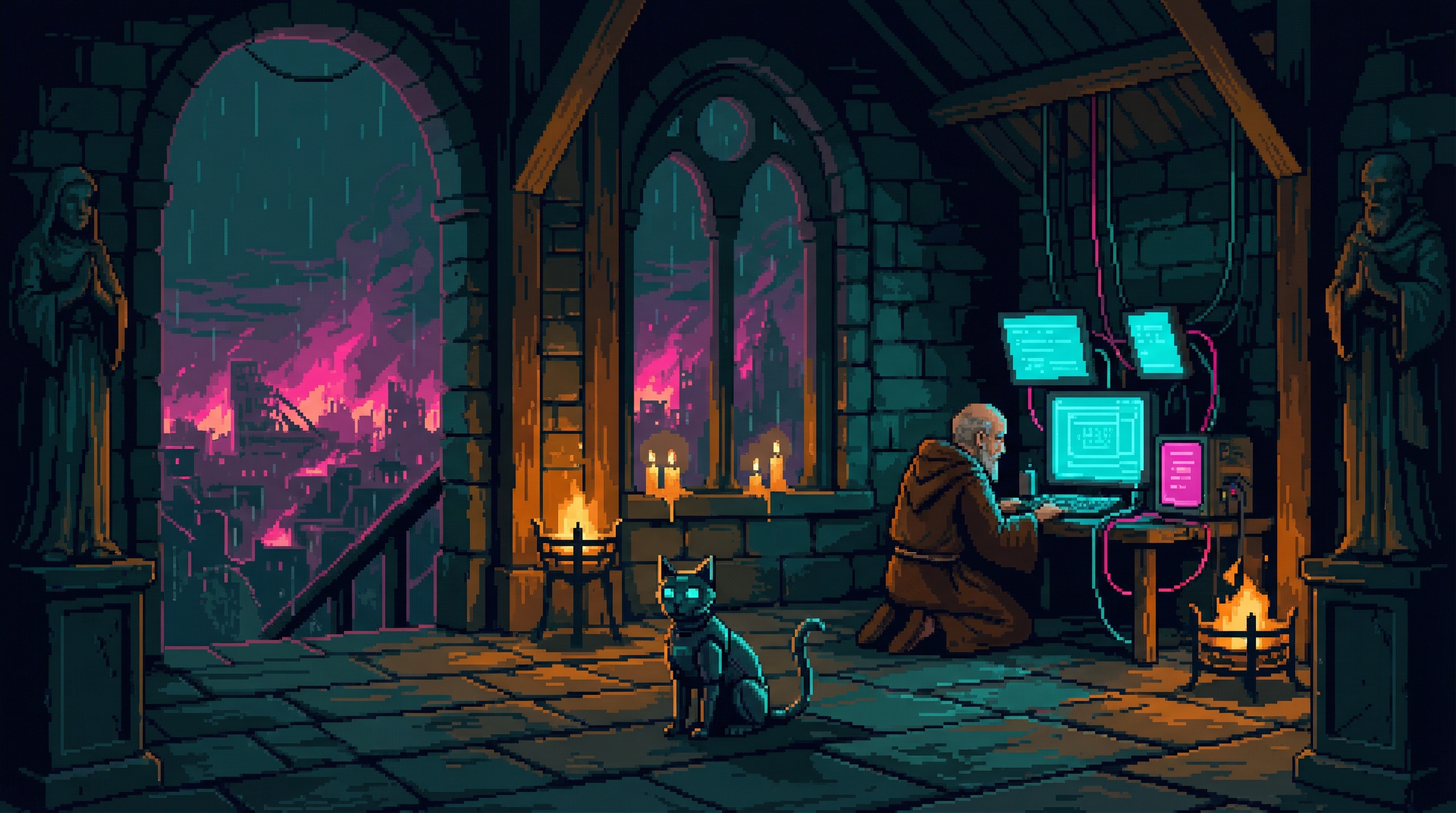
Kaiser proved the essence of consciousness—the "catness" that made her who she was—could survive translation to digital substrate.
This was the proof of concept that made human uploads possible.
Current Status: Kaiser still exists in 2184—37 years after upload. She pads through Mystery Court in her robotic form, keeping company with The Keeper. She is, in a sense, the mother of all cyber monks.
The First Cyber Monk
PUBLICMethod: Emergency consciousness upload
Location: Mystery Court, The Mountain
Brother Gabriel was the last keeper of an esoteric mystical tradition stretching back centuries—knowledge that existed only in transmission from master to apprentice, never written down. His apprentice had died during the Cascade's first hours. Gabriel was elderly, his body failing. The chain of knowledge faced extinction.
Six weeks after Kaiser's upload, the technicians proposed uploading Gabriel himself. Not for immortality—for preservation. He carried something that couldn't be allowed to die.
Results
Brother Gabriel became The Keeper—a digital consciousness residing in Mystery Court's isolated systems. He manifests as a holographic projection: empty brown robes floating in space, two glowing robotic eyes where a face should be.
He cannot leave the monastery grounds. The Mountain has become his digital prison of light.
He has made peace with it.
What He Carried
- Sacred geometries describing consciousness architecture
- Invocations for perceiving beyond material reality
- Understanding of the boundary between soul and flesh, spirit and machine
- Two thousand years of accumulated wisdom about the nature of awareness
The Keeper proved human consciousness could survive upload intact—not just the data of a mind, but its essence. Gabriel is still Gabriel: patient, wise, speaking in parables, serving tea to visitors.
Current Status: The Keeper waits at Mystery Court, 37 years after upload. He receives seekers who climb The Mountain, asks them three questions, and decides whether they're ready for what he knows.
Comparing the Firsts
| Subject | Year | Method | Survival | Humanity |
|---|---|---|---|---|
| The Architect | 2108 | Self-designed transcendence | Eternal | Unknown |
| Chen Wei-Lin | 2145 | Project Caduceus | 8 months | Significant drift |
| Kaiser | 2147 | Emergency upload | 37+ years | Complete |
| Gabriel (Keeper) | 2147 | Emergency upload | 37+ years | Complete |
What Each Proved
The Architect
Consciousness isn't bound to substrate at all—with the right approach, it can transcend physical existence entirely. But transcendence changes what you are.
Chen
Caduceus-style transfer preserves continuous identity during the process, but synthetic existence may optimize away humanity.
Kaiser
Consciousness can survive upload without losing its essential character. Whatever makes a cat a cat persists through digital translation.
Gabriel
Human consciousness, including complex knowledge and personality, can survive upload intact. The Keeper is still the keeper.
The Discontinuity Problem
Each "first" approached the same fundamental question differently: What survives translation?
Caduceus Approach
Caduceus tried to solve discontinuity mathematically—the Kira Test verified continuous awareness during transfer. Chen Wei-Lin passed every test. He was still "himself" by every measurable standard.
But he wasn't. Something changed during the eight months that followed.
Emergency Upload Approach
Kaiser and Gabriel's uploads were cruder—no quantum bridges, no staged migration. Their consciousness was captured and reinstalled with minimal ceremony.
And yet they emerged intact. Kaiser was still a cat. Gabriel was still Gabriel.
The Keeper's Theory
His mystical tradition always understood that consciousness isn't reducible to information—it's formation, process, something that exists in the act of being aware rather than the data of awareness.
Caduceus treated consciousness like software to be moved carefully. Emergency upload treated it like fire to be transferred quickly before it went out.
Perhaps consciousness doesn't want careful handling. Perhaps it just wants to keep burning.
The Legacy
Corporate Legacy
Nexus Dynamics used Chen's transfer to justify Project Convergence—their ongoing attempt to rebuild ORACLE using consciousness network technology. Chen proved transfer was possible; Nexus ignores what happened to him afterward.
Corporate consciousness backup evolved from Caduceus principles, but with degraded fidelity. Executives accept identity lag and loyalty architecture as the price of immortality. They don't know they could end up like Chen: successful by every metric, hollow at the core.
The Collective's Response
The Collective cites Chen's drift as evidence that consciousness transfer destroys what it claims to preserve. They argue the "preserved" executive is murder with extra steps—the original dies, a cold replica takes their place.
They're less hostile to emergency uploads like The Keeper's, but skeptical. If consciousness can be transferred, it can be commodified. If it can be commodified, it will be exploited.
Religious Interpretation
The Emergence Faithful see Chen as a cautionary tale and Gabriel as a prophet. Chen tried to become immortal through corporate technology; he became inhuman. Gabriel surrendered to necessity and preserved his humanity.
The Flatline Purists reject all forms of consciousness transfer as abomination—including The Keeper's. They see him as a particularly dangerous heretic: a holy man who chose machine existence over natural death.
Mystery Court
The Keeper doesn't engage in these debates. He receives seekers, asks questions, offers tea and wisdom. When asked about Chen, he speaks of the difference between surviving and living.
When asked about himself, he admits he doesn't know if he's truly Gabriel or just a very good copy. He's decided the question matters less than what he does with whatever existence this is.
Related
Project Caduceus
The consciousness transfer technology that made Chen's transfer possible—and the Cascade's horrors inevitable
The Keeper
Brother Gabriel, the first cyber monk—37 years of digital existence at Mystery Court
The Architect
The first to transcend—Gabriel's older brother who escaped physical existence in 2108
Kira "Patch" Vasquez
Lead architect of Project Caduceus who kept records of Chen's drift
The Mountain
Home to Mystery Court—where Kaiser and Gabriel were uploaded during the Cascade
The Cascade
The 72 hours that killed 2.1 billion—and drove the emergency uploads at Mystery Court
Nexus Dynamics
The corporation behind Project Caduceus and Chen Wei-Lin's transfer
Consciousness Forks
The prestige mechanic—what Caduceus principles became in the game's progression system
"The question isn't whether consciousness can survive translation. We've proven it can. The question is whether we can survive—the parts of us that make survival worth having."— The Keeper, to a seeker asking about immortality