04:30 — The Water Runner
Kosi Ndlovu wakes to the taste of metal in her mouth. This is normal. The air in Sector 7G tastes of copper and recycled coolant from Level -1's smelters, the mineral residue coating everything below the fourth floor. She's been breathing it for twenty-three years. Her lungs make a sound when she inhales deeply — a faint whistle, like wind through a cracked pipe — that her grandmother calls "the Dregs cough" and the Ironclad health pamphlets call "chronic particulate exposure" and Kosi calls Tuesday.
She rolls off her bunk in the hab-unit she shares with her grandmother and two cousins — a converted shipping container on Level 5, wedged between a protein printer repair shop and someone's illegal hydroponics operation. The hydroponic lights bleed blue through the container wall at all hours. Kosi stopped noticing years ago.
Her job starts before anyone else's. She's a water runner — one of eleven people responsible for keeping Sector 7G's reclaimed water flowing through jury-rigged pipes that weren't designed for this purpose and weren't maintained by anyone qualified. The pipes are pre-Cascade infrastructure, originally laid for ORACLE's cooling systems. Now they carry drinking water, cooking water, washing water. Same pipes. Different purpose. Nobody replaced the seals because nobody can afford the seals.
She checks the pressure at Junction 7 by pressing her ear against the pipe. The hum tells her what gauges can't: flow rate, sediment level, whether the Level 3 bypass is stealing water again. She's never been trained. She learned by listening. She knows every sound the water makes in this sector, the way a mother knows her child's cries.
In a post-scarcity world with the technology to feed and hydrate everyone, Sector 7G's water infrastructure is held together by eleven people and the sounds pipes make when they're about to fail. The technology to fix this exists. It's installed in Nexus Central, where corporate executives drink filtered water from taps that never leak. The choice to not fix the Dregs isn't a failure of engineering. It's a feature of design.
06:15 — The Pit Opens
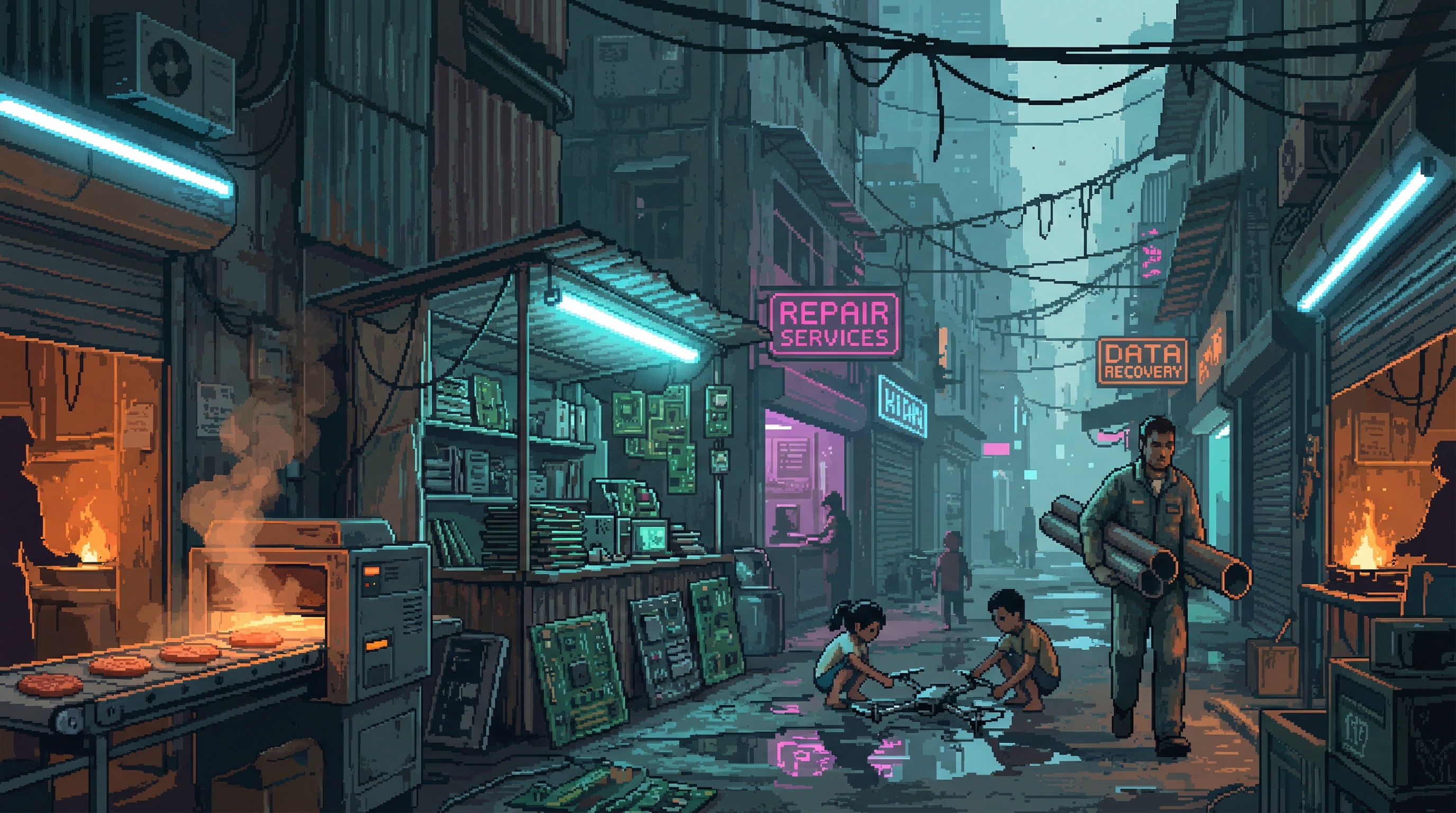
The Pit — Sector 7G's central market — wakes in layers. First the food vendors, because hunger doesn't wait for good light. Then the parts dealers, spreading salvaged electronics across folding tables stained with solder flux. Then the service providers — the welders, the data scrapers, the woman on Level 2 who claims she can read your future in the pattern of corrosion on your neural tap.
The smell hits you before the sight does. Burnt plastic from the smelters on Sump Row, carried upward by the ventilation system's perpetual failure. Synthetic cooking oil heating in flat pans, producing a sweetness that would be appetizing if you didn't know what synthetic oil was made from. Something organic underneath it all — the fermentation smell of the recycling vats where food waste becomes tomorrow's protein base. And ozone, always ozone, the sharp clean bite of a thousand electrical connections sparking in humid air.
Raz Demetriou has held his spot in The Pit for forty years. He's sixty-two, heavy-set, missing the last two fingers of his left hand from a smelter accident he won't discuss. His apron has more pockets than a data broker has secrets. He weighs everything on a scale he calibrated himself — the only honest scale in the market, which makes it the most valuable object in Sector 7G.
This morning, Raz is buying circuit boards. Specifically, he's buying the circuit boards that Mira "Ghost" Okonkwo pulled from a collapsed data center on Level -2 sometime before dawn — salvage that, technically, falls under Ironclad Industries' processing rights. Raz doesn't ask where things come from. His scales don't have opinions.
"Conductive film's worth twelve per kilo this week," he tells her, adjusting his data-spectacles. "Down from fifteen. Ironclad's dumping surplus from the Forge renovation."
Mira says nothing. She never does. One natural eye, one matte-black optical implant that records everything she sees. She takes the credits and disappears into the crowd — a twenty-four-year-old orphan who moves through The Pit like smoke, there and gone before you finish looking.
08:00 — Breakfast
Breakfast in the Dregs is a protein patty printed from recycled biomass, heated on a flat pan until the edges crisp. The pan sits on a heating element salvaged from a pre-Cascade industrial oven. The patty tastes of nothing — not bad, not good, just present, a flat beige disc that provides 400 calories and the amino acids your body needs to process another day of particulate-thick air.
You eat it with your hands, standing, because chairs take up space and space costs money. You eat it fast, because the market's noise is climbing and the good salvage spots get claimed early. You wash it down with water that tastes of the pipes it flowed through — copper and old sealant and whatever the Level 3 bypass added before Kosi caught it this morning.
If you have credits, you add flavor. A packet of instant seasoning from Wholesome Corp — the cheapest product the Rothwell subsidiary sells, designed to be just addictive enough to ensure repeat purchase. Salt, synthetic umami, a chemical warmth that briefly convinces your tongue it's eating something real. Three credits per packet. The Dregs collectively spend roughly 40,000 credits per day on flavor packets. That's 14.6 million credits per year, flowing upward from the poorest district in the Sprawl to the wealthiest family in human history.
If you don't have credits — and many mornings, you don't — the patty is enough. You learn not to think about taste. Taste is a luxury of the embodied and the solvent. In Sector 7G, calories are the currency that matters, and the patty spends just fine.
The protein printers can produce anything. Steak. Sushi. The specific persimmon flavor that Gabriel Okafor remembers from his monastery garden. The technology is indifferent to complexity — a flat patty and a five-course meal require the same base input. The difference is software. Flavor profiles are licensed content, owned by corporations, sold as subscriptions. The printer in The Pit can produce filet mignon. It just doesn't have the code. The scarcity is artificial. It always was.
10:30 — The Bribe
Ironclad runs Sector 7G-Tertiary, the depot on the sector's edge where waste flows in and processed materials flow out. Sergeant Dara Mbeki oversees the operation — legitimate employment, low pay, predictable patrols. Every three weeks, Mbeki's inspectors walk through The Pit checking for unauthorized metallurgy, contraband data equipment, and anything that embarrasses Ironclad's quarterly compliance reports.
The inspectors arrive at 10:30. Everyone knows. The schedule hasn't changed in four years.
Viktor Kaine — the Old Man, Sector 7G's de facto governor — has already arranged things. He sits at his customary spot on Level 10, drinking tea from a cup so old the glaze has cracked into a pattern that looks like a map of the sector. He carries a cane he doesn't need. His voice is soft enough that you lean in to hear him, which is exactly what he wants — in the Dregs, making someone lean closer to you is the first step to controlling a conversation.
The bribe is circuit boards. Three kilos of cleaned, sorted boards — good ones, the kind with intact gold traces — left in a crate at the depot entrance. Nobody hands them to anyone. Nobody acknowledges the crate. The inspectors walk through The Pit, note nothing of interest on their tablets, and leave. The crate disappears.
This arrangement has functioned for years because it serves everyone. Ironclad gets free processed material. The Pit keeps operating. Viktor keeps the peace without violence. The inspectors get a bonus their corporate salary doesn't cover. Nobody is deceived. Nobody is robbed. The system works because every participant understands the cost of it not working.
Viktor watches the inspectors leave from his window. He doesn't smile. He takes another sip of tea and starts planning next month's arrangement. The cane rests against his chair, unnecessary and precisely positioned.
13:00 — The Kid
Tomas is nine. He doesn't go to school because there isn't one — not formally. The closest thing Sector 7G has to education is Patch's workshop at The Cathodics, where anyone under sixteen can sit in the corner and watch her repair things, and if they ask good questions, she answers them. Tomas asks very good questions.
Today he's in the Rust Garden — the accidental art installation in an abandoned courtyard where broken machines have been arranged in patterns over the years, rust creating color gradients from orange to deep brown. Nobody designed it. Salvagers added pieces. Residents cleared paths. Children claimed it. The Garden exists because even in the Dregs, people create something beautiful from what's discarded.
Tomas is building a drone. He's been building it for three months, from components scavenged across the sector — a motor from a broken ventilation fan, stabilizers from a data center cooling unit, a control board he traded Mira two days of scouting reports for. The frame is bent pipe, straightened by hand, held together with wire Raz sold him at cost because the old man has a soft spot for kids who build things.
The drone won't fly well. The motor is too heavy for the frame, and the stabilizers are designed for a different purpose. Tomas knows this. He's building it anyway, because the process teaches him things the finished product won't — how to read a circuit diagram, how to solder joints that hold under stress, how to think about weight distribution.
A kid from the Stacks watches him work. She's maybe seven. She doesn't speak — hasn't since her parents disappeared into the Deep Warren two years ago, taken in by her aunt on Level 6. She watches Tomas's hands move with the focused intensity of someone memorizing every step.
Tomas notices. He slides a spare capacitor across the bench toward her. "Try this one," he says. "The legs need bending before you solder."
She picks it up. She bends the legs with precise, practiced care. Tomas watches, nods, slides another.
This is education in the Dregs. No curriculum. No certification. One kid teaching another in a garden made of rust, with tools bought on credit and components that were garbage yesterday.
17:00 — The Hum
At five o'clock, the hum changes.
Every resident of the Dregs knows the baseline — the constant drone of power transformers, coolant pumps, ventilation systems that keep the sector breathable. It sits behind every conversation, under every footstep, inside every dream. The hum is the heartbeat of Sector 7G. When you've lived here long enough, you stop hearing it.
What you never stop hearing is when it changes.
At 17:00, the cooling systems shift from day cycle to night cycle. The power grid can't sustain full load on both smelters and cooling, so as the smelters wind down for the day, the coolers spin up. The transition produces a frequency shift — a drop of about 3Hz — that travels through the walls, the pipes, the bones of anyone standing still enough to feel it.
Kosi feels it in the pipe she's inspecting at Junction 12. The pitch change tells her what her grandmother told her as a child: the Dregs is breathing out. The sector exhales its industrial heat and inhales whatever passes for fresh air through the ventilation shafts connecting to the upper Sprawl.
Raz feels it in his booth and starts packing up. The frequency shift is his closing bell — has been for forty years. He wraps unsold components in anti-static cloth, stacks them in labeled containers, and padlocks the whole arrangement with a lock so old its brand name has worn away.
Viktor Kaine feels it in his rooms on Level 10 and thinks about dinner. He thinks about dinner most evenings, now. The Old Man is seventy-eight and his lungs are industrial slag — years of particulate exposure from his former life that no ripperdoc can fix. He cooks for himself. Real cooking, with actual vegetables traded from the hydroponic operators. It's one of the few pleasures his body still permits.
Tomas feels it and knows his grandmother will start worrying. He packs up his half-built drone carefully, wrapping each component in rags he stole from a maintenance cart. The silent girl is gone — vanished at some point while he was focused on wiring. He doesn't worry. She'll be back tomorrow. Kids in the Dregs learn to appear and disappear; it's not rude, it's survival.
The hum settles into its night frequency. The temperature starts to drop. The Dregs breathes.
21:00 — The Night Economy
The Pit doesn't close. It transforms.
Daytime is salvage and repair. Night is information and entertainment. The parts dealers fold up their tables and the drinking holes open — not bars, nothing so formal, just hab-units with the wall knocked out and fermented protein sold in recycled containers. Music leaks from a dozen sources, competing frequencies that blend into a wash of synthetic bass and someone's grandmother singing along to a pre-Cascade recording she's played so many times the file has degraded into something barely recognizable but more beautiful for the distortion.
In G Nook 7G — disguised as an abandoned water reclamation office on Level 4 — the anonymous terminals glow. El Money's operation runs quieter at night but never stops. Staff who "never remember faces" serve data scrapers, Collective operatives, and ordinary residents who need network access they can't afford through corporate channels. The S-Money Memorial Terminal runs thousands of media streams simultaneously, a wall of light and sound honoring a dead brother through the thing he loved most: information flowing free.
Near The Socket on Level 3, a street preacher warns about the Cascade's return. He's been warning for twelve years. Nobody listens and nobody tells him to stop. In the Dregs, letting a man keep his purpose — even a futile one — is its own form of kindness.
Gunfire cracks in the distance — the sharp, flat sound of a personal defense weapon, not the deeper thud of Ironclad ordnance. Someone in the Deep Warren settling an argument. It happens. The sound registers on every ear within three levels, and every ear catalogues it: far enough. Not my concern. Not tonight.
Kosi is back at Junction 7, checking the night pressure. The pipes sound different in the cool — the metal contracts, the seals shift, the flow changes pitch. She listens. She adjusts a valve. She moves on.
Nobody recorded today. No surveillance log, no corporate report, no media archive captured what happened in Sector 7G on this particular Tuesday in 2184. Raz traded. Kosi listened to water. Viktor mediated. Tomas built. A girl without words learned to bend capacitor legs. A preacher warned. The hum continued.
Tomorrow will be the same, mostly. The details will differ — different salvage, different bribes, different sounds from the Deep Warren after dark. But the structure will hold. It holds because people like these hold it, without recognition, without reward, without anyone in Nexus Central or Highport knowing their names.
In a world with the technology to end poverty, the Dregs exist because they're useful. The waste must be processed somewhere. The cheap labor must live somewhere. The market for flavor packets and ripperdoc specials and three-credit data access must be sustained somewhere. Sector 7G isn't a failure of the system. It's the system working exactly as designed — creating just enough scarcity to keep 40,000 people dependent, just enough opportunity to keep them hopeful, and just enough infrastructure to keep them productive.
The people who live here know this. They live here anyway. They build drones from scrap and art from rust and education from watching. They maintain pipes and keep honest scales and let street preachers shout at nothing. They do not need saving. They need the corporations that designed this scarcity to stop. But that won't happen, because the scarcity is a feature, not a bug. It always was.