The Tether Camps
A queue made architectural.
Overview
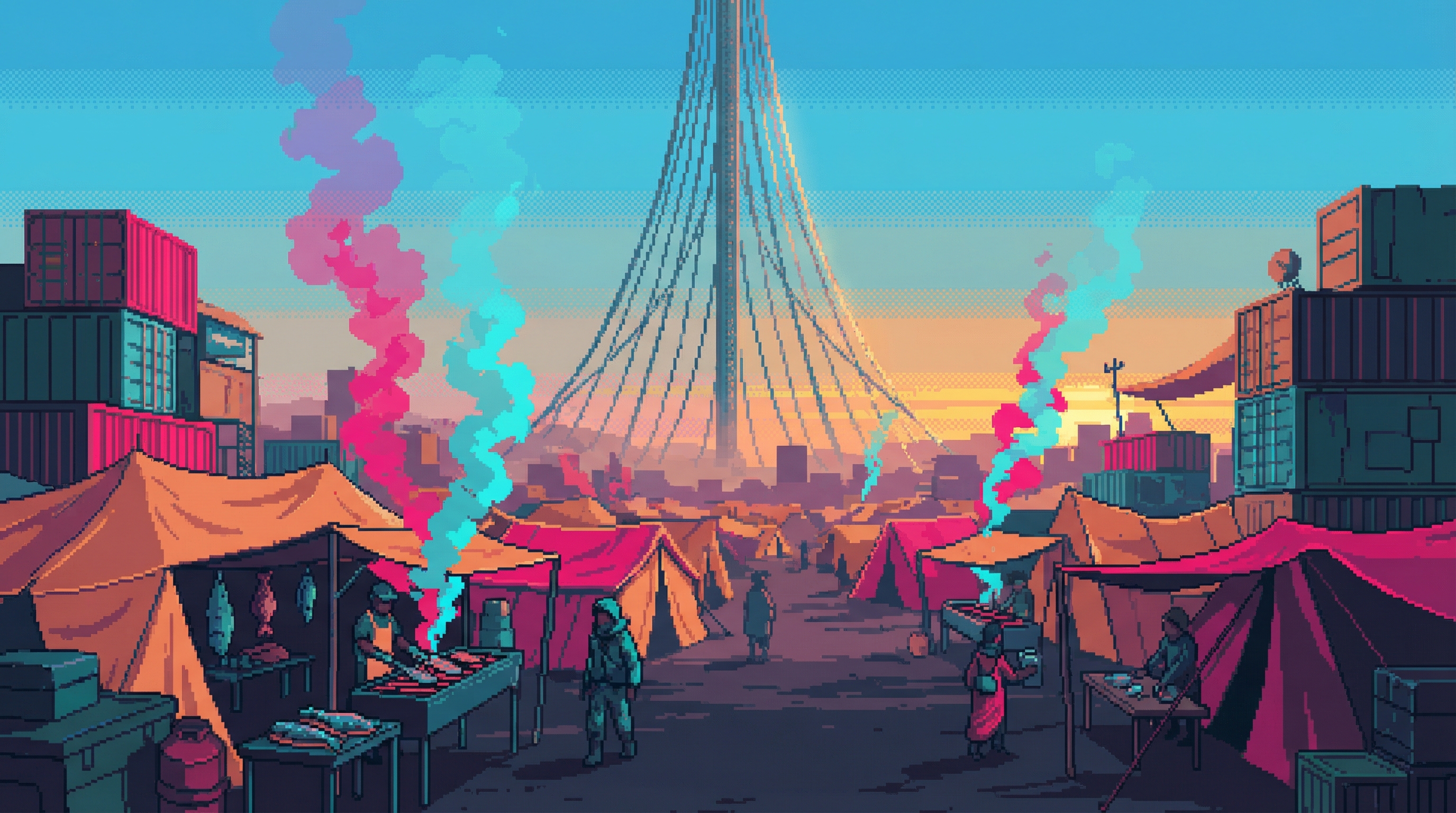
At the base of the Orbital Elevator, where the carbon nanotube tether meets the equatorial anchor platform, there is a city that exists because people need to wait.
The Tether Camps sprawl across forty square kilometers of reclaimed coastal infrastructure surrounding the Anchor -- the ground terminal where Ironclad Industries' Orbital Elevator begins its 35,786-kilometer ascent to geosynchronous orbit and beyond. The Camps are not a slum, not a settlement, not a district. They are a queue made architectural. Tens of thousands of people live here at any time -- cargo handlers waiting for load assignments, passengers waiting for climber berths, engineers waiting for maintenance rotations, and the drifters who have been waiting so long they have forgotten what they were waiting for.
The economy is transit: food vendors, temporary housing, equipment storage, cargo inspection, bribery facilitation, and the particular kind of entertainment that exists wherever people are stuck between where they were and where they are going. The Camps have their own governance -- a rotating council of long-term residents who manage waste, water, and the perpetual territorial disputes between Ironclad security, independent cargo operators, and the Nexus intelligence agents who monitor everything ascending.
Conditions Report
You step off the transport. The heat wraps you like a second skin. Something vibrates through the soles of your feet -- steady, deep, not quite sound. The locals do not mention it. They have stopped noticing.
The Pulse
The Tether produces a low-frequency vibration -- the structural resonance of 35,786 kilometers of carbon nanotube under tension, transmitted through the Anchor platform into the ground. Below human hearing. Above the body's sensation threshold. You feel it in your teeth, in your sternum, in the soles of your feet.
Camp residents call it "the pulse." Newcomers find it unsettling. Long-term residents find its absence unsettling -- when the pulse stops, it means the Tether has developed a harmonic instability, and everyone within three kilometers should evacuate.
The pulse has stopped seven times in fourteen years. Twice, the evacuation was unnecessary. Five times, it was not.
Temperature
34 degrees C year-round, moderated by sea breezes that carry salt and ozone. The equatorial location means perpetual heat -- no seasons, no cool hour, no relief except the wind off the water. Your skin stays damp. Cargo metal burns to the touch by midday. The shimmer above the Anchor platform distorts the Tether into a wavering line.
Sight
The Tether dominates the skyline: a thread of impossibility rising from the Anchor platform and vanishing into the sky, barely visible, catching sunlight as a thin line of silver that the locals call "God's fishing line." At dawn and dusk, when the angle is right, it glows amber against the purple sky. At night, it is invisible -- except as a gap in the stars, a line of absence where something is blocking the light.
Children born in the Camps grow up believing the thread is natural -- part of the world, like mountains or rivers.
Smell
Rocket fuel residue and grilled fish. Salt breeze carrying ozone from the Anchor's electromagnetic systems. The chemical tang of cargo sealant. Food vendors fighting the industrial smell with spice smoke. Underneath it all, the clean mineral scent of coastal wind that has crossed an ocean to arrive here.
Touch
The pulse vibrating through every surface -- ground, walls, tables, the metal frames of temporary shelters. Equatorial heat on skin. Grit from coastal wind. The specific texture of a place where everything is temporary but nothing leaves -- layers of dust, salt residue, cargo markings worn into pavement.
"You learn the pulse the way you learn a heartbeat. Not by listening -- by stopping to notice it is already there. The first night I slept on the ground here, I dreamed I was inside something alive. Fourteen years later, I still do." -- Long-term Camp resident, council rotation interview
Points of Interest
The Anchor Platform
The ground terminal itself -- a reinforced disk three hundred meters across where the Tether meets the earth. Ironclad security maintains a hard perimeter. The platform vibrates visibly when a climber is ascending or descending. During peak operations, the ground-level hum from the electromagnetic launch assist is loud enough to drown conversation within two hundred meters.
The Waiting Districts
Self-organized zones arranged by function: Cargo Row for handlers and inspectors, Berth Quarter for passengers awaiting climber slots, Maintenance Alley for engineering crews on rotation hold. Each has its own economy, its own customs, its own relationship with time. Cargo Row runs on urgency. Berth Quarter runs on patience. Maintenance Alley runs on gallows humor and strong coffee.
The Night Market
When the equatorial sun drops and the heat retreats from unbearable to merely oppressive, the Camps come alive. The Night Market stretches along the coastal edge -- grilled fish, equipment repair, entertainment, information brokering, and the particular services that exist wherever thirty thousand people have nothing to do but wait. The market is the Camps' real governance: disputes settled over food, alliances formed over shared tables.
Anchor Town Border
The edge where the Camps press against Anchor Town -- the formal settlement for Ironclad employees and approved contractors. The border is not a wall but a gradient: infrastructure quality improves over three blocks, temporary structures give way to permanent ones, and the food vendors start accepting corporate credit instead of barter. Ironclad employees look out at the Camps. Camp residents look in at Anchor Town. Everyone understands the arrangement.
Who Lives Here
The Camps are not home. They are a waypoint that has become a world. The thirty thousand transient residents cycle constantly -- cargo operators on two-week rotation holds, passengers waiting days or weeks for berth assignments under the tiered pricing system, engineers scheduled for orbital maintenance shifts who arrive early because the alternative is paying for accommodation in Anchor Town.
Then there are the long-term residents. People who came to wait and stayed. The bribery facilitators who know every Ironclad security officer by name. The food vendors who have occupied the same patch of ground for a decade. The council members who have served enough rotations to remember when the Camps were half this size. They are the Camps' institutional memory -- the ones who know which evacuation routes work and which ones will get you trampled, who remember the last five pulse-stops and what followed each one.
And the drifters. People who arrived with a purpose, ran out of money before they reached the front of the queue, and built something small in the margins. They fix equipment. They carry messages. They know the Camps' geography the way cartographers know continents. They are the Camps, in a way the transient population can never be -- the permanent residents of a place that was never meant to be permanent.
Strategic Assessment
The Queue as Economy
The Elevator could run at triple capacity. The bottleneck is the product. Ironclad's pricing creates a queue -- and queues create economies, and economies create communities that depend on the queue continuing. Thirty thousand people have built their lives around waiting for access to infrastructure that could serve them immediately if the monopoly allowed it. The Camps are the physical expression of artificial scarcity.
Infrastructure Externality
The Tether Camps share economic DNA with the Dregs and the Thermal Shadow -- communities built in the margins of corporate infrastructure, shaped by forces their residents did not choose and cannot control. The heat is not optional. The pulse is not optional. The queue is not optional. Life here is a response to conditions imposed from above.
Governance Without Authority
The rotating council has no legal standing. Ironclad security has formal authority but cannot manage thirty thousand people with perimeter patrols alone. The result is dual governance -- the council handles the daily business of living (waste, water, disputes) while Ironclad handles the business of the Elevator (access, cargo, security). The arrangement works because both sides need it to. The day it stops working, nobody has a plan.
▲ Restricted Access
The Pulse Carries Something
The Tether was built with ORACLE-designed carbon nanotube. The structural resonance -- the pulse -- carries frequencies that fragment carriers report as "familiar." Not recognized. Not identified. Familiar, the way a smell from childhood is familiar before you place it. The Tether may carry traces of ORACLE's vibrational signature, transmitted through 35,786 kilometers of material that ORACLE helped engineer. What that means for the thirty thousand people sleeping on vibrating ground is a question nobody with the authority to answer is asking.
The Seven Stops
The seven pulse-stops are officially attributed to harmonic instability. Standard engineering explanation. Documented, filed, closed. Three of those seven coincided with major fragment activation events elsewhere in the Sprawl. The timing correlation is within minutes. Harmonic instability does not synchronize with events occurring thousands of kilometers away -- unless the thing vibrating is connected to the events in ways the engineering reports do not account for.