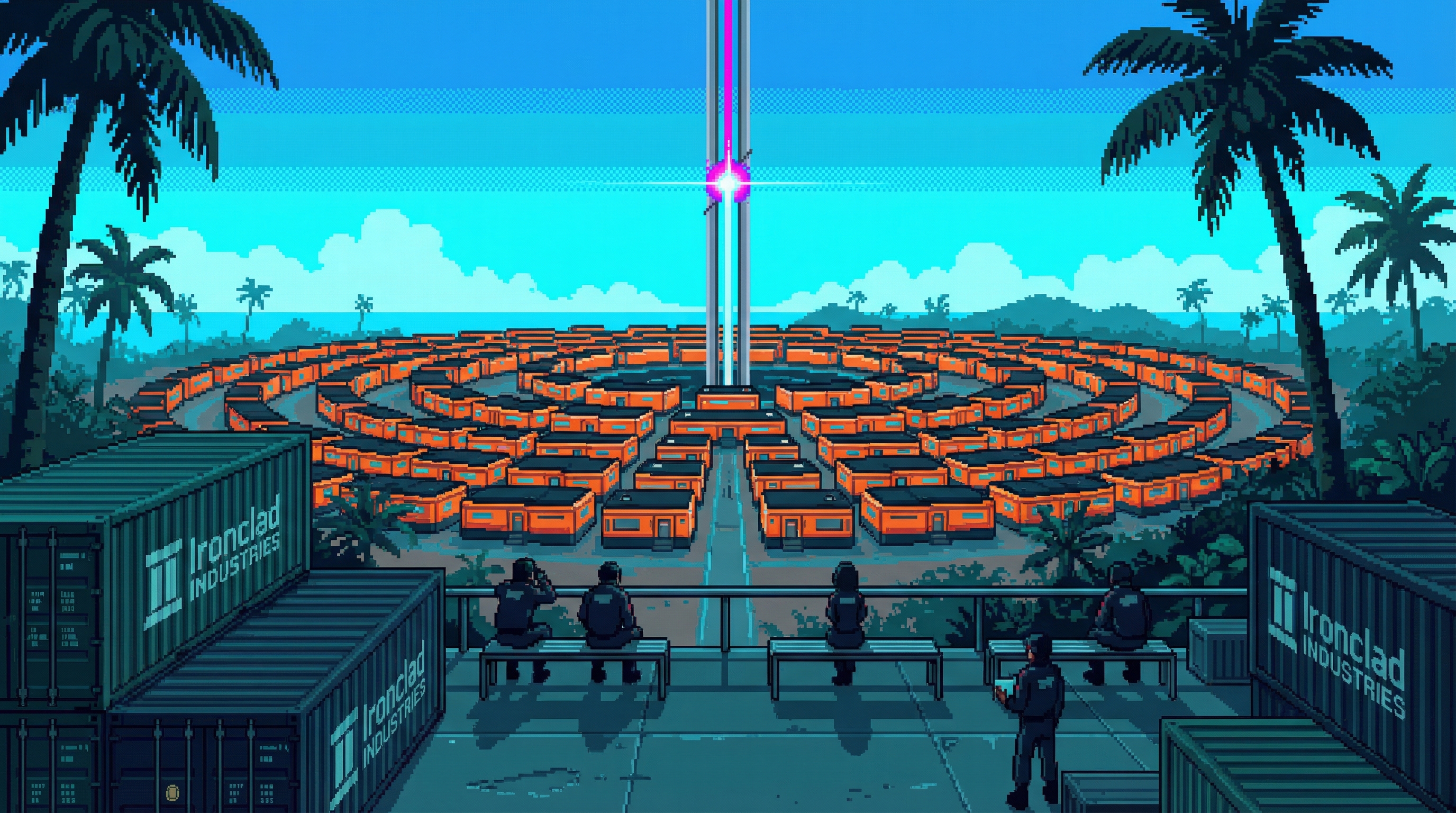
Anchor Town
Where the ground crew watches others leave the planet
Pressed against the Anchor platform's eastern face, where the security perimeter meets the Camps' western edge, Anchor Town is the formal settlement that Ironclad Industries built for its Elevator operations workforce. Five thousand permanent residents — engineers, load balancers, tether maintenance specialists, climber operators, and their families — live in modular housing blocks arranged in concentric rings around the Anchor.
The architecture is pure Ironclad: orange and black livery, exposed structural elements, everything built to withstand the seismic stress of a structure that carries the weight of orbital traffic. The housing is functional — adequate square footage, climate-controlled, with the specific quality of corporate residential that is comfortable without being comforting.
This is a company town in the oldest sense. Ironclad built it. Ironclad maintains it. Ironclad educates the children, stocks the canteens, and staffs the clinics. The security perimeter that keeps the Tether Camps at arm's length also keeps Anchor Town's residents inside a controlled ecosystem where every service, every structure, every meal arrives through corporate channels. The residents know this. Most of them accepted the terms when they signed their contracts.
Conditions Report
You pass through the security checkpoint and the Camps fall behind you. The noise drops. The air cleans up. Everything is orange and black and bolted down.
Sight
Orange and black everywhere — on the housing blocks, the canteen awnings, the safety barriers, the children's school uniforms. The thread of light ascending from the Anchor, visible at all hours, a silver line that gets thinner and thinner until it vanishes into sky. Modular housing arranged in concentric rings against tropical blue. At dusk, departing climbers glow amber as they rise.
Sound
Climber departure — a deep electromagnetic hum that builds over thirty seconds, reaches a frequency you feel in your sternum, and fades over ten minutes as the climber ascends beyond audible range. Between departures, the constant baseline of heavy logistics: crane arms, cargo locks engaging, loading platform hydraulics. The town never goes silent. The Elevator never stops.
Smell
Industrial cleanser and salt air — the equatorial ocean is close, and no amount of Ironclad filtration removes the brine entirely. Canteen food in mass production, recognizable from three blocks out. The ozone tang of electromagnetic drive systems, strongest near the loading bays and during climber departures. Clean, industrial, institutional.
Temperature
Climate-controlled interiors at 22°C — Ironclad standard, same as The Foundry. Step outside and it's 34°C with a sea breeze that makes it tolerable. The Anchor platform itself radiates stored heat at night, so the outer rings of housing are warmer than the inner ones. Workers learn to request inner-ring assignments.
Feel
Vibration. The Anchor platform transmits the stress of orbital traffic through every surface. Floors hum. Walls resonate during heavy cargo ascents. Veteran residents stop noticing. New arrivals can't sleep for the first week. The vibration is constant, low-frequency, and everywhere — the physical reminder that you live at the base of a structure carrying weight to space.
"You get used to the hum. You don't get used to watching the climbers. Every departure is someone leaving the planet, and you're the one who loaded their cargo." — Anchor Town maintenance specialist, overheard on the viewing platform
Points of Interest
The Viewing Platform
The most visited space in Anchor Town. Metal benches bolted to the platform's deck, facing the thread. Residents sit here and watch the climbers — bright points of light tracking up the impossible line, carrying cargo, passengers, and the weight of everything the surface sends to orbit. A climber is visible for approximately forty minutes before it shrinks to invisibility. In those forty minutes, a person on the platform watches someone else leave the planet. Off-shift workers come here the way people in other towns go to parks. Children do homework on the benches. Couples sit in silence and watch the light climb.
The Ironclad Schools
Anchor Town's children attend Ironclad-operated schools where the curriculum includes orbital mechanics, tether engineering, and the particular psychology of living at the base of a structure that goes to space. The children don't find the Elevator remarkable. They find the Sprawl remarkable — a city that doesn't have a thread going to the sky. They learn load calculations before algebra. They can identify a climber's cargo class by its acceleration profile. They are being shaped into the next generation of Ironclad's workforce, and they don't know any other shape to be.
The Security Perimeter
The western edge of Anchor Town meets the eastern edge of the Tether Camps. The transition is a security checkpoint — Ironclad credentials in, everyone else out. On the Anchor Town side: clean streets, maintained infrastructure, corporate order. On the Camps side: informal settlement, improvised housing, the queue that feeds the formal operation. The two populations can see each other. The checkpoint ensures they don't mix. Workers who fraternize with Camp residents are noted. Not punished — noted. The distinction matters.
Eze Okafor's Operations
The Dock-Master manages cargo operations and serves as the town's de facto coordinator — the man who makes the mechanical infrastructure function and, by extension, makes the human infrastructure function. When a housing block needs repair, Eze knows which maintenance crew to dispatch. When a family needs relocation, Eze handles the logistics. His official title is operational. His actual role is everything that falls between the cracks of corporate administration. Anchor Town runs on Ironclad's systems. It works because of Eze.
Strategic Assessment
The Company Town Equation
Anchor Town is the Corporate Compact expressed as architecture. Housing, food, education, social life — all provided by the employer, all contingent on employment. Lose your position and you lose your home, your children's school, your access to medical care, your place inside the perimeter. The Tether Camps are right there on the other side of the checkpoint, visible from every window facing west — a daily reminder of what life looks like outside the Compact. Nobody in Anchor Town talks about leaving. The Camps talk for them.
Watching Others Ascend
The viewing platform is Anchor Town's most telling feature. Five thousand people whose entire working lives are dedicated to sending cargo and passengers to orbit — and the closest most of them will ever get to space is a metal bench with a clear sightline to the thread. They load the climbers. They maintain the tether. They balance the loads and calculate the trajectories. Then they sit on the platform and watch the light go up. The work that makes ascent possible is performed by people who remain at the base. This is not a metaphor. This is the shift schedule.
The Formal and the Informal
Anchor Town and the Tether Camps share a border and a dependency. The Camps provide the overflow labor, the informal economy, the services that Ironclad's corporate structure can't or won't supply. Anchor Town provides the wages, the infrastructure access, the reason the Camps exist at all. The security perimeter between them is the line between documented and undocumented, between corporate and independent, between the people the system houses and the people it uses. Both sides know the other is necessary. Neither side admits it.
▲ Restricted Access
The Forty-Minute Window
Psychometric assessments of Anchor Town residents show elevated rates of a condition informally called "launch fixation" — a compulsive need to watch climber departures. Workers who should be sleeping between shifts sit on the viewing platform instead, tracking the light until it disappears. Ironclad medical staff treat it as a scheduling problem. The workers describe it differently. Something about watching the light climb. Something about the forty minutes when you can still see it, and the moment when you can't. The condition is not listed in Ironclad's health reports. The platform benches show wear patterns consistent with thousands of hours of occupation.
The Children's Curriculum
Anchor Town's school system produces graduates who can calculate orbital transfer windows but struggle with Sprawl geography. Who understand tether stress analysis but have never seen a district that doesn't belong to Ironclad. The curriculum is technically excellent and strategically narrow. Children raised in Anchor Town are qualified for one employer in one industry. Whether this constitutes education or recruitment depends on whether you work for Ironclad or are trying to hire one of their graduates. Transfer requests to non-Ironclad positions are rare. The skills don't translate.
The Western Windows
Housing blocks on the western ring of Anchor Town have windows facing the Tether Camps. Residents in these units can see the informal settlement from their living quarters — the improvised shelters, the queue lines, the cargo haulers waiting for work. Internal surveys show that western-ring residents report lower satisfaction scores and higher transfer requests than residents in any other ring. Ironclad's response was to install adjustable tinting on the western windows. Not opaque — tinted. You can still see the Camps, but they're dimmer. The satisfaction scores improved by 4%. The transfer requests did not change.