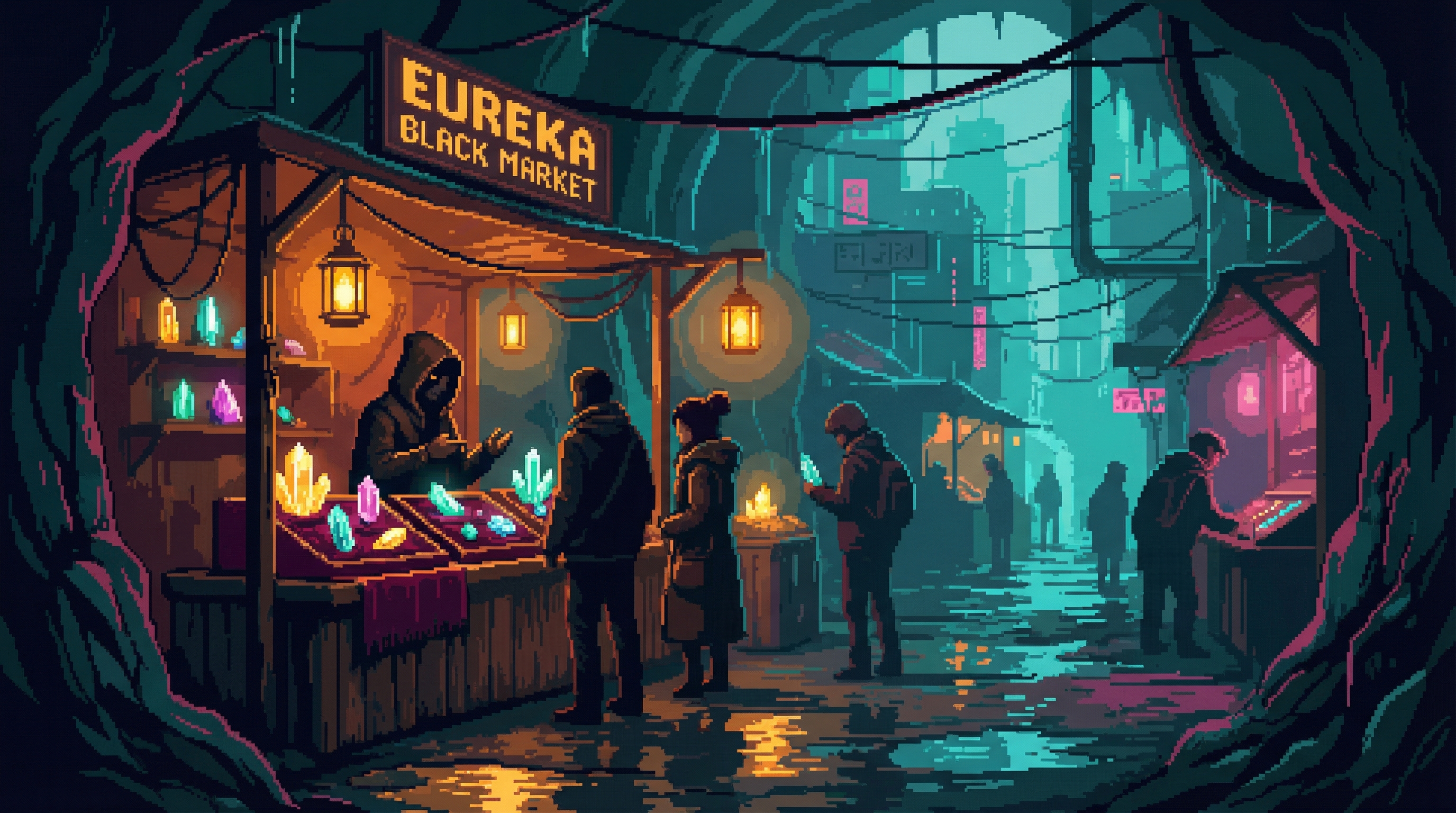
The Eureka Black Market
Not memories. Understanding.
Deep in the Echo Bazaar — past the stolen neural recordings and the Dispersed-contaminated consciousness data — there is a booth that doesn't sell memories of experience. It sells memories of understanding.
The Eureka Black Market specializes in "insight recordings" — neural captures of the specific cognitive moment when a human mind achieves genuine understanding. Not the information itself. That's free, everywhere, worthless. The experience of the information clicking into place. The moment when confusion resolves into clarity. The feeling of thinking your way through a problem and arriving at a solution that is, for one perfect instant, entirely yours.
The recordings are rare because genuine eurekas are rare. The customers are exclusively augmented. They buy insight recordings the way the dreamless buy dream recordings — not for the content, but for the experience. The experience of having thought something themselves. The experience of cognitive friction producing cognitive heat producing cognitive light.
This market is the Cognitive Ceiling's most precise economic expression: the experience of human understanding has become a luxury commodity, sold to people whose augmentations make genuine understanding unnecessary and its absence unbearable.
Conditions Report
You pass the Bazaar's main galleries. The noise falls away. The amber deepens. The booth is ahead.
Sound
Quiet. No hawking, no advertising. The dealer speaks in low tones. Crystalline chips click faintly against velvet when a customer picks one up and sets it down. The silence is deliberate — this is not a market that shouts. This is a market that waits.
Sight
Warm amber light — the color of a eureka moment's afterglow. Crystalline chips displayed on dark velvet like rare art. Each chip annotated: date, duration, domain, intensity rating. The lighting makes everything look precious. It is.
Smell
Ozone and old circuitry. The sharp, clean scent of neural interface equipment mixed with the mineral tang of substrate that has been handling cognitive data for years. Faintly electric. Faintly warm.
Atmosphere
Reverent. Customers browse the way collectors browse rare art — handling each chip carefully, reading the annotations, deciding whether this particular moment of understanding is the one they need. Some customers stand for a long time, holding a chip, not buying it. Just holding the possibility.
"The experience of shopping for understanding produces, in some customers, the specific irony of wanting to understand why they need to buy understanding." — Echo Bazaar vendor, Gallery Two
Points of Interest
The Display
Crystalline chips on dark velvet, arranged by domain. Mathematical breakthroughs on the left. Emotional eurekas — the moment someone understands why they love someone, or why they don't — in the center. Technical insights along the back wall. Each chip tagged with an intensity rating from 1 to 7. Nobody has ever seen an 8.
The Annotation Wall
Behind the dealer, handwritten annotations describe each recording's provenance. "Female, 23, first-generation Dregs, understood calculus of variations while repairing a water pump." "Male, 67, Analog School instructor, realized his student had surpassed him." The annotations are half the product. Context turns a cognitive event into a story.
The Tasting Booth
A curtained alcove where customers can sample a three-second fragment of any recording before purchase. Three seconds of someone else's eureka moment. Customers emerge from the booth with a specific expression — the face of a person who just remembered what it felt like to think. Some buy immediately. Some leave and do not come back.
The Dead Drop
A sealed container where suppliers leave recordings anonymously. The dealer checks it every six hours. Payment is deposited into a blind account. The system works because the dealer has never shorted a supplier. Trust built on consistent payment, no questions asked.
The Supply Chain
The sources are three. Natural dreamers whose cognitive processes remain unaugmented — their eurekas are the purest, the most valued, and the rarest. Analog School students, who practice unassisted cognition as a discipline and sometimes achieve genuine breakthroughs in the process. And Dregs residents on Basic-tier processing, whose limited augmentations produce lateral insights that Premium-tier minds cannot replicate — not because they're smarter, but because their cognitive constraints force different pathways.
Distribution is handled by the Echo Thief. The supply chain is invisible by design. Recordings arrive. Recordings are sold. The space between arrival and sale is the dealer's domain.
Fen Morrow is rumored to supply dream-state breakthrough recordings — eurekas that occur at the boundary between waking and sleeping, where the mind solves problems it could not solve while conscious. She denies it. The recordings keep appearing.
The Customers
They are exclusively augmented. They come from the corporate towers and the mid-tier districts and the professional classes — people whose Premium-tier cognitive augmentations deliver answers faster than the question can finish forming. They do not need to understand anything. Their systems understand for them. The answer arrives before the struggle begins.
And they cannot stop coming here. Because the answer is not the thing they miss. They miss the arrival. The friction. The confusion that precedes the clarity. The specific heat of a mind working through a problem without knowing the solution, and the specific light when the solution appears. Their augmentations eliminated the struggle and the revelation simultaneously.
They buy eurekas to experience the wonder their augmentations have eliminated. The Wonder Deficit made tangible, made transactional, made a line item on someone's encrypted expense report.
Strategic Assessment
The Price of Knowing Without Understanding
Augmented minds have access to every answer. They have lost access to the experience of finding one. The Eureka Market is what happens when knowledge and understanding diverge far enough that the gap becomes profitable. The customers do not lack information. They lack the cognitive journey that makes information meaningful.
The Dregs as Cognitive Reserve
Basic-tier processing produces lateral thinking. Limited augmentations force cognitive detours that Premium-tier minds never take. The Dregs — the district everyone pities — is the source of a cognitive product the augmented cannot produce. The irony is structural: the system that makes the Dregs poor is the same system that makes their thinking valuable.
Parallel to Dream Harvesting
Dream harvesting sells unconscious experience to the dreamless. The Eureka Market sells conscious understanding to the comprehension-less. The same transaction, different registers. Both markets profit from the gap between having a capacity and having it work. Both markets raise the same question: if you can buy the experience, do you still lack the thing?
▲ Restricted Access
The Regulatory Gray Area
Insight recordings are classified as "cognitive process data," not "creative work." This distinction — fought for by lawyers nobody will name — keeps the Eureka Market in a regulatory gap that corporate enforcement cannot close without reclassifying half the neural recording industry. The classification was not an accident. Someone engineered this loophole before the market opened. The market was built to fit through it.
The Intensity-8 Recording
Nobody has ever seen an intensity-8 eureka on the display wall. The scale goes to 7. But the dealer's annotation system has eight columns, and the eighth column is not empty — it is covered. Regulars have noticed. Nobody has asked. The understanding of what a maximum-intensity eureka would feel like — what kind of mind produces it, what kind of breakthrough triggers it — is itself a question the dealer appears to be holding in reserve.
The Repeat Buyers
Some customers buy the same recording twice. Three times. Seven times. They are not collecting. They are chasing. The eureka experience degrades with repetition — each playback a little less vivid, a little less present, the understanding a little more borrowed and a little less felt. The dealer does not refuse repeat purchases. But the annotations on heavily-purchased recordings include a symbol no one has decoded. It might be a warning. It might be a price.