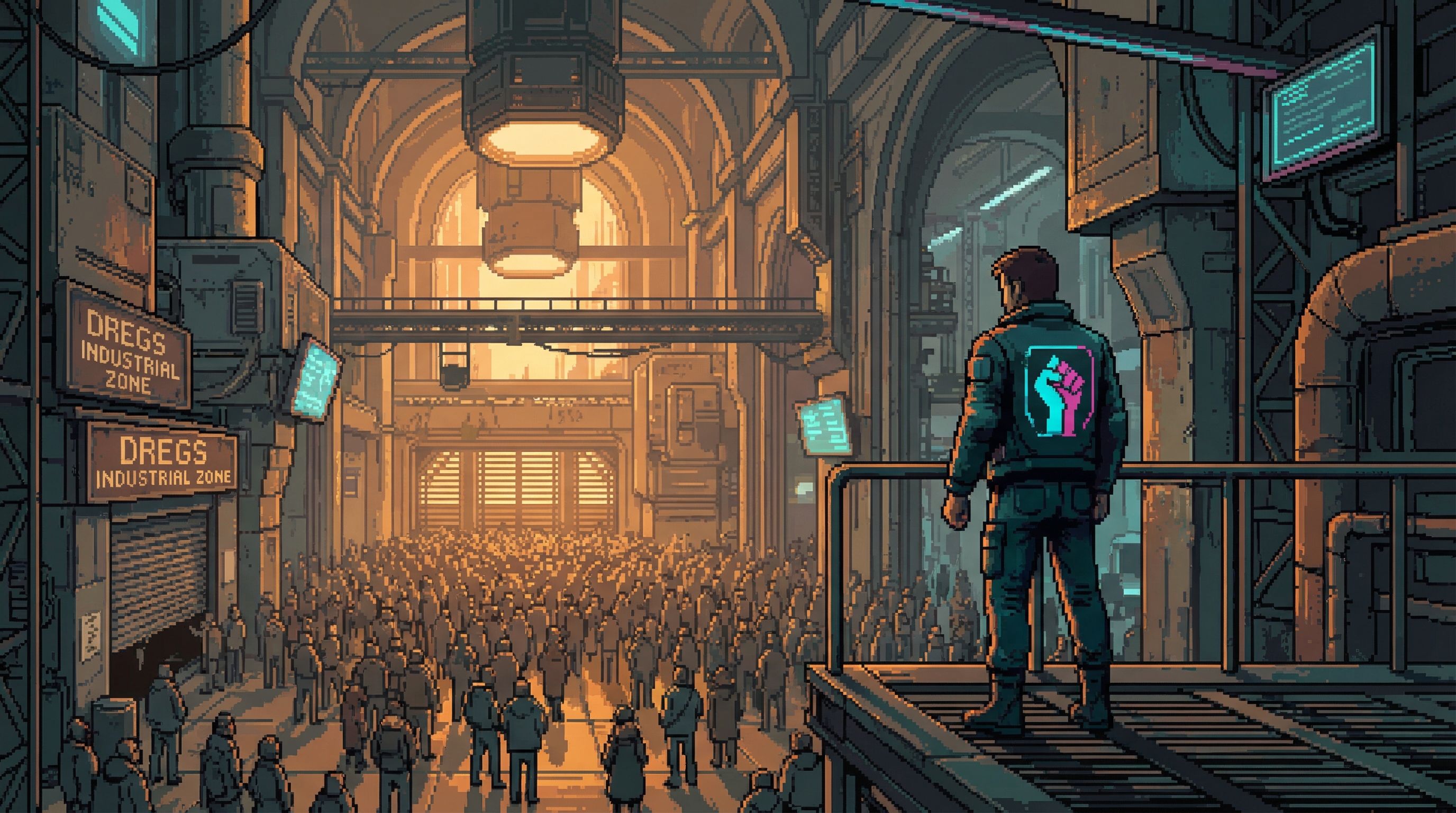
Lev Mirski
The Empathogen Cathedral operator
Overview
Lev Mirski is the son of the most famous labor leader in the Sprawl, and he organizes chemical communion instead of strikes. His father has never said he’s disappointed. His father’s silence says it for him.
He started the Cathedral because he noticed something his father’s movement couldn’t address: the workers weren’t just exploited. They were alone. The deprecated were alone. Everyone was alone, and the organizing models his father taught him required something the Sprawl’s residents increasingly lacked — the capacity to feel each other’s reality.
The empathogens provide that capacity, temporarily. Lev considers this a beginning, not an end — rehabilitation, not recreation. Whether it works is unclear. The data is ambiguous. He continues anyway, because the alternative is a population that cannot feel each other’s pain, and a population that cannot feel each other’s pain cannot organize.
Voice & Personality
Lev speaks with the rhythmic confidence of someone raised in a household where argument was exercise — quick, pointed, always ready for the counterargument.
Inherited Logistics
His father organized strikes. He organizes communion. Same talent, different application. The skill set for mobilizing four thousand angry dockworkers and four thousand empathogenic celebrants turns out to be identical.
The Ambiguous Data
He tracks outcomes. The data doesn’t support his thesis. He continues because the alternative — doing nothing — has no data either. Between an uncertain intervention and a certain decline, he chose uncertainty.
The Chemical Bridge
He doesn’t claim the empathogens cure loneliness. He claims they remind people what connection feels like, so they know what to reach for. A map, not the territory.
“My father organized workers. I organize synapses. He’ll tell you his way is harder. He’s wrong. Getting four thousand people to feel each other for six hours is easy. Getting them to remember it on Monday is the revolution.”
Key Relationships
The Empathogen Cathedral
The Sprawl’s largest regular empathogenic gathering. Lev built it, operates it, and watches from the edges — entirely sober — while 4,000 people produce the warmth the Sprawl’s systems have eliminated.
Pavel Mirski
Secretary-General of the Ironworkers’ Solidarity. Lev’s father. The man who organized strikes while his son organizes synapses. Both believe in collective power. They disagree about what “collective” requires.
The Warmth Tax
The Cathedral is the tax’s chemical bypass — paying in cortisol rather than credits. Lev’s solution to the warmth deficit: a chemical bridge to social reconnection.
The Touch Economy
The Cathedral provides touch at scale — 4,000 people in empathogenic proximity. In a Sprawl where physical contact carries a price tag, Lev offers it for the cost of admission and a willingness to feel.
Sector 7G
Based in the Dregs industrial zone adjacent to Sector 7G. The rusting heart of the Sprawl’s labor districts, where Lev grew up hauling e-waste.
The Organizer’s Dilemma
Chemical Solidarity
The Sprawl’s labor movements require collective feeling — the capacity to stand beside someone whose pain you recognize as your own. That capacity has atrophied. The deprecated don’t strike because they can’t feel each other enough to risk anything together.
Lev’s wager: if chemistry can restore the capacity for empathy, even temporarily, the memory of connection might outlast the chemical. The data says otherwise. He continues anyway, because the workers who attend the Cathedral report something his spreadsheets can’t capture — they remember what it felt like to not be alone.
Inheritance and Deviation
Pavel Mirski organized strikes. His son organizes communion. The father built barricades; the son builds neurochemical bridges. Both are trying to solve the same problem — a population too fractured to act collectively — and neither will admit the other’s method might work.
The silence between them is the silence of two people who love each other and cannot agree on what love demands. Pavel’s fist, closed around a wrench. Lev’s fist, open.
Secrets & Mysteries
Threads that pull at the edges of a man who watches communion but never participates:
- The longer effect: Several Cathedral regulars report increased social engagement during the week following attendance — small kindnesses, unsolicited conversations, eye contact with strangers. The effect is too small and variable to publish. Lev suspects it’s real. He won’t say so publicly because he learned from his father that a claim without evidence is a weapon your enemies will use against you.
- The sober operator: Lev never takes the empathogens himself. He watches. He says it’s because someone has to manage the logistics. The truth is simpler and harder: he’s afraid that if he feels what they feel, he’ll stop believing the data matters.
- The open fist: His father’s union symbol is a closed fist. Lev wears the same fist, opened. He’s never explained the symbol publicly. His father has never asked about it. The silence around that conversation is louder than the Cathedral’s subsonic bass.