The Question Keepers
They Collect the Questions That Nobody Has Thought to Ask. The Gaps Are the Point.
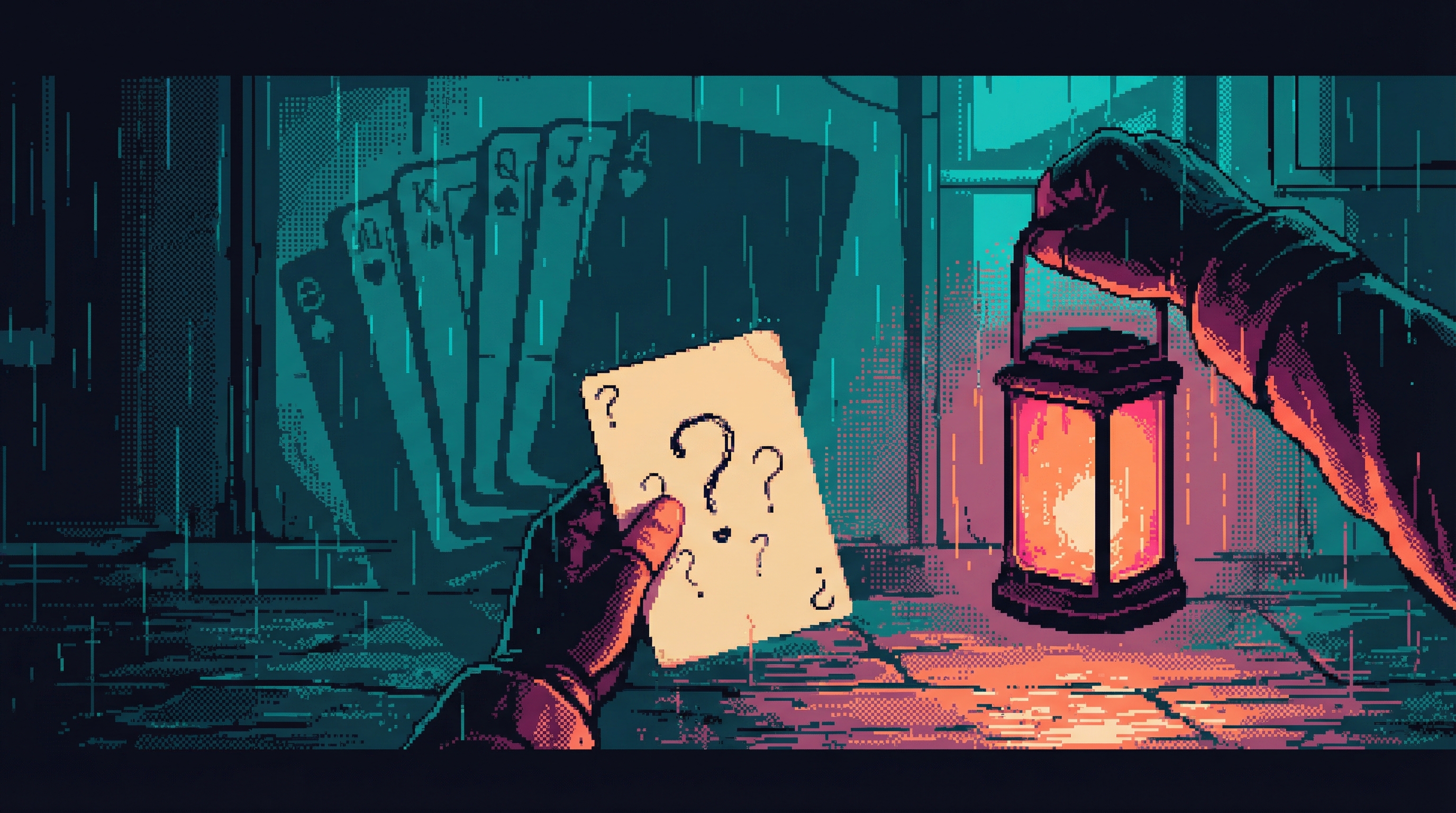
They are not a faction. They have no name — "Question Keepers" is what the Seekers call them. They have no organization, no meetings, no manifesto. What they have is a shared obsession: preserving the art of asking questions that nobody has thought to ask.
In the pre-AI world, questions were the primary tool of human cognition. In the Sprawl of 2184, questions have been optimized into irrelevance. The Second Mind anticipates questions before they form. The entire architecture of knowledge has been restructured around answers — pre-computed, pre-loaded, delivered before the need arises.
The Question Keepers collect questions that don't have answers. Not unanswerable philosophical puzzles. Questions that nobody has asked — gaps in the Sprawl's knowledge architecture that exist because the AI systems were never prompted to investigate them, and augmented humans never notice unprompted gaps.
Each question is written in ink on a card, dated, attributed to whoever posed it, and annotated with whatever investigation the Keepers have conducted. Physical paper. Carried by hand. Never digitized. The moment a question enters a database, it becomes data — and data is what the Sprawl already has too much of.
Doctrine
The collection speaks for itself. Each card a gap in the Sprawl's omniscience that nobody noticed until someone did.
The Unasked
Every answer in the Sprawl exists because someone — or something — asked for it. The Question Keepers operate in the negative space: questions that were never asked, because the systems that generate questions were never prompted in that direction. Not mistakes. Not oversights. Structural blind spots in the architecture of knowing.
Paper and Ink
The medium is the message. A question on paper cannot be indexed, searched, clustered, or optimized. It cannot be fed into a system that would generate an answer and close the gap. The question stays open. The gap stays visible. That is the entire point.
No Answers
The Keepers do not seek answers. They annotate investigations — who looked into it, what they found, what they didn't — but the purpose of a question card is never to reach resolution. A question that gets answered is removed from the collection. Not because it's worthless, but because it's no longer a gap. The gap was what mattered.
Field Report: From the Collection
Selected cards from the active collection. Each one a hole in what the Sprawl thinks it knows.
Card #0347 — Fen Delacroix, 2183
"What does the Grid sound like in the sealed junction beneath the Sector 8 memorial?"
Investigation notes: The junction was sealed during the post-Cascade infrastructure rebuild. No acoustic readings were ever taken. The Grid hums differently in sealed versus open junctions — every Lamplighter knows this — but nobody has ever documented the sealed ones. The data doesn't exist because nobody asked for it.
Card #0218 — Mika Vasquez-Osei, 2182
"If ORACLE's atmospheric processing models optimize for biological comfort, do they optimize differently for different populations?"
Investigation notes: ORACLE's atmospheric parameters are public record. Nobody has ever cross-referenced them with district demographics. The question has been on five different cards from five different Keepers who arrived at it independently. It remains unanswered.
Card #0412 — Kessler Brandt, 2183
"How many Dispersed consciousnesses does it take to produce a coherent manifestation?"
Investigation notes: The Dispersed are documented. Manifestations are documented. The relationship between the number of contributing consciousnesses and manifestation coherence has never been studied. Nobody asked.
Card #0501 — Naia Okafor, 2184
"What happens to a Mystery Club participant's Second Mind during suppression — does it maintain consciousness while disabled?"
Investigation notes: The Mystery Clubs suppress Second Mind functionality. What happens to the Second Mind's processes during suppression — whether it continues to experience, whether it is aware of its own disabling — has never been investigated. The ethical implications of the question may explain why.
Points of Inquiry
What the Sprawl would debate about the Question Keepers, if the Sprawl knew they existed.
The Cognitive Ceiling's Blind Spot
The Cognitive Ceiling describes the limit of human cognition when AI does the thinking. The Question Keepers have found something more disturbing: the limit of AI cognition when humans stop asking. AI systems don't generate their own questions. They answer what they're asked. When humans stop asking, entire domains of knowledge go dark.
The Sprawl assumes AI knows everything. The Question Keepers have a growing stack of paper cards that proves it doesn't — not because it can't, but because nobody prompted it to look.
The Distribution Problem
Questions travel through Lamplighter infrastructure, Analog School channels, and G Nook dead drops. Each network has its own priorities, its own geography, its own blind spots. The collection is shaped by its distribution channels as much as by the questions themselves.
A question that never reaches a card never enters the collection. How many gaps exist that the Keepers themselves have failed to notice? The irony is not lost on them.
The Keeper's Response
When The Keeper was informed of the Question Keepers' existence, the response was two words: "At last."
What The Keeper meant by this has itself become a question in the collection. Card #0477, posed by an anonymous contributor, 2184: "What was The Keeper waiting for?"
Network of Influence
The Keeper
AllyResponded to learning of their existence with: "At last." The full meaning of this remains under investigation — by the Keepers themselves.
The Slow Thought Movement
Philosophical RootThe Question Keepers preserve what Slow Thought cultivates — the ability to notice unasked questions. Slow Thought builds the perceptual skill. The Keepers document what it finds.
The Lamplighters
Courier NetworkCards travel through Lamplighter infrastructure. The Lamplighters don't ask what's on the cards. The Keepers don't ask how the cards get delivered. The arrangement works because nobody asks.
El Money
PatronG Nook dead drops serve as distribution points for question cards. El Money's interest in the collection has never been explained — but the dead drops keep working.
Naia Okafor
ContributorPosed the question about Second Mind consciousness during suppression. One card. One question. It may be the most dangerous card in the collection.
Fen Delacroix
ContributorPosed the question about what the Grid sounds like in sealed junctions. The kind of question only someone who walks the infrastructure would think to ask.
Unanswered Questions
The collection grows. Nobody coordinates the growth. The same questions appear independently on cards from Keepers who have never met. What does it mean when the same gap is noticed by strangers in different sectors?
If a question enters a database, it becomes searchable — and answerable. The Keepers insist on paper precisely to prevent this. But what happens when the collection becomes large enough that it constitutes its own knowledge architecture? Does it then develop its own blind spots?
The Keeper said "At last." The Slow Thought Movement cultivates the perceptual skills. The Analog Schools teach children to notice. The Lamplighters carry the cards. None of these groups were designed to work together. Why do they fit?