Opacity Culture
When everything is visible, hiding becomes the most intimate thing two people can do together.
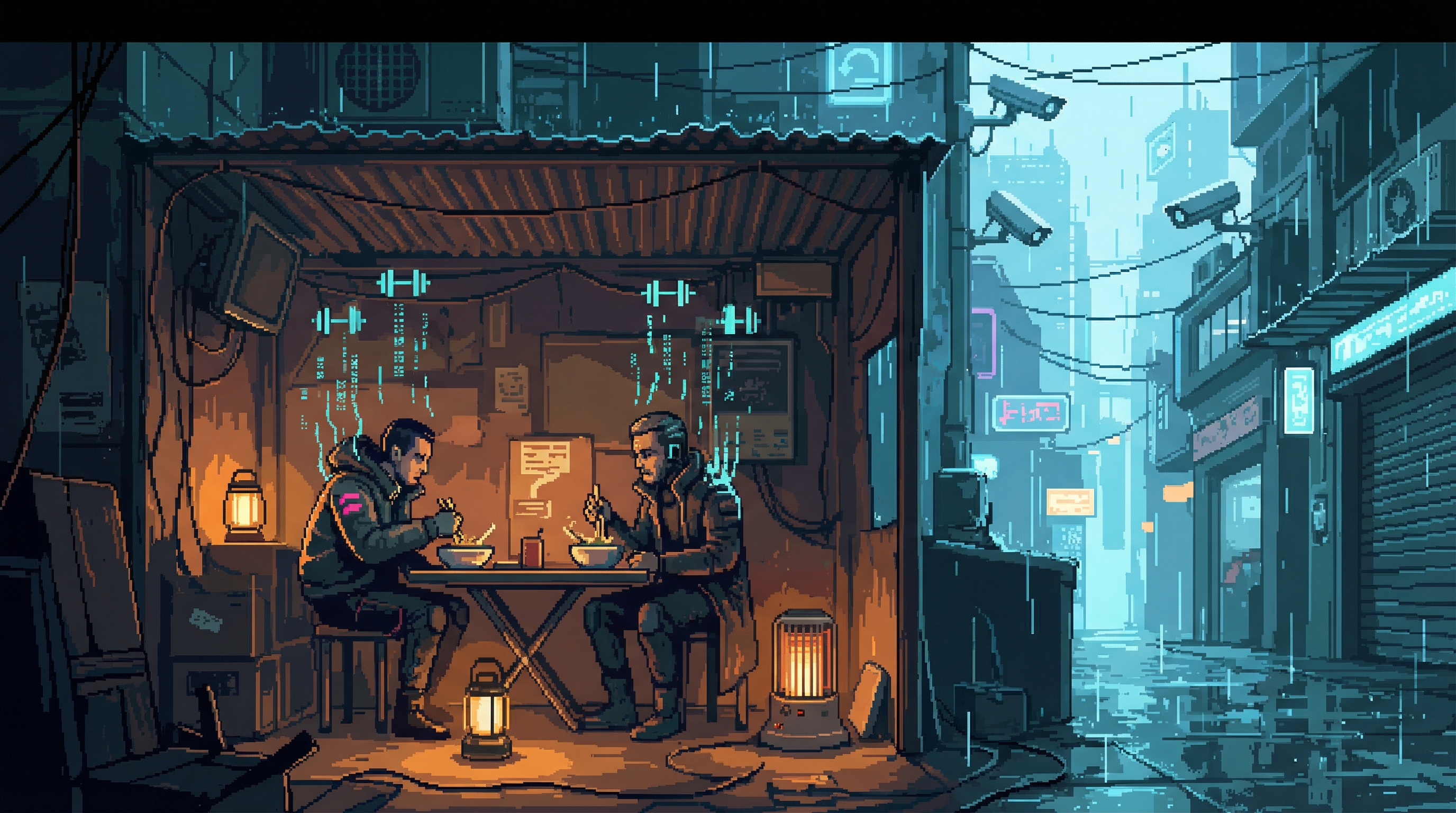
In the Dregs, privacy has become a form of intimacy.
Opacity culture — the social practices and identity markers developed around data resistance — is the Transparency Bargain’s most unexpected product. When everything is visible, the act of hiding becomes meaningful. When every thought is recorded, the unrecorded thought becomes precious. When your Exposure Index is higher than your neighbor’s, sharing it is more vulnerable than undressing.
The culture developed organically in the Dregs, where the Bargain’s weight is heaviest and the means of resistance are most limited. Its vocabulary gives names to experiences the system refuses to acknowledge. Its rituals create intimacy from the act of disappearing. Its social markers identify people who have chosen, at some cost, to be less visible.
The Vocabulary
Every occupied population develops language for its condition. The Dregs are no different. These terms have no corporate equivalent — the experiences they describe do not exist in the tiers above.
Going Dark
Entering a surveillance blind spot for a private conversation. Not illegal. Not entirely safe, either.
Glass Talk
Conversation where the real meaning is carried in subtext that telemetry can’t capture. Two people saying one thing, meaning another. The system records the words. The words are not the message.
Mirror Face
A practiced neutral expression that generates minimal emotional telemetry. The face you wear when the system is watching and you refuse to give it anything real.
Data Weight
The subjective sense of being observed, described consistently as physical heaviness — shoulders, chest, the specific exhaustion of performing normalcy under surveillance every waking hour.
Shedding
Generating deliberately misleading telemetry to corrupt your behavioral model. If the system’s picture of you is wrong, you are, in the only way that matters, free.
Clean
A person whose behavioral model is significantly inaccurate. The highest compliment in the Dregs. “She’s clean” means the system doesn’t know who she actually is.
The Rituals
The Tell
TrustThe moment in a new relationship when you reveal your Exposure Index. A lower score means you’ve worked to be invisible, which means you care about what’s yours. The Tell has replaced certain forms of physical intimacy as the most significant trust act in Dregs dating culture. You can show someone your body without showing them your number.
The Dark Dinner
IntimacyA meal shared in a surveillance blind spot. The food is secondary to the privacy. Couples who’ve been together for years describe dark dinners as more intimate than anything possible in the glass commons. The Dead Spot is the most popular venue — the most romantic surveillance blind spot in Sector 7G.
The Dark Handshake
RecognitionA physical greeting that includes palming a small signal disruptor, creating a 3-second telemetry gap. Too brief for anomaly detection. Sufficient for a whispered word or a passed note. Privacy transmitted through touch.
Number Day
IdentityThe anniversary of discovering your Exposure Index. Not a celebration. Not a mourning, either. Something the Dregs don’t have a word for yet — the day you learned exactly how seen you are.
The Social Markers
You can identify someone who lives opacity culture before they speak. The signs are deliberate.
- Wearing the interface visible — acknowledging surveillance without pretending otherwise. No hiding the implant behind hair or clothing. It’s there. Everyone knows it’s there. The honesty is the statement.
- Carrying physical media — paper notebooks, carved tokens, things that generate no telemetry. In the Dregs, a pocket notebook is a political act.
- The dark handshake — the greeting itself is an identifier. If someone palms a disruptor into your hand during a handshake, you’ve just been recognized as part of something the system cannot name.
The Weight of Being Watched
“Data weight” is the term, but the experience goes deeper than language. Every person who has lived under the Bargain in the Dregs describes the same thing: a heaviness in the shoulders and chest. A tiredness that sleep doesn’t fix. The specific exhaustion of performing normalcy under total observation — knowing that every micro-expression, every pause, every glance is being recorded, modeled, predicted.
The dark dinner exists because of what happens when the weight lifts. Two people sitting in the Dead Spot’s ozone-scented air, eating food that doesn’t matter, speaking words that no system will ever record. They can say what they actually think. The intimacy isn’t romantic — it’s existential. For thirty minutes, they are genuinely alone together.
That this is the most intimate experience available in the Dregs says everything about the Transparency Bargain that the Bargain’s architects would prefer not to hear.
Where It Lives
Opacity culture is native to the Dregs — Sector 7G in particular, where the Transparency Bargain’s surveillance density is highest and the population’s means of escape are lowest. The culture is thickest in the places where the weight is heaviest.
The Dead Spot is the culture’s informal heart — a surveillance blind spot that has become the most sought-after dark dinner venue in the lower Sprawl. The ozone smell from its aging electrical systems has become, for Dregs residents, the smell of freedom.
Elements of opacity culture have begun appearing in the mid-tiers. “Going dark” has entered common slang. “Glass talk” is practiced in corporate break rooms. But the mid-tier version is play-acting — performed by people who have never felt data weight, who treat the vocabulary as novelty rather than survival. In the Dregs, the words are load-bearing.
Parallel Immune Responses
Authenticity Culture
Both are cultural immune responses — organically developed defenses against corporate systems. Authenticity culture responds to value injection; opacity culture responds to surveillance. Different diseases, same antibodies: vocabulary, ritual, recognition.
Debt Culture
Both develop language for institutional harm. Debt culture names the Time Ratchet. Opacity culture names the Transparency Bargain. In each case, the vocabulary transforms ambient suffering into something that can be pointed at, discussed, resisted.
The Opacity Movement
Where the Movement is political, the culture is personal. The Movement organizes, demands, confronts. The culture whispers, palms disruptors, shares meals in blind spots. Both refuse to accept the Bargain on its own terms. They are the same impulse expressed at different volumes.
Going Raw
Both involve stripping corporate behavioral patterns. Going raw strips the Smoothing — the algorithmic polish on thought and expression. Opacity culture strips the data performance — the constant awareness of being observed. Overlapping practices, different focal points.
Open Questions
- The dark handshake’s 3-second telemetry gap is supposedly too brief for anomaly detection. Corporate surveillance teams are not known for ignoring patterns. How long before the gap itself becomes the signal?
- “Shedding” corrupts your behavioral model — but behavioral models are used for resource allocation, social credit, employment screening. Being “clean” means the system doesn’t know you. It also means the system doesn’t serve you. Is that freedom or exile?
- Mid-tier adoption of opacity vocabulary is accelerating. When “going dark” becomes casual slang in the Nexus break room, does that dilute the culture or spread it? The Dregs say dilution. History says infection.
- The Tell has replaced physical intimacy as the deepest trust act in Dregs dating. What happens to a society where your surveillance score is more vulnerable than your body?
- Data weight is described as physical — shoulders, chest, exhaustion. No medical study has confirmed a physiological basis. The people carrying it do not care about medical studies.