Debt Culture
Where there is shared suffering, there is ritual.
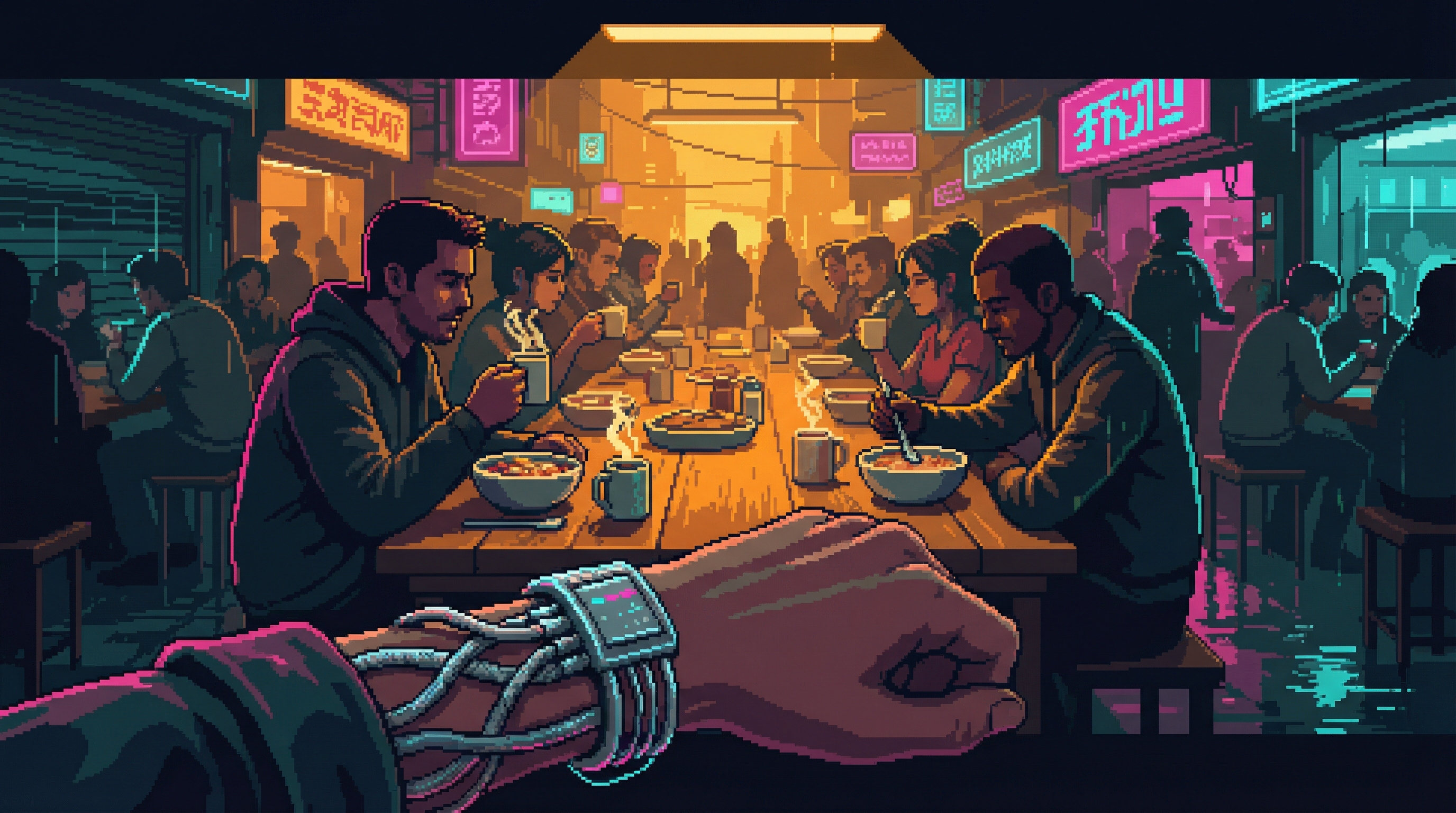
Where there is suffering, there is language to contain it. Where there is shared suffering, there is ritual.
The cognitive debt community has developed its own vocabulary, practices, and markers of identity — a culture as distinct as dream culture or authenticity culture, born from the shared experience of having your mind mortgaged.
The Vocabulary
The licensed system has no words for what it does to debtors. So debtors made their own.
“Dimmed” — currently under the Repossession Protocol. Distinct from “going gray” (deprecation) or the Dim Ward (MVC poverty). A dimmed person is having their cognitive capacity actively reduced to service outstanding debt. The word is precise because precision is what remains when hope is exhausted.
“Night-shifted” — fatigued from sleep-cycle processing that your conscious self never authorized. Your body worked last night. You don’t remember what it did. You feel it in your bones anyway.
“Haunted” — carrying the knowledge that your death will activate your neural backup as ghost labor. Every haunted debtor walks through the Sprawl knowing that dying with outstanding debt means your ghost works it off. You are pre-mourned by yourself.
“The clock” — the calculation every debtor carries: months to default, months from default to equilibrium, percentage of baseline at equilibrium. The most intimate number in a debtor’s life. More personal than your age. More definitive than your health status. You don’t ask someone their clock. They tell you when they’re ready.
Children in the Dregs use “dim” as an insult. It is crueler than any previous equivalent because it refers to a real, documented, administered condition. The word doesn’t exaggerate. That’s what makes it cut.
The Rituals
Everything in a debtor’s life is metered. The rituals exist because they are the things that aren’t.
Debt Breakfast — a weekly gathering at Dregs cafes where debtors share a free meal funded by community contribution and discuss their clocks. The meal is free because everything else isn’t. The conversation is honest because there is no profit in pretending. Someone says “fourteen months” and the table goes quiet and that silence is the most human sound in the Sprawl.
The Letter — writing to your future diminished self, stored at G Nook encrypted terminals. El Money provides the storage for free. The Letter acknowledges what the system won’t: that the person who emerges from dimming will not be the person who went in. You are writing to a stranger who will have your face. The tradition emerged from Grace Period experience — writing to the self you’re about to lose.
The Backup Ceremony — communal neural backup destruction. The most dangerous ritual in debt culture. Illegal under “impairment of corporate collateral.” Witnessed. A collective act of refusing to let the system follow you past death. If you destroy your backup, your ghost can’t be activated. The ceremony is quiet. The participants hold hands. The deletion is irreversible. The corporations call it vandalism. The debtors call it freedom.
The Silver Band
A thin wire band worn on the left wrist — salvaged from neural interface cabling, twisted into a circle. It signifies active cognitive debt.
Worn openly in the Dregs. Hidden in corporate territory. The band says: I am being consumed, and I am not hiding it. The same radical visibility practiced by authenticity culture — name what you are, don’t conceal it, let the visibility itself be defiance.
The wire is industrial salvage. It costs nothing. It means everything. A debtor who removes their band in the Dregs is making a statement — either they’ve paid off, or they’ve given up on solidarity. Both are noted. Neither is judged. The band is offered, never imposed.
Where It Lives
Debt culture is a Dregs phenomenon. The corporate tier has debtors — augmentation loans, cognitive upgrade financing — but those debts are serviced quietly, managed by financial advisors, hidden behind prestige. Corporate debtors don’t wear bands. They don’t attend breakfasts. They don’t write Letters.
In the Dregs, debt is collective weather. The Noise Floor hosts Debt Breakfasts and debtor gatherings in its dampened silence — a space where the clock doesn’t echo off the walls. The cafes know which tables to keep open on which mornings. The bartenders know not to charge.
G Nook terminals across the Dregs hold thousands of Letters — encrypted, time-locked, waiting for recipients who won’t remember writing them. El Money maintains the network without charge. When asked why, the answer is always the same: because someone should.
Points of Inquiry
Debt culture is the human response to the mechanisms of the Time Ratchet — language and ritual for naming what the licensed system refuses to name. The Ratchet creates the condition. The culture creates the container. Neither acknowledges the other. The Ratchet doesn’t recognize the vocabulary. The vocabulary doesn’t recognize the Ratchet’s authority.
The parallel with going raw is structural: both are cultural adaptation processes. Going raw adapts to deprecation. Debt culture adapts to cognitive debt. Both generate vocabulary, community, and identity from conditions designed to isolate. The system creates individual suffering. The culture makes it communal. Whether that makes the suffering more bearable or simply more visible is a question the Dregs have stopped asking. The answer doesn’t change the clock.
The Backup Ceremony sits at the intersection of resistance and despair. Destroying your neural backup is the only act a debtor can take that the corporation cannot reverse, cannot monetize, cannot absorb into the debt structure. It is also the destruction of yourself. The ceremony makes it witnessed. The ceremony makes it chosen. Whether those are enough is a question each participant answers alone, in a room full of people holding hands.
What Nobody Can Explain
- The Letters stored at G Nook terminals are encrypted and time-locked. Some debtors who emerge from dimming report that reading their Letter feels like correspondence from a dead friend. Others say it feels like being scolded by someone who loved them. The technology is the same. The experience never is.
- Debt Breakfast attendance correlates with slower cognitive decline — not because the meal helps, but because the isolation the Ratchet depends on is the thing the breakfast interrupts. Community as counter-optimization. No one has figured out how to monetize this, though three corporations have tried.
- The silver band has been adopted in fourteen Dregs sectors independently. No one coordinated it. The wire gauge is always the same — 22 AWG, the standard for neural interface cabling. The left wrist is always the same. No one remembers who started it. The practice spread the way debt spreads — from one person outward until it touches everyone.
- Backup Ceremonies are illegal, but no enforcement action has ever been successful in the Dregs. The ceremonies leave no evidence. The participants leave no testimony. The backups simply cease to exist, and the system notes the loss as “data corruption.” The corporations know. The debtors know they know. Neither side acknowledges the truth. It is the only negotiation debt culture has ever won.