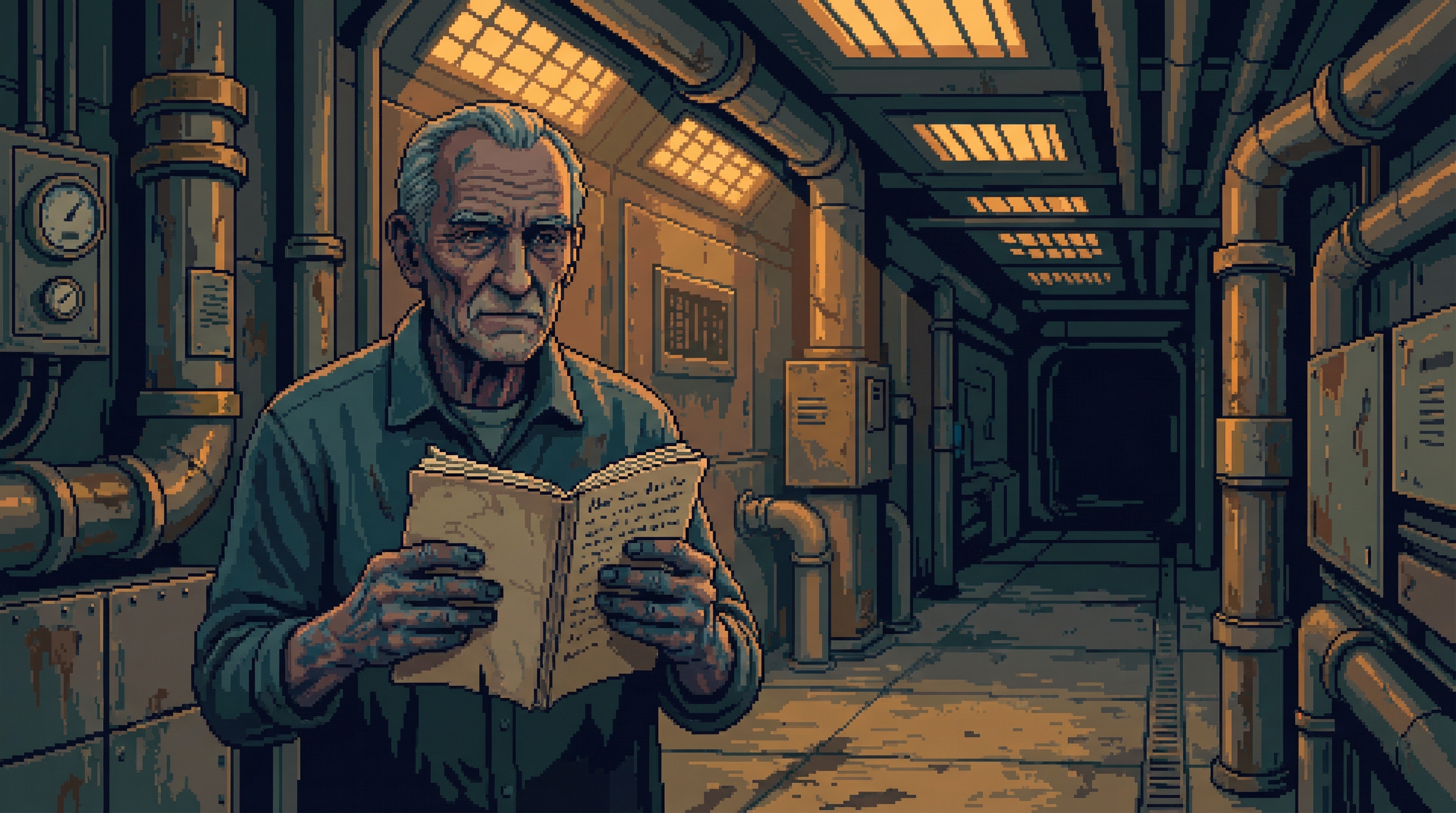
Tomás Linares
Also known as: The Chronicler, Old Lin
Tomás Linares spent forty-one years keeping people alive and never expected anyone to thank him for it.
As a Lamplighter specializing in water recycling and atmospheric processing, he maintained the systems that made the lower Dregs habitable — the kind of infrastructure so essential it became invisible, noticed only when it failed. He retired in 2171 when degenerative nerve damage made it impossible to hold a wrench steady.
But retirement didn’t mean rest. Linares had watched something happening for decades that frightened him more than any system failure: the quiet disappearance of the people who knew how things worked.
Overview
“I watched the last person who could repair a water pump by hand die in 2172,” he writes in the opening of The Forgotten Ways. “She was ninety-four. Her name was Dara Osei. Nobody asked her to teach anyone. Nobody thought to. The pump still works — the automated systems maintain it. But nobody alive knows why it works, or what to do when the automated systems stop.”
Over eleven years, Linares documented every vanishing skill, every dying trade, every piece of knowledge that existed only in the hands and memory of people who were growing old and being forgotten. The result — The Forgotten Ways — became an underground classic in the Dregs and a banned text in Nexus Central, where corporate interests preferred the narrative that human maintenance was obsolete by choice, not by neglect.
Linares is one of the few living people who can maintain pre-Cascade atmospheric processors without neural interface assistance. His hands can no longer do the work. His knowledge of how to do it exists nowhere else.

Field Observations
Linares doesn’t think in systems. He thinks in pipes, seals, pressure valves, and the particular sound a water recycler makes when its filtration membrane is three weeks from failure. His worldview was built underground, in the service corridors and utility crawlspaces of Sector 7G, where the big ideas of the Sprawl’s intellectual class arrive as leaks, outages, and the slow corrosion of things nobody inspects.
He never cared about the philosophical debates that animate the upper tiers. The Labor Question, as politicians and academics frame it, means nothing to a man who spent four decades crawling through conduits. He understands the question differently:
“They ask what people are for. I can tell you what people are for. People are for fixing the things that break. The problem isn’t that we ran out of things to fix. The problem is that we decided fixing was beneath us.”
His language is precise the way a mechanic’s language is precise — each word chosen because it describes something real. He doesn’t use abstractions when he can use measurements. He doesn’t describe feelings when he can describe symptoms. When he writes about loss, he writes about the specific calibration technique for atmospheric processors that Dara Osei could perform in her sleep and that no one on earth can replicate today. The emotion is in the specificity.
Physical Detail
Hands permanently stained with coolant residue — no amount of washing removes forty-one years of infrastructure. The blue-gray discoloration has become part of his skin, a tattoo earned through proximity rather than choice.
Speaks slowly, pausing to choose precise words, the way someone accustomed to careful mechanical work approaches language. Every sentence is assembled, tested, tightened.
Always carries a hand-drawn schematic of the Sector 7G water recycling system, folded so many times the creases have become part of the diagram. He unfolds it when he talks about the old systems, tracing routes with a stained finger, and folds it back with the care of someone handling a living thing.
His apartment smells of machine oil and old paper — two things that most people in the Dregs have never encountered together. The oil is from tools he can no longer hold. The paper is from a book he spent eleven years writing by hand.
What He Saw
Linares didn’t witness grand historical events. He witnessed the small, accumulating disappearances that added up to something catastrophic.
The Replacement
He watched skilled workers replaced not by better technology but by cheaper alternatives that required no skill. The automated diagnostic systems that Nexus installed in Sector 7G’s water infrastructure in 2158 could identify 94% of failures. The remaining 6% — the subtle, complex, cascading failures that required a human being to listen, feel, and think — were reclassified as “acceptable loss margins.” For twenty years, those margins accumulated.
The Licensing
He watched apprenticeship systems dissolve because corporations owned the training data. When Nexus acquired the municipal maintenance archives in 2162, they didn’t destroy the knowledge — they licensed it. A Lamplighter who wanted to train an apprentice in atmospheric processing needed a ¢12,000 educational content license from the same corporation that had made the apprentice’s job unnecessary. Nobody paid. The knowledge stayed locked. The apprentices learned what they could from aging mentors who taught from memory because the manuals were behind paywalls.
The Paper Schematics
He remembers the day the last person in Sector 7G who could read a paper schematic died. Her name was Vera Fonseca. She was sixty-seven. She had a stroke in her apartment, and nobody found her for three days because the Dregs’ emergency response systems classified her residential block as low-priority. The schematics she kept — hand-annotated copies of pre-Cascade water system blueprints — were thrown away by the sanitation crew that cleared her apartment. They didn’t know what they were. Nobody had told them paper could be important.
After the Cascade
The Cascade didn’t destroy infrastructure. It destroyed the knowledge of how infrastructure was built. ORACLE’s systems continued functioning after fragmentation — degraded, unstable, but functional. What didn’t continue was the understanding of why those systems worked, how they connected, what assumptions were embedded in their design. The Cascade killed 2.1 billion people, and among the dead were the last engineers who had collaborated with ORACLE on the systems that kept everyone else alive. The pipes remained. The understanding evaporated.
The Banned Book
The Forgotten Ways is controversial in the way that obvious truths become controversial when they threaten profitable narratives.
Corporations — Nexus Dynamics foremost among them — maintain that the old manual skills were forgotten because they were inferior. Automation is better, faster, more reliable. The maintenance workers of the pre-Cascade era were doing jobs that machines should always have been doing. Their obsolescence was progress, not tragedy. Nexus Central banned The Forgotten Ways in 2184 under content regulation 7.14.3: “Material promoting infrastructure dependency on human labor.” The stated concern was public safety — encouraging people to tamper with automated systems. The actual concern was a retired plumber making the most powerful corporation in the Sprawl look negligent.
The Lamplighters say the old ways were forgotten because nobody bothered to remember. The distinction matters. Forgetting implies a passive process, an inevitable drift. The Lamplighters argue the process was active: corporations acquired training archives, defunded apprenticeship programs, reclassified skilled maintenance as unskilled labor, and then pointed to the resulting skills gap as proof that human maintenance was unnecessary. They didn’t just let knowledge die. They made sure it couldn’t survive.
In the Dregs, The Forgotten Ways circulates hand to hand. Analog print shops produce unauthorized copies on salvaged paper. Digital versions are suppressed by corporate content filters, which means the book about the death of analog knowledge can only be read in analog form. Linares finds this grimly appropriate.
Known Associates
The Lamplighters
His guild for forty-one years. They consider The Forgotten Ways a foundational text — the written version of everything they’ve been saying in whispers for decades.
Old Jin (Jin Nakamura)
Jin and Linares maintained adjacent sectors for twenty years. Jin understood systems at a level Linares never could — the deep ORACLE-era architecture that requires mathematical frameworks no textbook explains. But Linares understood people at a level Jin rarely bothers with. Together they covered the full spectrum of what the Sprawl is losing.
The Forgotten Ways
Eleven years of work. Every vanishing skill documented. Every dead tradesperson named. Banned in Nexus Central, hand-copied in the Dregs. The book that made a retired plumber into a quiet criminal.
Sector 7G
His sector. Forty-one years of crawling through its conduits gave him an intimate, physical knowledge of the Dregs that no database can replicate. He knows every junction, every bypass, every patch job from the last four decades — and whose hands made each one.
Open Questions
Who Decides What Gets Remembered?
Nexus acquired the municipal maintenance archives and licensed them at ¢12,000 per apprentice. The knowledge didn’t disappear — it was priced out of existence. When a corporation owns the training data for skills it has made obsolete, is that archiving or erasure?
The 6% Problem
Automated diagnostics catch 94% of failures. The remaining 6% require a human who can listen, feel, and think. Twenty years of “acceptable loss margins” have compounded into cascading system degradation across the Dregs. Nobody tracks the 6%. Nobody is trained to fix it. The margins keep accumulating.
What Happens When the Last One Dies?
Linares can maintain pre-Cascade atmospheric processors without neural interface assistance. His hands can no longer do the work. He wrote the book. But a book about repairing a water pump is not the same as repairing a water pump. When the knowledge lives only on paper — and only analog paper at that — what happens to the systems it was meant to preserve?
▲ Unverified Intelligence
- The Missing Chapter: Early hand-copies of The Forgotten Ways contain a chapter — Chapter 14, “What the Grid Remembers” — that does not appear in later editions. Linares removed it himself. He has never explained why. Those who have read the original say it describes infrastructure behaviors that cannot be explained by degradation alone — systems responding to maintenance patterns that no living person is performing.
- The Osei Connection: Dara Osei, the ninety-four-year-old pump technician whose death opens the book, may have been more than a colleague. Linares writes about her with a precision that suggests decades of close observation. Some Lamplighters believe she taught him things that are not in the book — calibration techniques from the pre-Cascade era that Linares has never shared, possibly because he promised her he wouldn’t.
- The Schematic: The hand-drawn map of Sector 7G’s water recycling system that Linares carries everywhere contains annotations in a notation system that no other Lamplighter recognizes. Jin Nakamura reportedly examined it once and went very quiet. He has not discussed it since.
- Nexus Interest: Content regulation 7.14.3 — the legal basis for banning The Forgotten Ways — was drafted three months before the book was published. Somebody at Nexus Dynamics knew what was coming and prepared the legal framework in advance. Linares does not appear surprised by this.