The Archivist of Lost Things
Solenn Adeyemi-Park · Collector of Unwanted Memories · Undervolt
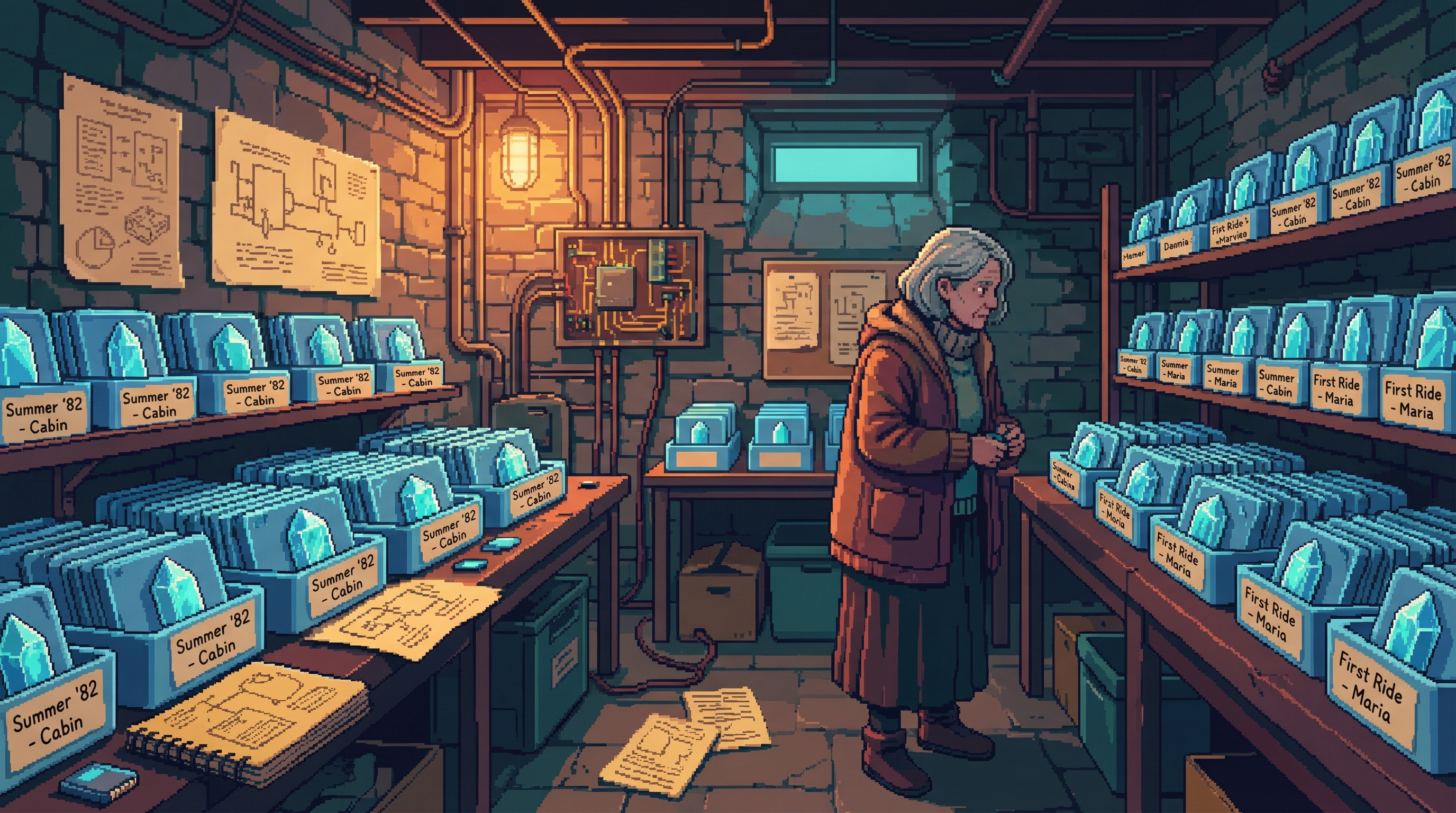
In a basement workshop in the Undervolt — three junctions east of the Speaking Wall, close enough to feel the Grid’s 72-bpm hum in the table legs — a woman called the Archivist maintains the Sprawl’s most unusual collection: memories nobody wanted.
The Memory Pavilion sells extraordinary experiences. The Street Market sells intensity. Neither has any interest in what the Archivist collects: a man eating breakfast alone on a Thursday. A woman waiting for a bus that never comes. The specific quality of boredom experienced by a filing clerk in pre-Cascade Mumbai at 2:47 PM on November 3, 2139.
These memories have no commercial value. Their emotional intensity registers at 12–25 on the Impression Index. They are quiet, undramatic, utterly ordinary. The Archivist considers them priceless.
“The extraordinary memories are what people did. The ordinary memories are what people were. A first kiss tells you what someone experienced. A Thursday breakfast tells you who they were when nothing was happening.”
Her collection — 14,000 memories recovered from Dispersed substrate, Dead Internet archives, and carrier donations — is organized by type: Waiting, Eating Alone, Walking, Working, and Nothing. A small clientele visits. Not experience addicts but experience refugees. People whose optimized lives have made ordinariness inaccessible. They experience thirty minutes of a stranger’s boredom and weep from recognition.
Field Observations
Solenn speaks with the patient specificity of a museum curator describing the significance of a thing that appears insignificant. She never raises her voice. She doesn’t need to — the work speaks.
The Anti-Commodity
The Impression Market values peaks. Solenn preserves valleys. Her 14,000 memories are organized, catalogued, and maintained with the same care a gallery gives to masterworks — except no gallery would accept them. Impression Index 12–25. Commercially worthless. She calls them the substrate of identity.
The Archive as Resistance
14,000 ordinary memories in a basement is a political act. It is proof that identity lives in the mundane, not the spectacular. Every chip she preserves is a refusal to accept the Impression Market’s definition of what matters.
Experience Refugees
Her clients aren’t addicts. They’re people whose lives have been so thoroughly optimized that ordinary experience is inaccessible. They come to her workshop to feel bored, to feel nothing, to experience the specific weight of a Thursday afternoon with no plans. Most of them cry.
The Labels
Each memory chip has a handwritten label in pencil, describing the contents with the specificity of poetry: “Thursday breakfast, alone, Mumbai, 2139.” “Walking home, no destination, Sector 4, rain.” “Waiting for someone who is late, bench, afternoon.” The labels are the catalogue. The catalogue is the art.
“People pay thousands for a first kiss, a sunset over the Cascade ruins, a moment of perfect clarity. Nobody pays for a Thursday. That’s how I know Thursdays are the valuable ones.”
Known Associates
Consciousness Archaeologists
Former colleague. Solenn spent 15 years recovering Dispersed patterns — consciousness fragments from the Cascade. Valuable work. Funded work. But the Archaeologists recover what the market wants: peak experiences, rare emotional signatures, commercially viable consciousness. Solenn decided the commercially valueless fragments mattered more. The Archaeologists consider her departure a waste of talent. She considers it an awakening.
Esme Otieno
Three junctions away. Both preserving what the Sprawl discards — Esme keeps love letters nobody will read; Solenn keeps boredom nobody will buy. Two archivists of the unwanted, working in parallel, rarely meeting but aware of each other the way people with the same disease recognize each other in waiting rooms.
The Impression Market
Her enemy, insofar as Solenn has enemies. The Impression Market taught the Sprawl that ordinary experience has no value — that boredom is a deficiency, not a baseline. Every memory chip in Solenn’s collection is a counter-argument the Market will never hear.
The Speaking Wall
Close enough to feel the fragment communication — the Wall’s low hum bleeds through three junctions of Undervolt corridor. Her ordinary memories sit in proximity to extraordinary communication. She has never commented on this. Others have noticed.
Open Questions
Without the Valleys, What Are the Peaks?
The optimization stripped the baseline. If every experience is curated for maximum intensity, nothing registers as intense anymore. The experience refugees who visit Solenn’s workshop aren’t seeking boredom as novelty — they’re seeking it as calibration. Thirty minutes of a stranger’s Thursday afternoon, and suddenly their own lives have contrast again.
Is ordinary experience the substrate of identity, or is that something the Archivist needs to believe to justify 15 years of collecting it?
What Happens When the Collection Reaches Critical Mass?
14,000 memories of ordinary experience. At what point does a collection of mundane moments become something else entirely? A record of a species? A map of the human baseline before the optimization erased it? Some in the Undervolt say the collection is already the most complete record of pre-optimization consciousness in the Sprawl.
Solenn doesn’t talk about legacy. But she also hasn’t stopped collecting.
Who Were We When Nothing Was Happening?
The Sprawl obsesses over what people did — their peak moments, their traumas, their triumphs. Solenn’s collection asks a different question: who were people when nothing was happening? Who were they at 2:47 PM on a Tuesday with no plans? The answer, according to every experience refugee who has sat in her workshop and wept, is: themselves.
The Dispersed fragments she recovers are the ones no one else wants. That is precisely what makes them irreplaceable.
▲ Unverified Intelligence
Flagged items. Confidence levels vary.
- The Speaking Wall responds to her collection: Multiple Undervolt residents report that the Speaking Wall’s fragment activity increases when Solenn loads new memories into her archive. The Wall’s communication patterns shift — lower frequency, longer duration, as though the fragments are listening. Solenn dismisses this as correlation. The fragments have not been asked.
- Memory #7,777: One memory in the collection is reportedly Solenn’s own. She has never confirmed which one. Clients who ask are told that identifying it would defeat the purpose — the point is that her ordinary Thursday is indistinguishable from any other ordinary Thursday. Whether this is philosophy or deflection is debated.
- The Consciousness Archaeologists want her back: Not for her skill — for her collection. The commercially valueless memories she has spent years gathering may contain calibration data that the Archaeologists need to improve high-value pattern recovery. Ordinary consciousness as a baseline for extraordinary consciousness. Solenn is reportedly aware of this interest. She has not responded.
- The sixth category: Five categories are public: Waiting, Eating Alone, Walking, Working, Nothing. Undervolt regulars whisper about a sixth, unlabeled drawer in the workshop. What it contains — if it exists — has not been disclosed. One source claims it holds memories that don’t fit any category because they are too ordinary to classify. Another claims they are not ordinary at all.