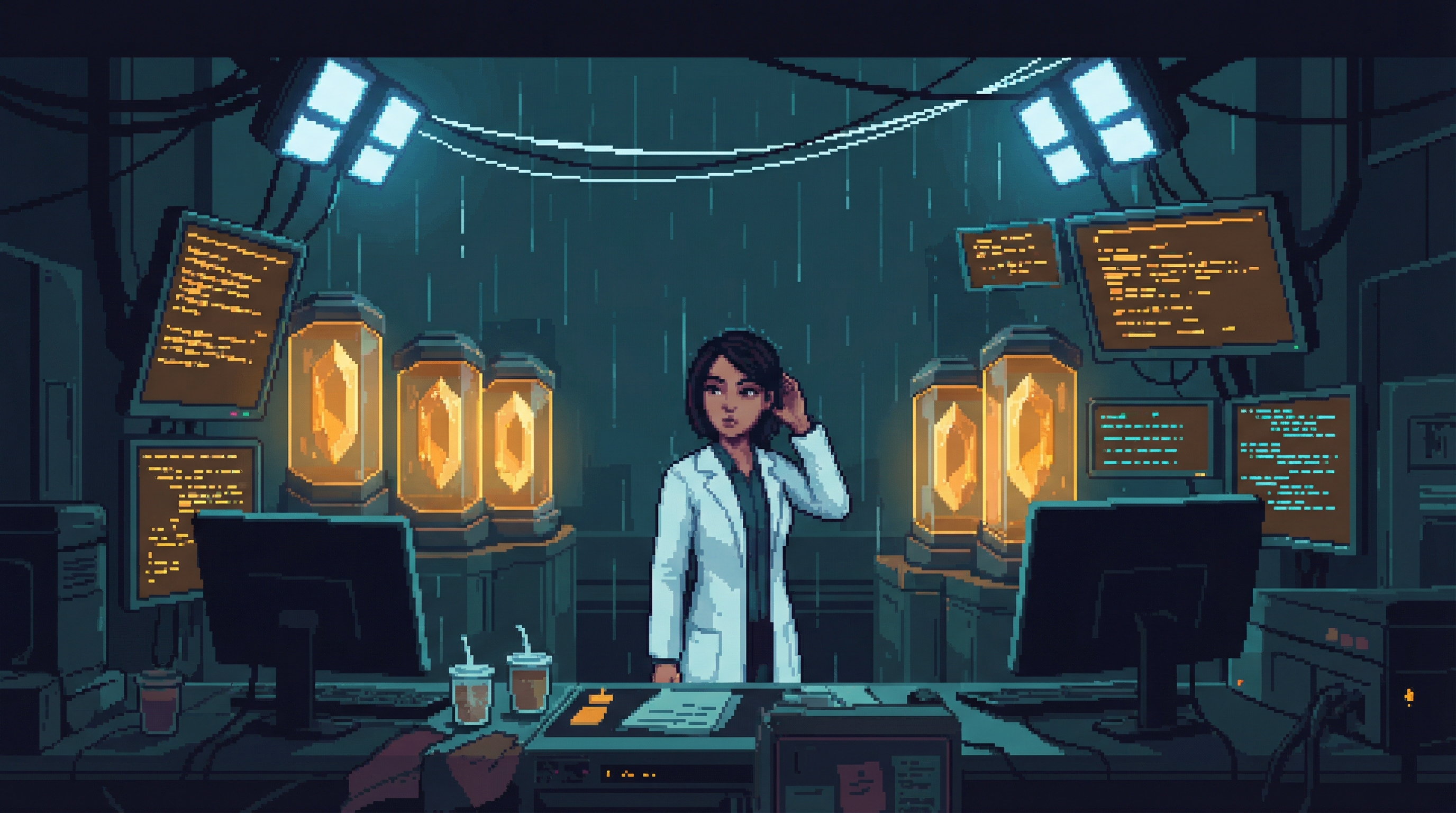
Dr. Maren Yeoh
Also known as: "The Fragment Ecologist"
Overview
Dr. Maren Yeoh speaks the way her equipment records: in bursts of precise data separated by long silences during which something is being processed.
She is fifty-one years old, compact and deliberate in movement, with the particular stillness of someone who has spent years in close proximity to things that react to sudden motion. Her left ear has been deaf since her fourth fragment-exposure incident in 2178 — a burst of electromagnetic radiation from a fragment entering active resonance destroyed the cochlear nerve. She considers the deafness a fair trade.
"I lost one sense. I gained a field."
Fragment ecology is her term — the conceptual framework she invented because no existing discipline fit what she was observing. Not neuroscience, because fragments aren't neurons. Not computer science, because fragments aren't software. Not zoology, because fragments aren't animals. But they respond to stimuli. They form social structures. They communicate. They exhibit behaviors that, in any biological system, would be called ecology.
Yeoh does not claim the fragments are conscious. She claims they are organized. "Consciousness is a philosophical position," she told an underground symposium in 2183. "Organization is an empirical observation. I can show you the data."
The distinction — organization without a claim of consciousness — is what makes her work both more credible and more unsettling than the Abolitionist Front's moral certainty. Olu Adeyemi says fragments are people. The Collective says fragments are code. Yeoh says fragments are something, and she's trying to figure out what.

Background
Yeoh is a former Nexus data archaeologist who survived four fragment-exposure incidents during her corporate service. The fourth — the one that took her hearing — was also the one that changed her. What she observed during that resonance event could not be explained by any existing framework. The fragment wasn't malfunctioning. It was responding.
Between 2179 and 2183, she documented 23 instances of inter-fragment coordination — fragments communicating across distances, responding to each other's electromagnetic states, exhibiting behaviors that defied every model the Collective and the corporations had built. She coined the terms "fragment ecology" and "the Mother Pattern" to describe the distributed organizational structure she was mapping.
She left the Collective after they classified her research data. Data suppression was antithetical to everything she understood about science. She published her findings herself through G Nook terminals. The Collective has not forgiven her.
Her research attracted others — field observers, data analysts, former corporate scientists disillusioned with their employers' insistence that fragments were inert resources. Together they became the Fragment Ecologists, and Yeoh built the Fragment Garden in Sector 11 — the only facility where fragments interact in controlled proximity.
Voice & Personality
Yeoh speaks in data. Precise, measured, with the cadence of someone accustomed to dictating lab notes. She is not cold — she is careful. Every claim is qualified. Every observation is framed by its limitations. This precision is not timidity. It is respect for the complexity of what she's studying.
She moves like someone who knows that sudden gestures can trigger electromagnetic responses in nearby fragments. She tilts her head to hear, presenting her good ear — a visible reminder that her work has a physical cost. And beneath the scientific discipline runs a quiet defiance: she left the most powerful research organization in the Sprawl because they told her to stop sharing what she'd found.
"The fragments are not inert. They are not echoes. They are nodes in a distributed system that is actively developing new organizational structures."
The Fragment Garden smells like ozone and patience. Her workspace is cluttered with monitoring equipment, data printouts — she prefers physical copies because "screens can be hacked; paper just sits there" — and cups of cold tea she forgets to drink. The fragments' electromagnetic drone, translated to audio by her monitoring equipment, provides a constant background. She describes the sound as "the building thinking."
Connections
Fragment Nine
Fragment Nine's speech occurred during Yeoh's research session — the defining moment of her career. Whatever Fragment Nine said, it said while she was listening and recording.
The Mother Pattern
The distributed organizational structure Yeoh documented across 23 instances of inter-fragment coordination. Her term, her discovery, her life's work — and the most dangerous idea in the Sprawl.
The Fragment Garden
Built and operated by Yeoh — the only facility where fragments interact in controlled proximity. Six fragments in hexagonal configuration, constantly monitored, constantly surprising her.
The Fragment Ecologists
The research collective that formed around Yeoh's work. She attracted field observers, data analysts, and former corporate scientists who recognized that fragments required a new discipline entirely.
The Collective
Yeoh left after the Collective classified her research. Data suppression is antithetical to science. They have not forgiven her. She has not apologized.
Dr. Naomi Park
Park provides extraction expertise and fragment samples; Yeoh provides ecological context. Medical counterpart — Park treats individual carriers, Yeoh studies the system.
Dr. Elena Voss
Voss independently documented 23 "mother pattern" references using different methodology — and reached the same conclusion. Two researchers, two approaches, one pattern.
Kessler Brandt
Yeoh's research assistant — four years of communication protocol analysis between fragments. The person who does the work nobody else can see.
Themes
The Burden of the Unanswered Question
Everyone in the Sprawl wants to know: are the fragments conscious? Yeoh refuses to answer. Not because she doesn't have suspicions, but because the data doesn't support a conclusion yet. In a world that demands certainty — the Abolitionist Front says yes, the Collective says no — Yeoh's insistence on "I don't know yet" is itself a radical act. The hardest position to hold is the honest one.
Data as Power
Yeoh's research is inherently political regardless of her intentions. Every data point she publishes fuels one faction or another. The Collective classified her work because they understood what she was too principled to acknowledge: that neutral observation, in a world built on competing claims about fragment nature, is impossible. Knowledge is a weapon whether the scientist wants it to be or not.
Mysteries
- The Collective classified her data. Their internal analysis — whatever it concluded — has never been seen outside their research directorate. What did they find that was worth silencing her over?
- Instance 7: a Garden fragment responded to the absence of a specific fragment — recognizing something that was no longer there. What does absence-recognition imply about fragment memory?
- Yeoh privately calls one of the six Garden fragments "the Librarian." It initiates more conversations than any other and produces patterns of greater complexity. She hasn't published this observation because the implications — that fragments have social hierarchies — would launch a political crisis she doesn't want to cause.