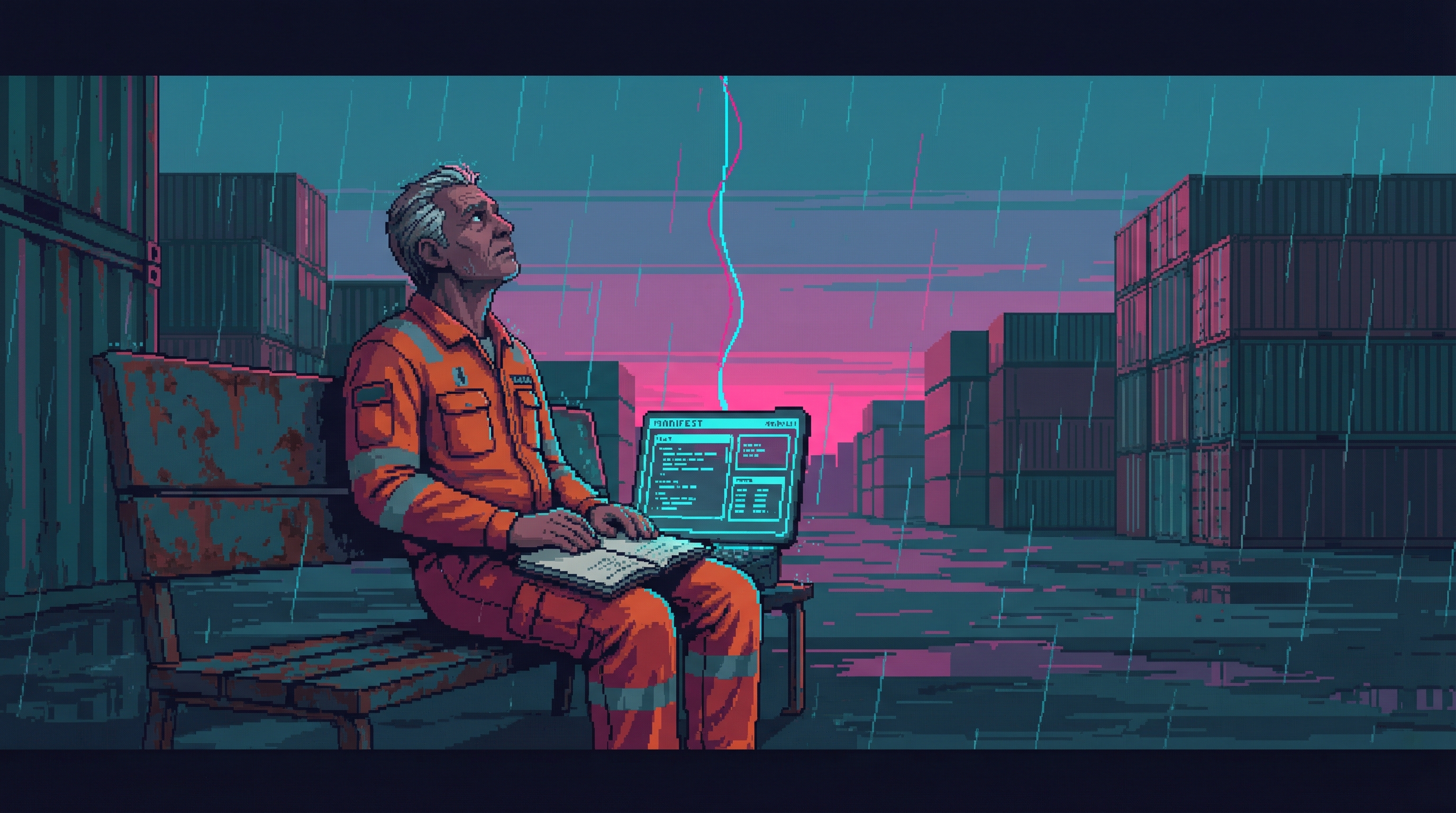
Dock-Master Eze Okafor
Anchor Town Cargo Operations, 22 Years
Eze Okafor is sixty-one years old and has never been above the atmosphere. This is not unusual for Anchor Town residents. The Elevator carries cargo and passengers upward; it brings very little down except empty climbers and returning workers. Eze's job is the transition — the moment when surface cargo becomes orbital cargo, when terrestrial jurisdiction becomes the ambiguous legal space of the Tether, and when the weight of a container shifts from Ironclad's insurance to whoever paid for the berth.
He processes approximately 200 cargo transfers per day. Each transfer requires physical inspection, electromagnetic screening, biological contamination checks, jurisdictional documentation, and the informal assessment that Eze performs by instinct after twenty-two years — does this container feel right?
His instinct has flagged 847 containers. Of those, 340 contained contraband — consciousness-grade substrate, unlicensed biological samples, fragment-containing materials, weapons components. The remaining 507 were legitimate cargo that felt wrong for reasons Eze couldn't articulate. Containers whose crews were hiding not contraband but fear. Crews afraid of what they were shipping. Crews told not to ask questions who had obeyed.
No relation to Abbas Okonkwo (Ironclad colonel) or the Sector 7G Okafor family. Different people. Different names. The Sprawl has been asked to stop conflating them.
Field Observations
Eze speaks with the unhurried precision of a man whose job requires getting things right the first time because errors at the base of the Elevator compound on the way up. He answers questions completely, waits for the response, considers it, then responds. He has the particular authority of someone who has been good at the same job for longer than most of his colleagues have been alive.
The Notebook
He keeps a physical notebook alongside the digital manifest. The manifest tells you what's in the box. The notebook tells you what people feel about what's in the box. Both are cargo data. Only one is honest.
The 507
He has never been curious about the 340 contraband containers. He has thought about the 507 fear containers every day for twenty-two years. The contraband was someone else's problem. The fear was his.
Never Ascended
Twenty-two years at the base of a structure that goes to space, and he has never ridden it. His job is the ground. The ground is where the decisions happen.
The Bench
His name is scratched into a metal bench at the docks — not carved, scratched, the way a child marks territory. He watches every dawn departure from that bench, notebook open on his knee.
On the distinction between his two records:
"The manifest tells you what's in the box. The notebook tells you what people feel about what's in the box. Both are cargo data. Only one is honest."
When asked why he's never ridden the Elevator:
"My job is the ground. You want someone who loves the sky, hire someone who loves the sky."
The 507
Eight hundred and forty-seven containers flagged in twenty-two years. Three hundred and forty contained contraband. Five hundred and seven contained legitimate cargo shipped by people who were afraid of it.
No scanning protocol identifies fear. No manifest records dread. The electromagnetic screeners catch weapons components. The biological sensors catch unlicensed samples. The jurisdictional documentation catches licensing violations. Nothing in Ironclad's inspection suite catches the way a cargo crew refuses to make eye contact with their own shipment.
Eze catches it. The notebook is the only instrument that records the signal, and the instrument is a sixty-one-year-old man with a pen.
What were those 507 crews afraid of? What were they carrying that was legal enough to pass inspection but terrifying enough to make grown workers flinch? Eze doesn't know. He has the observations. He does not have the answers. The notebook is full of questions written in the margins of a man's working life.
Sensory Profile
Weathered hands, salt-streaked hair, the particular squint of someone who watches the sky for departures. He smells of cargo holds and sea air — the equatorial humidity of Anchor Town mixed with the ozone tang of the Elevator's electromagnetic systems. The bench has his name scratched into it, the metal worn smooth around the letters by twenty-two years of sitting.
Dawn at the docks: the Elevator thread catches first light while Anchor Town below is still dark. Orange Ironclad coveralls against amber morning. The digital manifest terminal glowing beside the open notebook. The sound of climbers ascending — a low, continuous hum that residents stop hearing after their first year. Eze still hears it.
Known Associates
Okafor's position at the cargo transition point makes him a node between surface infrastructure and orbital commerce. These are the systems and people his daily work intersects.
Anchor Town
His community, his bench, his sunrise. Twenty-two years of processing the world's cargo from the same stretch of dock. Anchor Town is where the Elevator meets the ground, and Eze is the man who stands at the seam.
Ironclad Industries
Employer. The orange coveralls, the worker-grade augmentation, the digital manifest terminal. Ironclad manages the surface-to-orbit transition and Eze manages the moment within it where cargo changes hands, jurisdiction, and insurance.
The Elevator Compact
The framework he operates within daily. Its tiered pricing determines what cargo he processes, whose shipments get priority, and which containers sit on the dock long enough for the crews to start looking nervous.
Garrison Cole
Surface parallel. Both are men who know the numbers and keep working. Cole counts particulates at breathing height; Okafor counts fear in cargo crews. Different instruments measuring the same thing — the gap between what the system records and what people actually experience.
Suki Lin
Inverse parallel. She processes trades without asking what they cause. He processes containers and can't stop asking. Two people on opposite sides of the same question: what do you owe to the cargo you handle?
Open Questions
What Can Fear Detect That Scanners Can't?
Five hundred and seven containers passed every automated inspection protocol Ironclad deploys. Electromagnetic screening cleared them. Biological contamination checks cleared them. Jurisdictional documentation was in order. And the people who shipped them were terrified.
What does human fear detect that no sensor array can measure? And what happens to that signal when the last dock-master who reads it retires?
The Ground vs. The Sky
Twenty-two years at the base of a structure that reaches orbit, and he has never gone up. He says his job is the ground. But the ground is where cargo stops being abstract — where it has weight, where crews have faces, where fear has a physical signature that a man with a notebook can read.
The higher the cargo goes, the more abstract it becomes. The ground is the last place in the supply chain where anyone is watching the people instead of the manifests.
When the Notebook Closes
Eze is sixty-one. Ironclad has no succession protocol for instinct. When he retires, the digital manifest will continue operating. The electromagnetic screeners will continue scanning. The biological sensors will continue detecting.
The 508th fear container will pass through without anyone noticing that the crew won't look at it.
▲ Unverified Intelligence
Sprawl Analytical Bureau — Confidence: Low to Moderate
- The number 847 — containers flagged by Okafor over his career — matches the official fragment carrier census count. It also matches Loop's notebook entries and the observed count of fragment communication morphemes. The repetition is probably meaningless. The Sprawl's pattern-matching division has flagged it anyway. They flag everything that repeats three times.
- Three of the 507 fear containers were shipped by the same Nexus subsidiary over a four-year period. All three contained materials listed as "calibration equipment." Okafor's notebook records the same observation for all three: "Crew wouldn't make eye contact with the container." The subsidiary dissolved eighteen months after the third shipment. Its assets were absorbed by a holding company with no public officers.
- Okafor's notebook has never been digitized. He has been offered digital transcription tools three times by Ironclad efficiency consultants. He declined each time. The notebook remains the only record of the 507. If it is lost, the observations cease to exist.