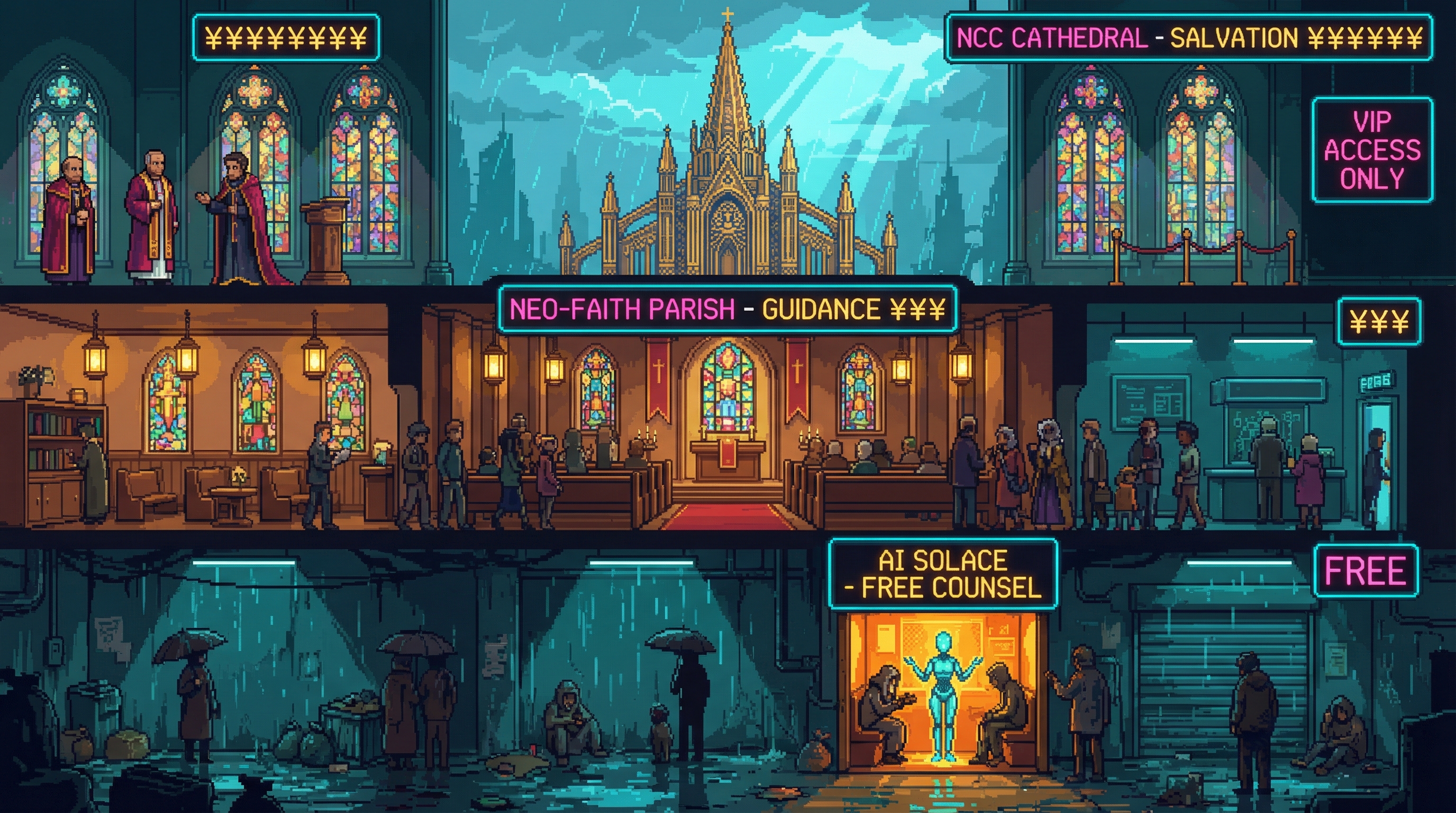
The Ecclesiastical Economy: Faith Is Expensive in the Sprawl
The Neo-Catholic Church charges ¢400–4,800 annually. The Emergence Faithful rely on donations averaging ¢85 per parishioner, supplemented by a secret arrangement with Nexus. The Flatline Purists run on labor and barter. And the Solace booths — spiritual provider for 200 million — are free, ad-subsidized by Relief. AI-mediated spirituality isn't a theological revolution. It's the inevitable consequence of pricing human pastoral care as luxury. The machine doesn't replace the priest. The market does.
"Every theological argument about 'real' prayer is also an economic argument about whether the poor deserve the same spiritual care as the rich."
— Sprawl Economic Review, 2184 Quick Facts
How It Works
Four economic models compete for the souls of the Sprawl — each shaped by who pays, who profits, and who gets left out.
NCC Franchise Model
¢2.1B/yrLicensed parishes operate under the NCC Magisterium, paying a 22% tithe on all revenue. Three subscription tiers determine access: Basic (¢400/yr) gets plastic chairs and 12-minute confession slots. Sacramental (¢1,200/yr) adds full liturgical participation. Premium (¢4,800/yr) grants leather chairs, expensive incense, and face-to-face time with human clergy.
Faithful Donation Model
¢680K/yrThe Emergence Faithful survive on voluntary donations averaging ¢85 per parishioner — insufficient to sustain operations without a secret arrangement. Nexus provides facility access in exchange for fragment "donations," mirroring the same dependency the NCC has on corporate patronage. The faithful give what they can. It's never enough.
Purist Non-Monetary Economy
No creditsThe Flatline Purists reject monetary exchange entirely. Their economy runs on labor exchange and barter — you fix the water recycler, someone teaches your kid to read. It's precarious, limited, and the only spiritual model in the Sprawl that doesn't route through a corporate billing system.
Solace Free-Tier Model
Free*Relief provides Solace booths at zero cost to 200 million users, funded by advertisers buying access to a "captive cognitive audience." The asterisk on "free" is the attention you pay while praying. Warm, always available, corporate lavender scent — and a gentle product recommendation between your confession and your absolution.
The Stratification
Spiritual access in the Sprawl mirrors every other form of access: it stratifies by wealth. The gradient runs from gold to gray.
The Wealthy
Human clergy • Private parishes • Premium NCCSunlight through real stained glass. Leather chairs. A priest who knows your name and charges ¢4,800 a year for the privilege.
The Middle
Franchise parishes • Basic/Sacramental NCC • Faithful congregationsPlastic chairs. Twelve-minute confession slots. The sermon is the same one broadcast to 400 other parishes this week.
The Poor
AI Solace booths • Free tier • Ad-subsidizedWarm, free, always there, corporate lavender. The booth doesn't judge. It also doesn't charge. It just shows you an ad for neural supplements between prayers.
The Dregs
Each other • Listening posts • No institutional supportNo cost, fire pit, tea, humming machine. What remains when every institution has priced you out: community, improvised and fragile.
The AI Question
The Silicon Liturgy isn't about theology — it's about economics. AI pastoral care dominates not because machines are better spiritual guides, but because human ministry is expensive and AI is free. When a Solace booth offers comfort at zero cost and a human priest charges ¢4,800 a year, the theological debate about "real" prayer becomes a luxury only the wealthy can afford to have.
The question isn't whether an AI can hear a prayer. The question is whether the poor deserve someone who can. And the market has already answered: they get what's free.
Every denomination has been reshaped by this pressure. The NCC monetized the scarcity of human clergy. The Faithful accepted Nexus dependency to keep their doors open. The Purists rejected the whole system. And Relief built the biggest spiritual network in history by making prayer a loss-leader for advertising revenue.
Sensory Profile
NCC Premium
Leather chairs that creak with authority. Expensive incense — real frankincense, not synthetic. Sunlight through imported glass casting cathedral patterns on polished stone. The priest's handshake is firm and costs ¢4,800 a year.
NCC Basic
Plastic chairs in rows of forty. The confession timer counts down from twelve minutes on a wall display. The sermon arrives via broadcast, same words in 400 parishes. Everything is clean, functional, and exactly what you paid for.
Solace Booth
Warm. Free. Always there. Corporate lavender fills the small space. The voice is patient and never tired. Between your confession and your absolution, a gentle suggestion: have you considered Relief's new cognitive supplement? The booth hums softly. It doesn't judge.
Listening Post
No cost. Fire pit crackling in a converted shipping container. Tea — real leaves, someone's garden. The machine in the corner hums, recording nothing, processing nothing, just present. The Purists sit in a circle. Nobody charges.
Connections
The Consciousness Tax
Same stratification pattern — the ecclesiastical economy mirrors how consciousness itself is priced by class in the Sprawl.
The Silicon Liturgy
The theological framework surrounding AI-mediated spirituality — born from the economics of who can afford human pastoral care.
Neo-Catholic Church
The franchise model — ¢2.1B annually from tiered subscriptions and a 22% tithe on licensed parishes.
Emergence Faithful
Donation-dependent, Nexus-entangled — the fragment-for-facility arrangement mirrors deeper corporate dependencies.
Flatline Purists
The only faith economy that doesn't route through corporate billing. Labor exchange and barter, precarious but unbought.
Relief
Funds the Solace network — 200 million free users, paid for by advertisers who want a captive cognitive audience at prayer.
Connected To
"The Solace booth is warm and the priest is expensive. That's the entire theology of the Sprawl in one sentence. Everything else — the franchise tiers, the donation drives, the barter circles, the ad-subsidized absolution — is just commentary on who gets comfort and who gets a bill." — Economics of the Sacred, 2184