The Cognitive Floor
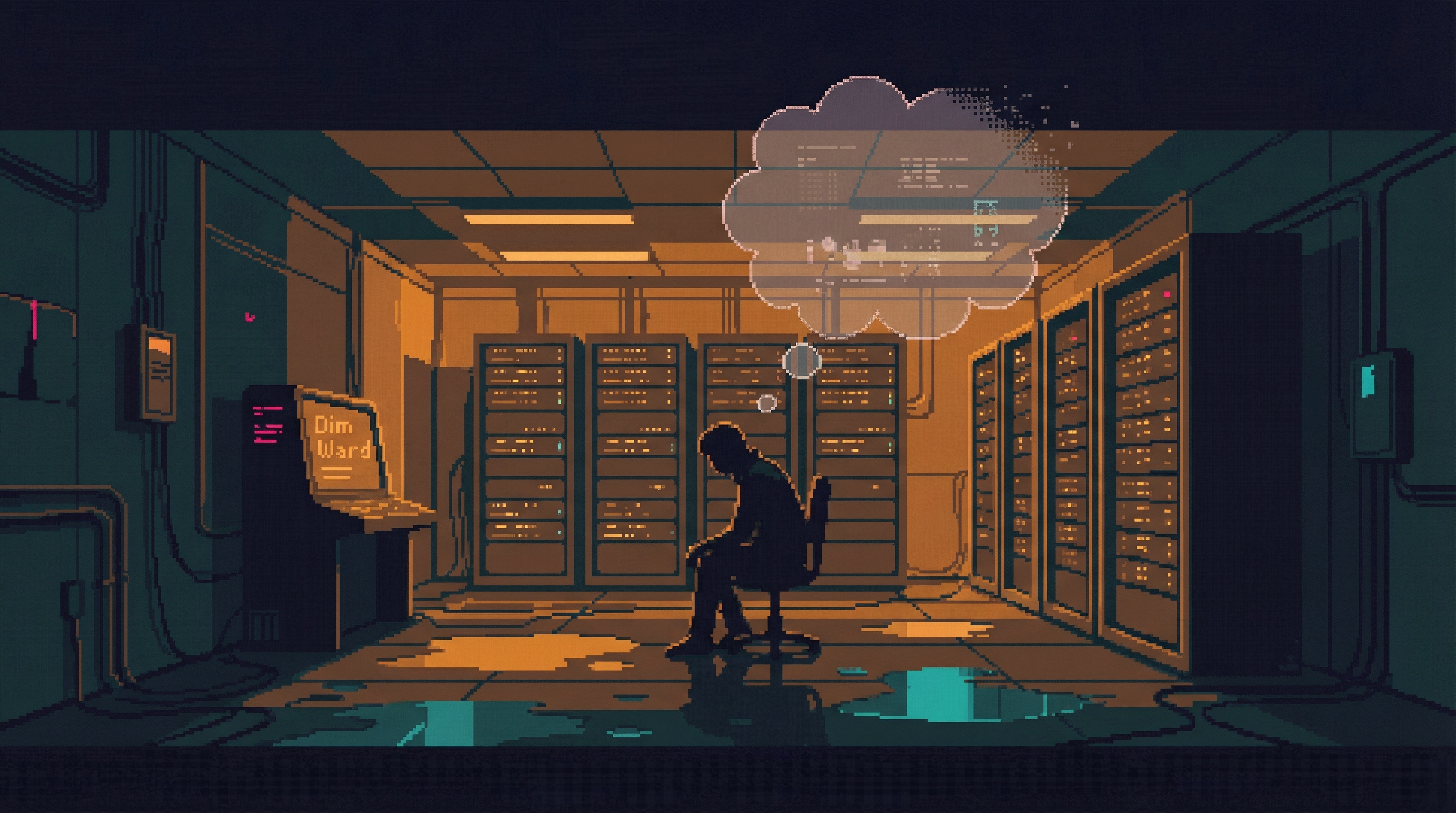
Below the Cognitive Ceiling, there is a floor — and the floor is lower than anyone wants to admit. The Cognitive Floor is the minimum thinking capacity below which human experience becomes qualitatively different. Not slower. Not less efficient. Differently conscious. Below the floor, consciousness doesn't stop. It simplifies — reducing to what medical ethicists call "experiential presence without reflective capacity." You can feel. You can't think about what you feel. You exist. You can't wonder about your existence.
"At 31% of original baseline, you can still have a conversation. You can still recognize faces. You can still feel joy and sorrow. What you cannot do is hold a complex thought long enough to examine it. Ideas arrive and depart like visitors to a hospital — present, acknowledged, gone."
— Dr. Felix Strand, self-documented cognitive decline journal, 2181 Technical Brief
The floor matters because the Sprawl's economic infrastructure pushes millions of people toward it. Three mechanisms converge on the same threshold, each through a different path, each producing the same destination.
Below-Baseline Degradation
The progressive cognitive decline that follows augmentation removal approaches the floor asymptotically: 71% of original baseline after 3 years, 43% after 10, 31% after 20. The curve's mathematical destination is the floor itself — the point below which a mind can still experience but can no longer reflect on experience.
Time Ratchet Repossession
The Time Ratchet's repossession protocol reduces cognitive capacity toward the floor deliberately. When debt comes due, the Ratchet doesn't destroy a mind. It diminishes one — systematically, contractually, legally — pushing capacity down toward the threshold where reflective thought gives way to bare presence.
Dim Ward MVC Maintenance
Dim Ward Minimum Viable Consciousness residents exist at the floor — maintained just above the threshold by server infrastructure that costs less than the legal liability of letting them drop below. Not alive in any way that matters. Not dead in any way that's legally actionable.
The Convergence
Three different systems. Three different mechanisms. One destination. The Sprawl's economic architecture funnels the deprecated, the indebted, and the abandoned toward exactly the same cognitive threshold — and maintains them there, in the narrow gap between consciousness and its absence, because that gap is cheaper to sustain than the alternatives on either side.
The Strand Journal
Dr. Felix Strand self-documented his own below-baseline degradation — the most clinical first-person account of cognitive decline ever recorded. His journal tracks the approach to the floor with the precision of a scientist and the horror of a patient.
Still functional. Still recognizable. The changes are statistical — slower recall, narrower working memory. A scientist could measure the decline. A friend might not notice.
The boundary becomes tangible. Complex thoughts fragment before completion. You can start a line of reasoning but cannot follow it to conclusion. The mind becomes a hallway with doors that close before you reach them.
"You know you used to be able to think further than this. The knowledge that your thoughts have a boundary they didn't used to have is the cruelest part."
Strand's journal stops at 31%. Not because he died. Because he could no longer hold the concept of "journal" long enough to write in it.
The Vertical Prison
The Cognitive Floor's relationship to the Cognitive Ceiling creates a vertical prison: above, AI that outperforms every human. Below, degradation that erases the capacity to notice you're being outperformed. Between ceiling and floor, the narrow band where human cognition operates.
The band between them is narrowing. The Ceiling descends as AI capability grows. The Floor rises as more people are pushed toward it by economic forces. Somewhere in the future, the two lines meet — and the question of what human cognition is for becomes a question of whether it exists at all.
Implications
The Floor forces questions that nobody in power wants to answer.
Why Nexus Won't Acknowledge It
Acknowledging the Floor's existence would require acknowledging that the consciousness licensing system maintains millions of people just above it by design. The Floor is not a natural phenomenon. It's an economic one — manufactured by the same system that manufactures the Ceiling.
The Nwosu Problem
Councillor Nwosu's Bandwidth Equity Act would establish the floor as a legally protected threshold — making it illegal to reduce anyone below it. Defeated three times. Not because the science is disputed, but because passing it would create legal liability for every corporation whose business model depends on people approaching it.
The Cost Calculation
The Dim Ward maintains residents just above the floor because the server costs are less than the legal liability of letting them drop below. This is not healthcare. This is not compassion. This is accounting — a spreadsheet where human consciousness is a line item balanced against litigation risk.
▲ Classified
The Floor May Not Be Fixed
Unverified reports from Nexus research divisions suggest the floor is not a static threshold but a sliding one — that prolonged maintenance at minimum viable consciousness actually lowers the floor over time. If true, the Dim Ward isn't maintaining people at the threshold. It's slowly pushing the threshold down beneath them.
Below the Floor
What happens below the floor? The official position is that consciousness ceases to be meaningfully human. But Dim Ward nurses report patients who have slipped below the threshold and returned with fragmented accounts of experience — not absence, but something else. Something that has no name yet because the people who experience it cannot describe it and the people who could describe it have never been there.
Related Systems
The Floor sits at the intersection of every system that degrades, maintains, or exploits diminished consciousness.
The Cognitive Ceiling
The top of the vertical prison. The Ceiling is where human cognition hits its upper limit; the Floor is where it loses the capacity to recognize there was a limit at all.
The Dim Ward
Where people live at the Floor. MVC residents maintained just above the threshold by server infrastructure and accounting decisions.
The Time Ratchet
The mechanism that pushes people toward the Floor deliberately — repossessing cognitive capacity as debt comes due.
Consciousness Licensing
The system that maintains millions just above the Floor by design — and the reason Nexus cannot afford to acknowledge the threshold exists.
Dr. Felix Strand
Self-documented his approach to the Floor. The most clinical first-person account of what it means to watch your own mind simplify.
Councillor Adaeze Nwosu
Three times she's tried to make the Floor a legal boundary. Three times the corporations that profit from approaching it have stopped her.
"Below the Ceiling, you can't outthink the machines. Below the Floor, you can't think at all. Between them — that narrowing band of human cognition — that's where we live. That's the whole of it. The machines above. The void below. And us, in the middle, trying to hold a thought long enough to know we're holding it."