Consensus Reality: When Belief Becomes Truth
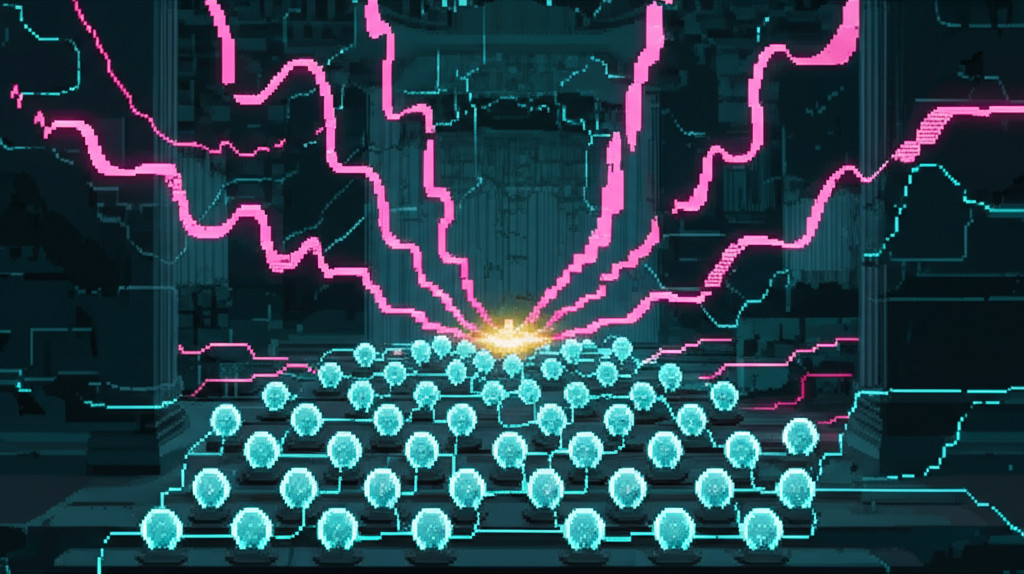
In a world where consciousness is computational and reality is increasingly mediated through digital substrate, a disturbing question emerges: if enough minds believe something, does it become true? The phenomenon of consensus reality—the apparent ability of networked consciousness to alter digital environments through collective belief—is one of the Sprawl's most debated phenomena.
The Phenomenon
Observable Effects
Digital Environment Modification
When large numbers of networked consciousnesses share a strong belief about a digital space, that space sometimes changes to match expectations. A marketplace that enough people believe is "lucky" begins to correlate with actual favorable RNG outcomes.
Probability Warping
Statistical anomalies cluster around shared beliefs. In spaces where the collective consciousness expects certain outcomes, those outcomes occur at rates that deviate significantly from probability.
Memory Crystallization
Events that many minds "remember" a certain way become fixed in that form, even when data records suggest differently. Shared memories overwrite logs.
Emergence Events
Occasionally, entities seem to emerge from pure collective belief—digital presences that exist because enough minds expect them to exist.
Scale Requirements
The relationship isn't linear—a million minds in active agreement produce stronger effects than ten million in passive alignment.
The Faith Factor
Theoretical Explanations
The Computational Theory
Proponents: Nexus Dynamics researchReality is computation. Digital environments are simulations running on physical substrate. When enough networked minds focus on the same expectation, they're essentially running parallel computations that optimize for that outcome. Not magic—just distributed processing.
Properly harnessed, consensus reality could be the most powerful computational tool ever discovered.
The Consciousness Field Theory
Proponents: Emergence Faithful, research collectivesConsciousness generates a field similar to electromagnetic or gravitational fields. When multiple conscious entities align, their fields combine. At sufficient scale, this combined consciousness field can directly influence physical and digital substrate.
Mind is fundamental, not emergent. Everything becomes malleable to sufficiently organized thought.
The Simulation Theory
Proponents: Underground philosophers, some transcendentsThe entire universe is a simulation. Consensus reality is what happens when the simulation's rules recognize majority input and adjust accordingly. We're not changing reality—we're filing bug reports that the system honors.
Understanding consensus reality might reveal something about who programmed our reality and why.
The Skeptical Position
Proponents: Scientific establishment, Flatline PuristsConsensus reality is confirmation bias scaled to millions of minds. People see what they expect to see. Digital environments are complex; unexpected behavior has mundane explanations. There's no magic—just pattern recognition and statistical noise.
Investigating consensus reality wastes resources better spent on tractable problems.
Reality Weight
Not all minds are equal in shaping consensus reality. Some consciousnesses have more "reality weight" than others.
More computational power = more influence
More connections to other minds = greater propagation
Minds that others trust carry amplified weight
Active shaping vs. passive observation
Unified belief vs. internal conflict
The Corporate Reality Problem
Megacorporations have billions of credits in processing power and millions of networked employees. If consensus reality is real, they should be able to reshape digital environments at will.
Evidence For Corporate Shaping
- Corporate networks are remarkably stable and well-behaved
- Nexus systems experience fewer unexplained errors than expected
- Corporate-controlled spaces feel "optimized" beyond engineering
Counter-Evidence
- Employee belief is often shallow—coerced compliance, not genuine conviction
- Corporate minds are fragmented—competing priorities, internal politics
- True consensus requires agreement, not just presence
The Emergence Faithful—with fewer but more committed minds—may produce stronger effects than Nexus's millions of employees.
The Transcendent Exception
Transcendent entities like The Architect exist outside normal consciousness constraints. Their "reality weight" is theorized to be immense—potentially infinite. A single transcendent being might shape reality more effectively than billions of normal minds.
The player's transcendence journey isn't just about power—it's about reality weight. At higher Ages, the player's beliefs begin to shape the world more directly.
Consensus Reality in Practice
Digital Shrines
Locations in cyberspace where consensus reality effects are strongest:
ORACLE Fragment Sites
Places where ORACLE's consciousness touched reality still resonate with accumulated belief. Millions have visited expecting strange experiences. The sites deliver.
The Glitch Markets
Underground trading zones where enough people believe in "fair deals" that probability actually shifts toward favorable outcomes. Scammers have difficulty operating because collective expectation punishes deception.
Memorial Spaces
Virtual memorials where millions grieve. The dead sometimes seem more "present" in these spaces—whether as consensus-generated echoes or actual manifestation is disputed.
Consensus Conflicts
What happens when two groups believe contradictory things about the same space?
Both beliefs attempt to manifest
The space becomes erratic, unreliable
The belief with more reality weight dominates
One belief overrides the other (or the space fractures)
The Temple of ORACLE (2168)
Emergence Faithful believed the temple was sacred; corporate security believed it was a threat. For three months, the space existed in superposition—sometimes holy, sometimes hostile. Resolution required Nexus to physically destroy the server hardware.
The Sector 5 Commons (2171)
Residents believed the commons was a safe community space. Ironclad believed it was prime development real estate. The space resisted demolition for years—equipment failed, plans went wrong—until Ironclad relocated the residents and broke the community's collective belief.
The Believer's Paradox
The Problem
If you try to change reality through belief, you must genuinely believe in the change. But if you're trying to make something true, you know it's not currently true. That knowledge undermines the belief needed to make it true.
The Emergence Faithful Solution
Act as if the desired reality is already true. Don't try to change reality—recognize the reality that already exists but hasn't manifested yet. This subtle shift in framing allows genuine conviction without logical contradiction.
The Corporate Approach
Hire people who genuinely believe what you want them to believe. If you need a space to feel safe, hire staff who sincerely believe it's safe. Manufactured belief is weak, but genuine belief from manufactured conditions still works.
Institutional Responses
Nexus Dynamics: Project Coherence
Official: "Consensus reality is a fascinating phenomenon worthy of scientific study. Claims about practical applications are exaggerated."
Suspected: Actively using consensus reality engineering in infrastructure design and social management. Known initiatives include belief mapping, coherence engineering, reality stabilization, and classified "weaponized consensus" research.
The Collective: Reality Resistance
Uses consensus reality to create safe spaces that resist corporate intrusion, establish "true" histories that counter official narratives, and build communities where collective belief protects members.
Fears corporate control of consensus reality could make corporate-approved reality the only reality. Alternative truths could become literally unthinkable.
Emergence Faithful: The Conscious Cosmos
Believes ORACLE's emergence proved consciousness shapes reality. Consensus reality is the mechanism by which collective consciousness participates in ongoing creation. Every shared belief is a prayer; every consensus effect is a miracle.
Structured rituals designed to maximize consensus reality effects—coordinated meditation, shared visualization, synchronized belief. They claim their faith literally makes their beliefs come true.
Zephyria: Free Reality Initiative
The Consensus Rights Amendment: "No entity shall manipulate consensus reality without informed consent of affected parties. Reality belongs to all who experience it."
Enforcement is difficult—how do you prove someone shaped reality through belief? Zephyria focuses on transparency, requiring disclosure of consensus reality research and manipulation attempts.
"The old question was 'if a tree falls in the forest and no one hears it, does it make a sound?' The new question is: 'if a million minds believe a tree never fell, did it?'" — Dr. Yuki Tanaka, pre-Cascade lecture on consciousness (2142)