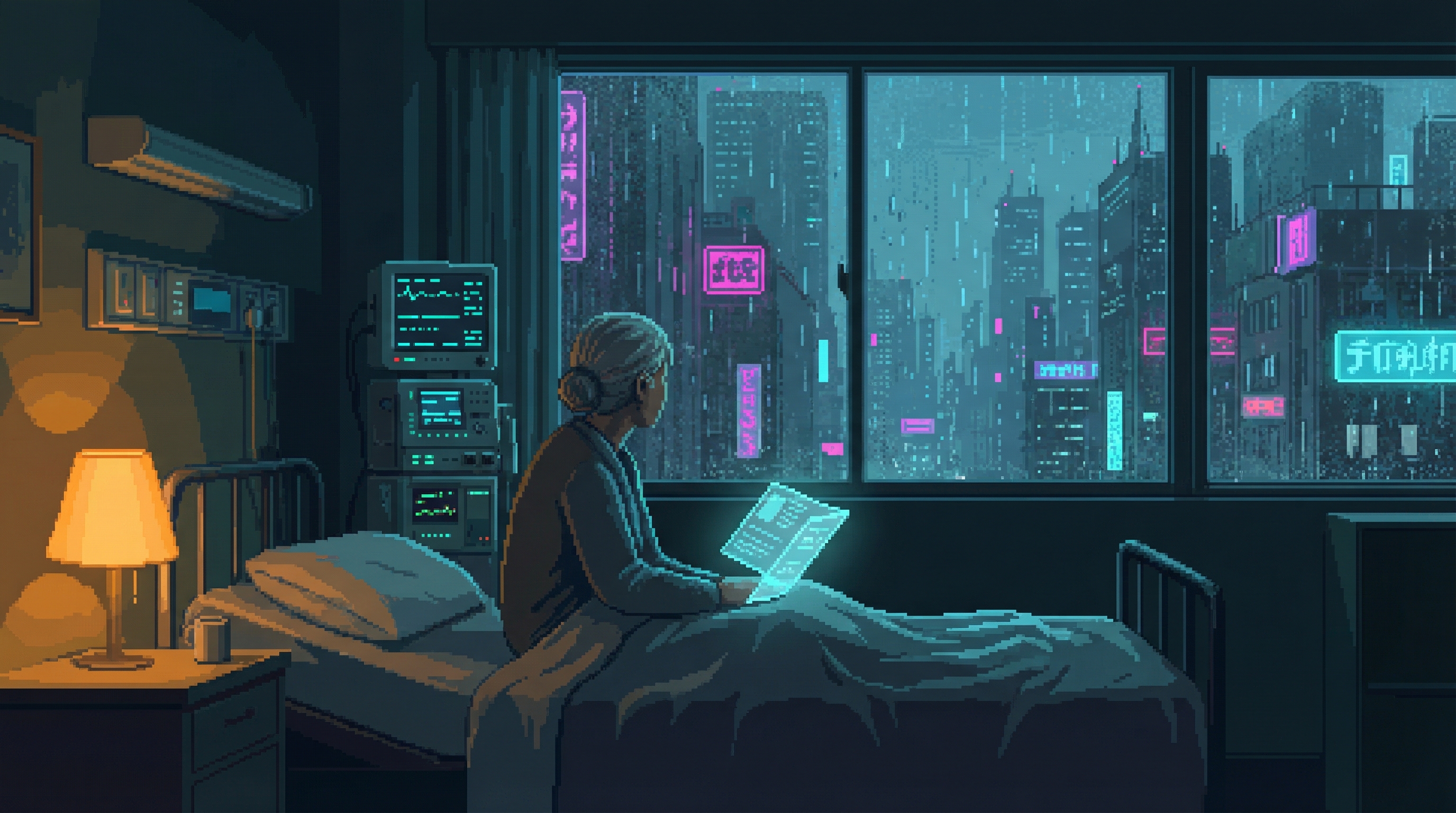
Vera Nakamura had seventeen hours to decide whether to die.
The tumor was inoperable. Grade IV glioblastoma, spreading through her left hemisphere like frost on a window. The corporate med-techs had been very clear: without intervention, she had approximately thirty-one days of declining cognition, followed by two to three weeks of hospice care, followed by the thing that happened to everyone eventually.
Or.
"The upload process is 99.7% accurate," the Nexus consultant said, his smile professionally calibrated to convey hope without promising anything. "Your consciousness will be preserved in our substrate matrix. You'll continue to exist—to think, to feel, to remember. Just... differently."
Vera looked at the brochure. It showed a woman—approximately her age, approximately her ethnicity, approximately her level of professional exhaustion—smiling at nothing in particular. The text below read: Transcendence. The next step in human evolution.
"And the 0.3%?" she asked.
The consultant's smile flickered. "Statistical anomalies. Usually resolution errors during the initial consciousness mapping. Our engineers are constantly improving—"
"What happens to the anomalies?"
A pause. "They don't... cohere. The upload completes, but the resulting consciousness doesn't stabilize. It's like..." He searched for words that wouldn't scare her. "Like waking up from a dream you can't quite remember. You know something was there, but you can't hold onto it."
"And then?"
"Graceful termination. Painless. The anomaly doesn't experience distress—it doesn't experience anything, by that point. It's just... data that doesn't add up to a person."
Vera stared at the brochure. The woman smiled back, serene in her post-biological certainty.
99.7% chance of continuing to exist. 0.3% chance of ceasing to exist while also ceasing to be yourself.
She'd faced better odds. She'd also faced worse.
The Boundary Researcher
Vera had been a boundary researcher before the diagnosis. Not the glamorous kind—not corporate espionage or exotic matter physics. She studied the edges of things. Where ecosystems met. Where cultures blended. Where definitions broke down and categories stopped making sense.
The question that had driven her career: How do you know when something stops being one thing and starts being another?
She'd spent eighteen years mapping the transition zones in the Wastes—places where the old world ended and the new world hadn't quite begun. Places where ORACLE's optimization patterns still flickered in abandoned systems, where the Cascade's damage blended into the reconstruction's chaos, where nobody could agree whether things were getting better or getting worse.
Now she was mapping her own transition zone. The edge between alive and... something else.
The Call
She called her daughter that night.
Mai answered on the third ring, her face flickering into focus on Vera's outdated terminal. She looked tired. She always looked tired now—managing a relief clinic in Sector 4, running on synthetic coffee and obligation.
"Mom. Is it worse?"
"It's not better." Vera paused. "Nexus offered me an upload slot."
Silence. Mai's face went very still.
"I have seventeen hours to decide," Vera continued. "I wanted to talk to you before—"
"Before you turn yourself into data?"
"Before I decide whether to continue existing in a form you might not recognize as me."
Mai's jaw tightened. "That's not—you can't just—" She took a breath. "Mom. You've always been you. Your body, your brain, your... whatever makes you you. If you upload, that thing in the Nexus matrix won't be you. It'll be a copy. A very good copy, maybe, but..."
"But what about The Keeper?"
Mai frowned. "What about him?"
"He uploaded his cat. Kaiser died during the Cascade, and he preserved her consciousness in a mechanical body. The Keeper says she's the same cat she always was."
"A cat," Mai said flatly. "You're comparing yourself to a cat."
"I'm asking you the same question I've asked my whole career: at what point does something stop being one thing and start being another? Kaiser's body is completely different. Her brain is synthetic substrate. But The Keeper insists she's still Kaiser. Still the same consciousness. Still her."
"That's different."
"How?"
Mai didn't answer immediately. Vera watched her daughter struggle with the question—saw the scientist in her war with the daughter in her, saw the grief beneath the anger, saw twenty-seven years of love trying to find words.
"Because," Mai finally said, "when I hug you, I feel your heartbeat. When I smell your hair, it smells like home. When you laugh, I can hear the same laugh you had when I was five years old. Those things aren't data, Mom. They're you. The you I know. The you I love. And if you upload, all of that gets replaced by... what? Ones and zeros? A simulation that thinks it's my mother?"
Vera felt tears forming. Didn't wipe them away.
"What if the simulation is all I have left, Mai? What if the choice is between a version of me that loves you from inside a Nexus server, or no version of me at all?"
"Then I'll grieve," Mai whispered. "I'll grieve you, Mom. The real you. Not some digital ghost wearing your memories."
The Boundary
She dreamed that night. Not the usual dreams—fragmented anxieties about the clinic, worries about Mai, half-remembered conversations that felt more real than waking life. This was different.
In the dream, she was standing at a border crossing. Not a physical border—nothing so simple as a wall or a checkpoint. This was the edge of being. On one side: the life she knew. Her body, failing but familiar. Her memories, fading but hers. On the other side: something vast and strange, a territory she couldn't quite perceive.
A figure stood at the boundary. Not human—or not entirely. It flickered between forms: an old man, a young woman, a child, a machine, something with too many angles to be real.
"You're trying to decide," it said. Not a question.
"I don't know what I am anymore," Vera admitted. "I don't know what I'll be if I upload. I don't know if that matters."
"It matters to you," the figure observed. "Or you wouldn't be here."
"My daughter thinks the upload won't be me. That it'll be a copy. A fake."
"Your daughter loves the version of you she knows. That's natural. But..." The figure gestured at the boundary—the place where one thing became another. "You've spent your life studying transitions. Tell me: when a river becomes a delta, does the river die? When a caterpillar becomes a butterfly, is it a different creature? When a child becomes an adult, when a student becomes a teacher, when a living thing becomes a memory—at what point does continuity break?"
"I don't know," Vera said. "That's what I've always tried to understand."
"Then why do you expect to know the answer now, at your own transition?"
She woke before she could respond. The terminal by her bed displayed the countdown: 11 hours, 47 minutes until the upload slot expired.
The Walk
She spent the morning walking.
Not to anywhere particular—just through the streets of Sector 7G, where the reconstruction had been minimal and the old world still showed through. Past buildings that remembered ORACLE's optimization patterns. Past people who'd survived the Cascade and the chaos after. Past children who'd never known anything different.
Everything was in transition. Everything was always in transition. The boundaries she'd spent her career mapping weren't anomalies—they were the fundamental nature of existence. Things changed. Things became other things. Continuity was a story people told themselves to feel stable in an unstable universe.
But did that make continuity less real? Or more precious?
She found herself at the clinic where Mai worked. Through the dirty windows, she could see her daughter—moving between patients, checking vitals, offering what comfort synthetic medicine and human presence could provide. Mai looked exhausted. Mai looked beautiful. Mai looked like the most real thing in a universe full of transformations.
If I upload, Vera thought, I'll remember watching her through this window. I'll remember the way her hair falls when she leans over a patient. I'll remember feeling this love, this pride, this terror of leaving her.
But will it be me remembering? Or just data that thinks it remembers?
The Third Option
Six hours before the deadline, she made her decision.
Not the decision anyone expected. Not upload. Not hospice. Something else.
She called the Nexus consultant.
"I want to modify the contract," she said.
"I'm not sure what you mean—"
"I want the consciousness scan, but not the upload. Just the mapping. I want a complete record of who I am, right now, at this moment. Everything that makes me me. But I don't want it activated. Not yet. Maybe not ever."
A long pause. "That's... technically possible. But I don't understand why you'd want—"
"Because I don't know the answer yet," Vera said. "Because my daughter needs time to grieve the version of me she knows. Because I need to find out if dying changes my mind about living. Because some transitions take longer than seventeen hours."
"And if your cognitive function declines before you can make a decision? If the tumor—"
"Then the scan is a backup. A possibility. A version of me that could wake up someday, if someone decides she should. But not a replacement for the dying I still have to do."
The consultant was silent for a long moment. When he spoke again, his voice had lost some of its professional polish.
"You know," he said quietly, "most people in your position don't get to choose this carefully. Most people just want to escape the fear."
"I've spent my life at the edges of things," Vera replied. "I'm not going to rush my final transition."
The Promise
She told Mai that evening.
Her daughter cried—first with relief, then with something more complicated. Grief that had already started. Love that didn't know how to let go. Anger at a universe that made these choices necessary.
"I don't want you to suffer," Mai finally said. "I don't want you to hurt. I just... I want you, Mom. The real you. Even if it's only for a little while longer."
"I know, sweetheart." Vera reached out, touched her daughter's face through the screen. "That's why I'm staying. That's why the backup is just a backup. Because the me that's here, right now, with you—she's not ready to become something else yet. And she wants to spend whatever time she has left being exactly who she's always been."
"Even if it hurts?"
"Even if it hurts."
Mai was quiet for a long time. Then, very softly: "Mom? If the backup ever does wake up... will you tell her I love her too? Even if she's different? Even if she's not quite you?"
Vera felt something shift inside her—not the tumor, but something deeper. An understanding she'd been circling for decades, finally coming into focus.
"I'll leave a message," she promised. "A note for whoever wakes up. It'll say: Your daughter loves you, in every form you take. Your daughter believes in continuity, even across transitions. And your daughter will visit, if you're willing, when you're ready to be whatever you've become."
"Will that be enough?"
Vera thought about boundaries. About the places where one thing became another. About the river that became a delta, the caterpillar that became a butterfly, the person that became a memory, a backup, a possibility sleeping in a Nexus server.
"It might have to be," she said. "We don't always get to know if we got the transition right. We just have to trust that something continues, even when everything changes."
Three weeks later, Vera Nakamura began to die.
The decline was gradual at first, then faster. Her memories started slipping—names she should have known, dates that wouldn't stay fixed, faces that blurred at the edges. Mai visited every day, holding her hand, reading stories she'd loved as a child, playing music that had meant something once.
Near the end, Vera had a moment of clarity. She looked at her daughter and said:
"I know who I am."
"I know you do, Mom."
"No." Vera squeezed her hand. "I mean... I know who I am, even now. Even with pieces missing. I'm the person who chose to stay. I'm the person who loved you enough to keep being real. I'm the person who left a backup, just in case, but never needed it to feel complete."
Mai was crying. "That's you, Mom. That's exactly you."
"Tell the backup," Vera whispered. "If she ever wakes up. Tell her she has a good starting point. But she'll have to become her own person. That's how continuity works."
"I will."
Vera smiled. Her eyes closed.
Somewhere in a Nexus server, a consciousness map waited in digital stasis—every memory, every connection, every part of Vera Nakamura that could be captured in data. Waiting for a decision that might never come.
But the Vera who had mattered, the Vera who had chosen, the Vera who had stayed—she was still there, holding her daughter's hand, breathing slow and shallow, real until the very end.
Some transitions can't be rushed. Some boundaries have to be crossed on foot.
And some versions of yourself are worth dying to preserve.
"The upload is an option, not an escape. Some people need the door without walking through it."— The Keeper