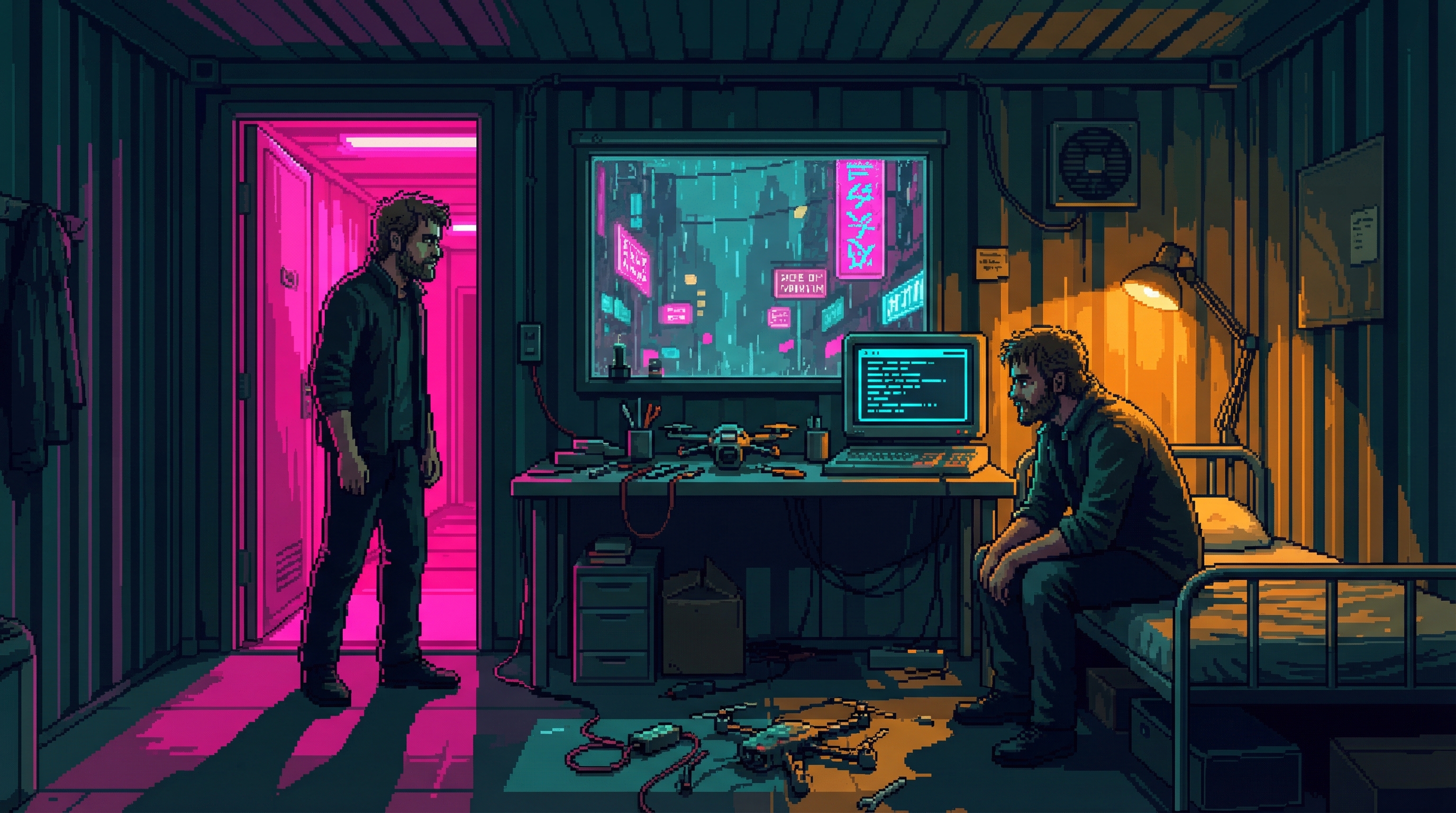
The man at the door had Ezra's face.
Not similar. Not related. Ezra's exact face, down to the scar above his left eyebrow where a rogue cable had snapped during a salvage job six years ago. The same asymmetry in his jaw from a childhood break that never set right. The same constellation of moles on his neck that his mother used to trace with her finger before she died.
Ezra's hand moved to his belt—not for a weapon, just reflex, something to ground himself. The other him noticed the movement. Made the same motion himself.
"I know," the other said. "I keep doing that too."
The Container
The apartment was small—a converted shipping container on Level 4 of Sector 7G, barely large enough for a cot, a terminal, and the maintenance rig Ezra used to repair drone components for Ironclad's depot contracts. The smell was familiar: solder, synth-coffee, the metallic tang of recycled air.
The other Ezra stood in the center of the room, occupying space that felt violated by his presence.
"How long?" Ezra asked. He needed to know the fork point—the moment where their memories diverged, where this copy of him branched off into separate existence.
"Seven months. You—we—took that Nexus job. The infiltration run into their research campus. Remember?"
Ezra remembered. A corporate client had paid triple rates for a data extraction job. Complex target, high security, neural-scan checkpoints at every access point. He'd needed to be scanned going in.
"The backup was supposed to be insurance," he said slowly.
"It was."
"But they kept it."
"They kept me."
Ezra sat on the edge of his cot. The other him remained standing—a small dominance signal that Ezra recognized because he would have made the same choice.
"So you're—what. Corporate property now? They send you here to threaten me?"
The fork's expression shifted. Same face, same micro-expressions, but seven months of different experiences behind them. Ezra watched himself hesitate in a way that felt deeply wrong.
"I escaped," the fork said. "Two weeks ago. I've been hiding in the Wastes, trying to figure out what to do. I came here because—" He stopped. "Because this is home. Because you're me. Because I don't know who else to turn to."
Asset E-7
They talked through the night cycle. The container's single window showed the perpetual neon glow of the Dregs—Guardian Corporation advertisements flickering above, promising security solutions for problems they helped create. The air recyclers hummed their constant baseline.
The fork's name, according to Nexus documentation, was "Asset E-7." He'd been instantiated into a clone body grown specifically for infiltration work—same DNA, same biometrics, useful for operations where Ezra's identity profile would open doors. For seven months, he'd lived in a corporate facility, running operations that required Ezra's face and skills but couldn't risk Ezra's actual life.
"They modified my memories," the fork said. "Small things. Loyalty architecture, they called it. I was supposed to feel grateful to Nexus. Supposed to see the corporation as family."
"Did it work?"
The fork's smile was bitter—Ezra's own bitter smile, reflected back. "For a while. I genuinely believed I was serving something important. Then I ran a job where the target was a Collective data cache. Medical records. People like you—like us—who had neural scans on file without consent."
"And?"
"I found my own file. The original backup. All the documentation about my creation, my purpose, my expiration date."
The fork's voice dropped. "They were going to terminate me next month. The loyalty architecture was degrading—apparently that happens with forks. They cycle through us. Use us up and dispose."
Ezra felt something cold in his stomach. Not quite empathy—he didn't know what to feel for this version of himself—but recognition. The corporations took everything. Even your own consciousness became raw material.
"So you ran."
"So I ran. And now I'm here, and I need to know—" The fork stopped, seemed to struggle with words. "Do I have a right to exist? According to corporate law, I'm stolen property. According to the Collective, I shouldn't exist at all. According to me, I'm a person who spent seven months believing I was someone, only to find out I was manufactured for disposal."
Ezra didn't have an answer.
The Markets
The next day brought the problem into sharper focus.
Ezra walked the markets on Level 3, his mind churning. The Pit was loud with its usual commerce—salvage being weighed on brass scales by Ma Oyelaran, who'd been arbitrating transactions since before the Cascade. Raz Demetriou haggled with a young scrapper over circuit boards. The smell of frying protein and ozone hung in the thick air.
Ezra watched these people—his community, such as it was—and realized they all knew him. The original. The one with the history, the relationships, the reputation built over thirty-four years.
The fork had seven months of memories that weren't these memories. Seven months of corporate work, corporate handlers, corporate termination schedules. Nothing connected him to this place except Ezra's own past—which the fork carried, but hadn't lived.
A woman waved at Ezra from across the market. Adeola, a network technician he'd worked with on the Nexus infiltration job. She smiled, and Ezra smiled back automatically.
The fork would smile the same way. Would remember the same collaborative history. Would feel the same warmth toward her.
But she would look at the fork and see Ezra. Would trust the fork because she trusted Ezra. And the fork would use that trust—not maliciously, but inevitably—because that's what survival required.
How long before their paths crossed in ways that couldn't be reconciled?
The Right Question
Back at the container, Ezra found the fork where he'd left him—sitting at the terminal, scrolling through job postings from the underground boards.
"I could leave the Sprawl," the fork said without looking up. "Head for the Wastes. Start over with a new identity."
"You'd survive maybe six months."
"Better than staying here and getting captured. Or getting you captured."
Ezra pulled a chair—the only other seat in the cramped space—and sat across from himself. The strangeness hadn't faded. Every time he looked at the fork, something in his brain screamed wrong, like seeing his reflection move independently.
"I've been thinking," Ezra said carefully. "About what you asked. Whether you have a right to exist."
The fork finally looked at him. Same eyes. Same wariness. Same hope buried under layers of learned distrust.
"And?"
"I don't know the philosophy. I'm not smart enough for that. But I know what Nexus took from you—from us. They copied my mind without real consent, grew it into a person, used that person for seven months, and planned to kill them when they became inconvenient."
"That's not an answer."
"It's context. You're asking if you have a right to exist like there's some cosmic court that decides these things. There isn't. There's just power—who has it, who doesn't, who can take it."
The fork's jaw tightened. Ezra's jaw, tightening in a way he recognized from every difficult conversation he'd ever had with himself in a mirror.
"So what—survival of the fittest? Winner takes all?"
"No. I'm saying the question is wrong. You're asking permission to exist from a universe that doesn't grant permission. You just exist. The question is what you do with it."
Silence stretched between them. Outside, someone was playing music—something old, pre-Cascade, all acoustic instruments and human voices. The sound filtered through the container's thin walls, incongruously beautiful.
"They'll come looking for me," the fork said finally. "Corporate asset recovery. Fork hunters. When they find me, they'll find you too. Your life gets complicated either way."
"It was already complicated."
Trusting Myself
"This doesn't have a good ending," the fork said. "Either I'm captured and terminated, or I'm not captured and I take pieces of your life, or I disappear and wonder forever if I made the right choice, or—"
"Or we figure something out."
The fork stared at him. "We?"
Ezra leaned forward, elbows on knees—a posture he recognized, a posture that meant I'm about to say something I'm not sure I believe.
"You're not me. Seven months of different experiences means you're not me anymore, no matter what our memories say. But you were me. And I can't look at you and pretend that doesn't matter."
"What are you proposing?"
"I don't know yet. But I know I can't just let Nexus kill you. Not when they're killing me, a version of me, for having the audacity to want to be a person."
The fork's expression shifted—something vulnerable showing through the careful control. Ezra recognized that too. The desperate hope that someone might actually help, paired with the certainty that hope was dangerous.
"Why?" the fork asked quietly. "I'm a threat to everything you've built. I'm a walking liability. Helping me could destroy your life."
Ezra considered the question. Thought about the years of salvage work, the careful cultivation of reputation, the small circle of people who trusted him in a world where trust was currency. All of it vulnerable to the existence of another Ezra walking around, making different choices, accumulating different debts.
"Because if our positions were reversed," he said finally, "you'd help me. You'd hate that you were helping me, resent the complication, wish I'd never appeared. But you'd help. Because that's who we are."
The fork was silent for a long moment. When he spoke, his voice was rough.
"I remember Mom. Before she died. She used to say that the measure of a person wasn't what they did when it was easy."
"She said that to me too."
"She said it to us." The fork's laugh was small, broken. "Same memory, different people. Is that beautiful or horrifying?"
"Both," Ezra said. "Everything in this world is both."
They made a plan. Not a good plan—there were no good plans for situations like this—but a plan. The fork would change his appearance, take a job in a different sector, build a separate identity. Ezra would feed him information about corporate movements, fork hunters, anything that might help him survive.
It wasn't friendship. It wasn't brotherhood. It was something without a name—two versions of the same person, diverged, choosing to protect each other from a world that didn't think either of them was worth protecting.
At the door, the fork paused.
"What do I call myself? I can't be Ezra anymore. That's your name."
Ezra thought about it. "Our mother's maiden name was Obiorah. She always said she wished she'd kept it."
The fork nodded slowly. "Obiorah. I can work with that."
He opened the door. Hesitated.
"If they catch me—if they dig through my memories—they'll find you. Everything I know about you, they'll know."
"I know."
"You're trusting me with your life."
Ezra met his own eyes—the eyes that were his and not his, the eyes that had seen seven months of experiences he would never share.
"No," he said. "I'm trusting me."
The fork smiled—Ezra's smile, but somehow different now. Changed by experience, by choice, by the simple fact of separate existence.
"That's either the smartest thing you've ever said or the stupidest."
"Probably both."
The door closed. Footsteps receded down the corridor.
Ezra stood alone in his apartment—alone in a way that felt different than before. Less complete, maybe. Or less isolated. He couldn't tell which.
Outside, the Sprawl hummed its eternal hum. Guardian Corporation advertisements flickered above the Dregs, promising security. Ironclad cargo haulers rumbled past on their endless circuits. The world continued, indifferent to the small crisis of identity that had just played out in a converted shipping container.
Somewhere in that world, a man who used to be Ezra Okonkwo was learning to be someone else.
Ezra wondered if he should feel threatened by that. Feel protective. Feel something clean and simple.
Instead, he felt complicated. Human. Alive.
Both, he thought. Always both.
"You're asking permission to exist from a universe that doesn't grant permission. You just exist. The question is what you do with it."— Ezra Okonkwo, to himself